🔄 Updated 21 Jun 2026
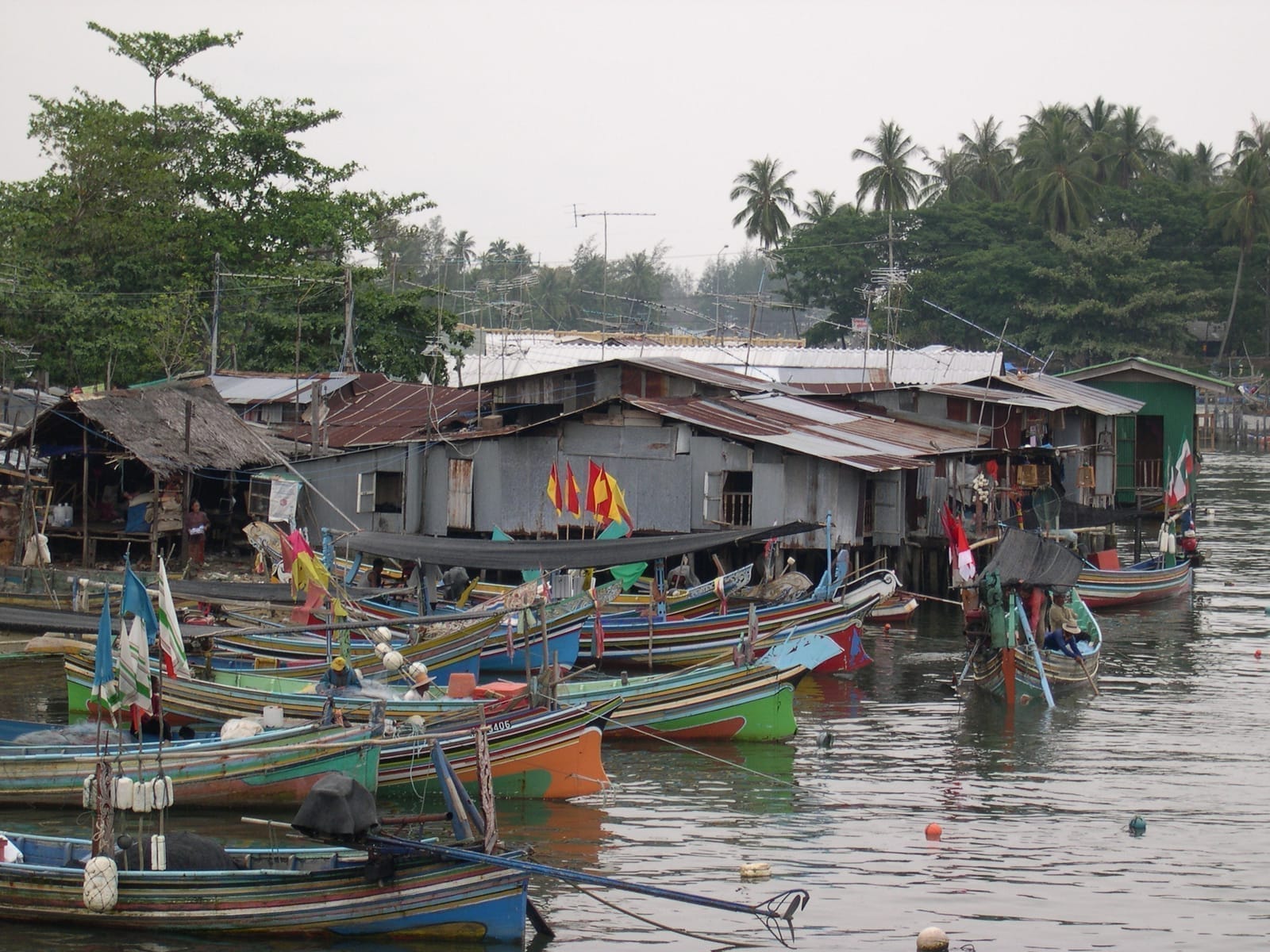
A Kolae boat isn't just a photo prop. It's a real working boat used by small-scale fishermen along the southern Gulf of Thailand coast: a small-to-medium wooden boat with a bow and stern that rise sharply above the hull, traditionally built from local takian sai wood. What makes them instantly recognizable is the way the whole hull is painted and decorated with patterns, the colors set against the sea and sky. Seeing a row of them pulled up on the beach is a sight you'll find in only a handful of places in Thailand.
Read before you go
Narathiwat sits in Thailand's deep south. Before you travel, check the latest news and official safety advisories, and plan to visit during daylight hours. Ban Thon is a Muslim community, so dress modestly and cover up, ask permission before photographing people or homes, and treat the boat builders and fishermen with respect. Do that and the visit will feel relaxed for everyone.
Ban Thon — Narathiwat's home of the Kolae boat
Ban Thon beach is in Khok Khian subdistrict, Muang Narathiwat district, about 16 kilometers from town along the coastal road, and only around 3 kilometers from Narathiwat Airport. It's a Thai-Muslim fishing village that lives mainly on small-scale fishing, and one of the last places in the province where Kolae boats are still built. The beach runs long, the sand is fairly white, and a line of tall coconut palms gives shade. It's quiet, not a crowded tourist beach. What people come to see are the Kolae boats lined up along the sand.
- Location — Ban Thon beach, Khok Khian, Muang Narathiwat district (about 16 km from town / ~3 km from the airport)
- A real fishing village — locals head out to fish by season; this isn't a beach staged for photos
- Souvenirs on hand — beyond the real boats, the community also makes miniature Kolae boats to sell as keepsakes
Want more out of Narathiwat? Book tours & activities
Booking online ahead on Klook or GetYourGuide is usually cheaper than the gate and skips the queue. Pick only the experiences you actually want — prices and availability are shown live on each site.
The patterns — three cultures in one hull
The charm of a Kolae boat is in its patterns. A craftsman paints the whole hull a base color, then draws the patterns on top, blending Malay, Javanese, and Thai motifs together — with Thai motifs usually taking up the largest share, like kranok flame patterns and lotus designs. The bow is often painted with a mythical or imaginary creature: a naga's head, a bird, Hanuman soaring through the air, or Rahu swallowing the moon. No two boats are exactly alike; it comes down to the craftsman and the owner's taste.
This kind of pattern work takes both time and skill, and few craftsmen can still do it well. Today the only communities still building Kolae boats and painting them in earnest are in Narathiwat and Pattani. To see a real boat with the patterns still sharp is to see a piece of local craftsmanship that gets harder to find every year.
How to read the patterns
Compare the bow to the stern — many boats are painted with completely different designs on each end. Notice which ones feature mythical creatures and which stick to pure Thai kranok work. And if a craftsman or boat owner is around, say hello and ask politely; many are happy to explain where their patterns come from.
Traditional fishing life by the sea
At Ban Thon, Kolae boats are still used for real fishing by season. The hours before and just after dawn are when the fishermen come back to shore, and that's when the beach is at its most alive — boats being hauled up the sand, nets gathered in, the catch sorted. From mid-morning into the afternoon, the boats usually rest in a row along the beach, which is the easiest time to come, look, and take photos without getting in the way of anyone's work.
- Pre-dawn to early morning — boats return to shore and you see real fishing life, but this is the locals' working time, so keep your distance and stay respectful
- Mid-morning to afternoon — boats rest along the beach; easy to walk around, study the patterns, and take photos
- Evening — soft light, cool breeze; a good time to sit on the beach and catch the boats backlit by the sun
Best light and photo angles
Kolae boats photograph well for most of the day, but the best light is in the morning and the late afternoon, when the pattern colors look vivid and the shadows aren't too harsh. Try finding an angle that fits a whole boat, the line of coconut palms, and the sea horizon all in one frame — or move in close for a tight shot of the bow patterns to really show off the craftsmanship.
Photo etiquette
These boats are the livelihood of the people here. Don't climb onto a boat or move anything on it to set up a shot. If you want to photograph someone working or a child in the community, always ask first — and avoid shooting during prayer times or when people are busy gathering nets and sorting the catch.
Miniature Kolae boats — souvenirs to take home
If you'd like something to take home, the community makes miniature Kolae boats as souvenirs — carved and hand-painted like the real thing in scaled-down form, in several sizes to suit your budget and shelf space. Prices depend on the size and how detailed the patterns are, from a few hundred THB for a small one up into the thousands for a large model packed with patterns. Buying one here helps keep local craftsmen at work.
How to get to Ban Thon beach
The easiest way is to have your own car or rent a car or motorbike in Narathiwat town, then drive the coastal road north for about 16 kilometers — roughly 20–25 minutes from town. If you fly into Narathiwat Airport, Ban Thon beach is only around 3 kilometers away, so you can stop by before heading into town. There's a fair amount of parking along the beach, but public transport going directly to the village is limited, so it's best to arrange your own ride.
- From Narathiwat town — drive the coast road north ~16 km, about 20–25 min
- From Narathiwat Airport — very close, around 3 km; easy to stop on the way into town
- Getting around — private car / rental car / motorbike is easiest; direct public transport is limited
Pairing Ban Thon with nearby stops
An unhurried visit to Ban Thon beach takes about 1–2 hours, and it pairs easily with other stops the same day since it sits on the north side of town and close to the airport. Build it into a morning half-day or an evening half-day, depending on the light you prefer.
Fishing life + craftsmanship
Catching the late light by the sea
Want a full Narathiwat itinerary
See the Narathiwat travel guide →