🔄 Updated 21 Jun 2026
If you're a photographer who's tired of the same old angles, Narathiwat hands you frames that are genuinely hard to find anywhere else. As a deep-south border province where Thai, Chinese, and Malay cultures all mix together, every spot has details worth capturing — from the bullet-wood pillars carved with bullet-flower motifs inside the old mosque to the colors painted along the hulls of the kolae boats. We picked the province's four main photo landmarks and ordered them by direction and light so you get the best shots at each point in the day.
Read this before you go
Narathiwat sits in Thailand's deep-south border region. Before you actually travel, check the latest news and security advisories from local government agencies. Most of these sites welcome visitors as usual, and updating yourself on the situation beforehand makes planning easier. Since this is a Muslim-Malay city, dress modestly with shoulders and knees covered when entering a mosque or village, and always ask permission before photographing people.
Overview: the 3-day photo route
This trip uses Narathiwat town as your base, since that's where most of the lodging and restaurants are, then places each photo stop according to the light. Day one heads north to Bacho to capture the 300-year-old mosque in soft morning light. Day two stays in town for the kolae boats along Narathat Beach and the Bang Nara estuary in the evening. Day three takes you to the peat-swamp boardwalk and the palace on Tanyong Hill. Driving yourself is by far the easiest option — the whole trip totals around 120 kilometers on good roads.
- Day 1 — 300-Year-Old Telok Manok Mosque (Bacho) · old wooden building blending Thai-Chinese-Malay, morning light
- Day 2 — Kolae boats at Narathat Beach · Bang Nara estuary lighthouse · town clock tower, evening light
- Day 3 — Toh Daeng peat-swamp boardwalk · Thaksin Ratchaniwet Palace on Tanyong Hill
Book the activities in your Narathiwat trip ahead
Booking online ahead on Klook or GetYourGuide is usually cheaper than the gate and skips the queue. Pick only the experiences you actually want — prices and availability are shown live on each site.
Day 1 — The 300-Year-Old Telok Manok Mosque
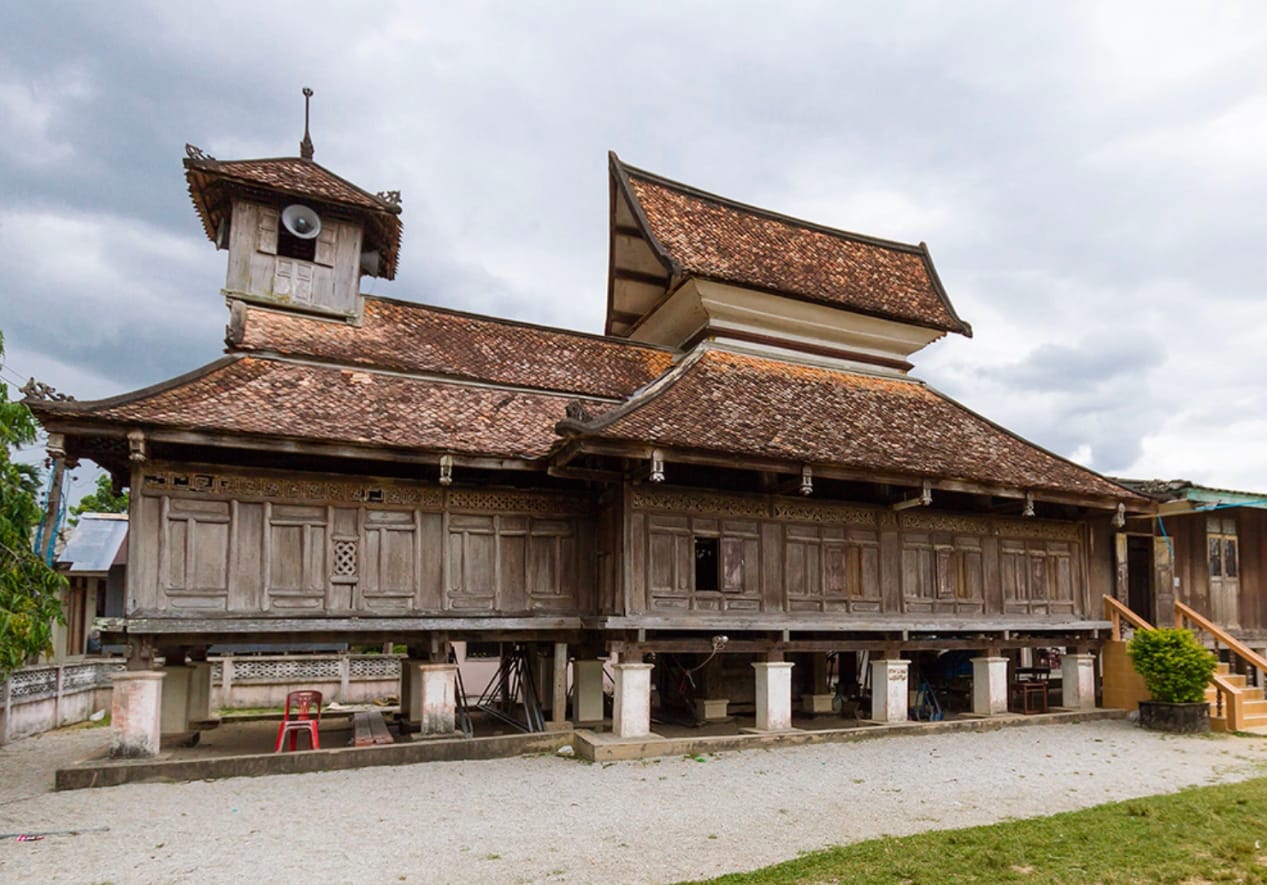
Wadi Al-Husein Mosque — which locals in Bacho call Telok Manok Mosque, and visitors know as the "300-Year-Old Mosque" — is an old wooden mosque built back in 1624 by Wan Husein As-Sanawi. The whole building is made of takian wood, with a three-tiered roof in an adapted local Thai style topped by a dome shaped like a Chinese pavilion, and pillars carved with bullet-flower motifs. This single building combines Thai, Chinese, and Malay art, giving you frames you can't get from any other mosque. It sits at the foot of Budo Mountain, about 25 kilometers from town, roughly a 35-40 minute drive.
Narathiwat town → 300-Year-Old Telok Manok Mosque → back to town
Etiquette when photographing the mosque
The 300-Year-Old Mosque is still an active place of worship, not just a photo spot. Dress modestly with shoulders and knees covered, take off your shoes when entering the building area, avoid shooting during prayer times, and always ask permission before photographing locals. A little courtesy gets you both the shots and a warm welcome.
Day 2 — Kolae Boats, Narathat Beach, and the Bang Nara Estuary
Narathat Beach is right next to town — a long, curving stretch of white sand running about 5 kilometers, shaded by a line of pines. In front of the fishing village you'll find kolae boats lined up along the shore: slim wooden boats painted in bold Malay-style patterns, the real stars of any Narathiwat photo. The southern end of the beach meets the mouth of the Bang Nara River, where a concrete pier juts out into the sea with a lighthouse at its tip — a viewpoint and sunset spot where locals like to come for an evening stroll.
Town clock tower → kolae boats at Narathat Beach → Bang Nara estuary lighthouse
About the light at Narathat Beach
Narathat Beach faces the sea to the east, so sunrise is prettier here than a straight-on sunset. If you want golden light falling on the kolae boats, the early morning gives you direct light. In the evening the light goes soft and backlit at the Bang Nara estuary, which is great for silhouettes of boats and the lighthouse against the sky. Go for both windows if you have time.
Day 3 — The Peat-Swamp Boardwalk and the Hilltop Palace
The final day captures two completely opposite scenes. In the morning, head to the wooden boardwalk through the Toh Daeng peat swamp (the Sirindhorn Peat Swamp Research and Nature Study Center) in Sungai Kolok district. The boardwalk runs about 1.2 kilometers into the largest freshwater peat swamp in the country, with an observation tower for looking out over the treetops from above. The leading lines of the boardwalk stretching deep into the swamp make a frame people love on social. Then in the afternoon, head to Thaksin Ratchaniwet Palace on Tanyong Hill by the sea, with wooden buildings in shaded gardens and viewpoints over the water below.
Toh Daeng peat swamp → Thaksin Ratchaniwet Palace → head home
Visiting the palace properly
Thaksin Ratchaniwet Palace is a royal residence, so visiting requires neat, modest dress — no spaghetti straps, shorts, or overly casual sandals. It may close to visitors at certain times depending on the royal schedule, so checking with the provincial office or calling ahead is the surest bet. Photography may be restricted in some areas inside — follow the signs and the staff.
Extra photo spots if you have time
If you're staying in Narathiwat longer than 3 days, or want to grab a few more shots along the way, there are other photo spots that are easy to drop by and give you different frames. Pick whichever fits the direction you're driving.
Narathiwat town clock tower
A landmark in the center of town, surrounded by old buildings and roadside food — good for street shots in the morning or at dusk
Morning market and the Bang Nara riverside
Local town life, colorful fruit stalls, and small boats along the river — great for storytelling shots in the morning
Manao Bay & Tanyong Hill
A curving beach with granite boulders right by town, near the palace — easy to add a sea shoot the same day
Getting around and gear
The easiest way to reach Narathiwat is to fly into Narathiwat Airport (NAW) and rent a car to drive yourself, since the photo spots are scattered in different directions and public transport isn't convenient. The airport and town have several rental options, both self-drive and with a driver. If you're not confident on the routes, hiring a local car with a driver helps a lot — they know both the roads and the situation on the ground.
- Lenses — a wide lens captures the mosque and the peat-swamp boardwalk full-frame; a zoom captures the kolae-boat patterns and the wooden-pillar details
- Light timing — the mosque and peat swamp shine in the morning; Narathat Beach and the Bang Nara estuary in the evening — line up your stops by the light
- Cash — carry cash; many local shops and entry points still take cash only
- Season — avoid the late-year monsoon (around November-December) when it's wet, the sea is rough, and the sky won't clear
Local etiquette
Most people in Narathiwat are Muslims of Malay descent. Dress modestly with shoulders and knees covered, especially when entering a village or mosque, ask permission before photographing people, and respect prayer times. Paying attention to this gets you better shots and a warmer welcome from locals.
Want a well-located hotel in Narathiwat town as your photo base
See the Top 10 Narathiwat hotels →