🔄 Updated 21 Jun 2026
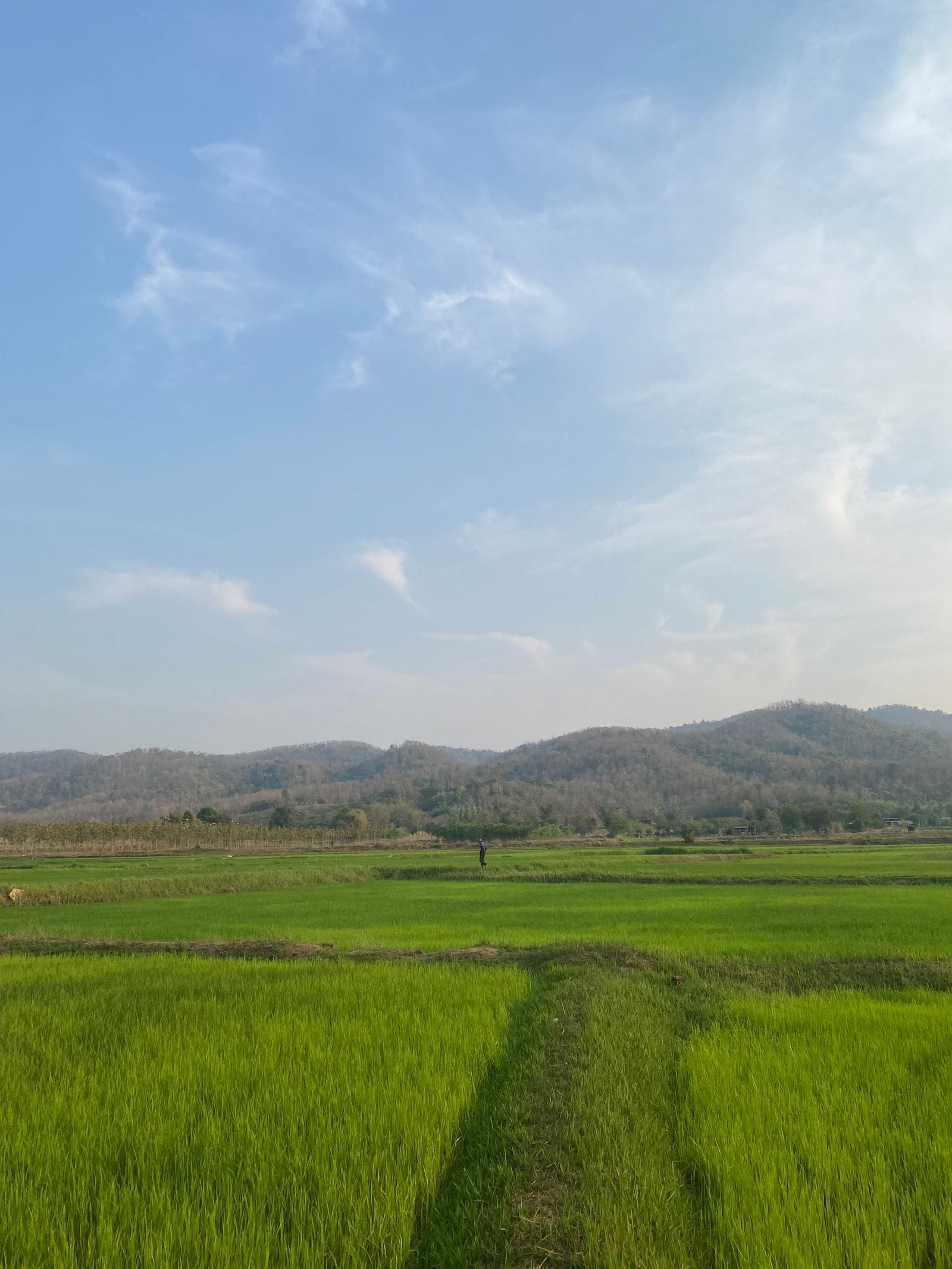
If you've ever seen a photo of someone walking along a narrow bamboo bridge over bright green rice fields with mountains behind it in Pai, that photo was taken here — the Boon Ko Ku So Bridge (Kho Ku So). The name "Kho Ku So" roughly means "bridge of merit," because it was first built so villagers from Pam Bok village and the monks could cross the fields between the village and the temple on the hill. The monks still walk this path each morning to collect alms. Over time it became a spot people stop by to walk across and take photos.
What is the Boon Ko Ku So Bamboo Bridge?
The bridge is made of woven bamboo and runs more than 800 meters (some sources say around 815 meters), with concrete and steel posts underneath for support. It sits just above the rice stalks, and you can walk the whole length to the foot of the hill on the far side. Along the way, bamboo pavilions give you spots to sit in the shade and take photos. At the end of the bridge is Wat Pa Huai Khai Khiri, a small forest temple on a rise that looks back down over the fields and the full run of the bridge.
- Length — over 800 meters; an easy walk that takes about 40 minutes to an hour round trip
- Entry fee — 30 THB per person, paid at the entrance; this money helps maintain the bridge and temple
- Open daily — no fixed opening hours, but go during daylight; it's prettiest in the morning and late afternoon
- Parking — there's a dirt lot at the entrance for both cars and motorbikes, free
About the many names
People call this place a few different things — Boon Ko Ku So Bridge, Kho Ku So Bridge, Pai bamboo bridge, or just Bamboo Bridge. On Google Maps, try searching "Boon Ko Ku So Bridge" or "Kho Ku So Bamboo Bridge" and you'll land on the same spot. We'd suggest dropping a pin on the parking lot rather than the bridge itself — you'll find the entrance more easily that way.
Want more out of Pai? Book tours & activities
Booking online ahead on Klook or GetYourGuide is usually cheaper than the gate and skips the queue. Pick only the experiences you actually want — prices and availability are shown live on each site.
How to get to the Boon Ko Ku So Bamboo Bridge
The bridge is about 11 kilometers south of central Pai, near Pam Bok village in Mae Hi subdistrict. It's roughly a 20 to 25 minute drive from the Pai Walking Street. The first stretch is a main road, then you turn onto small village roads that wind up and down hills into the valley.
- Motorbike — the easiest option and the best for the views; rentals in town run around 150 THB a day, and it's a 20-minute ride. But the village roads have steep sections, tight bends, and the odd pothole, so take it slow
- Car — you can drive all the way to the parking lot; the road narrows near the end, so watch for oncoming traffic
- Songthaew / private hire — if you're not driving yourself, you can hire a songthaew from town; agree on the price first. It's often bundled with Pai Canyon or Pam Bok Waterfall in one trip
Honest note — the road up to Pai and the hill roads in Pai
The road up to Pai from Chiang Mai has 762 curves, so if you get carsick easily, bring something for it. Many roads within Pai itself wind up and down hills too. If you're not confident on a motorbike, take extra care on the steep stretches and tight bends. Always wear a helmet, and don't rush.
When are the rice fields at their greenest?
The fields are the whole point here, and the bridge looks completely different depending on the rice season. If you want that postcard-green look, you'll want to time your visit right.
- Green fields (the prettiest) — around July to October, when the rice is growing and the whole field is lush green. This is when most people come for photos, but it's rainy season, so bring an umbrella and shoes with grip
- Golden fields (before harvest) — around November, when the rice starts turning golden, the air gets cooler, and the sky clears up. Another lovely window, with less rain
- After the harvest — around December to February, when the fields turn a brown-yellow stubble. The view isn't as green, but the weather is cool and the sky is at its clearest, which makes for an easy stroll
Honest note — haze and morning mist
Around March to April, northern Thailand including Pai often gets haze from crop burning, leaving the sky murky. The mountains behind the fields can be hard to see and photos won't come out as well. If you can avoid this period, do. As for Pai's famous morning mist (the "sea of fog"), it depends on the weather each day — some mornings it's there, some it isn't. No guarantees.
Best time for photos and how to prepare
Morning and late-afternoon light makes the fields softer and gives the bridge more depth than the harsh midday sun. Between 8 and 9 a.m. there are still few people around, so you can get the bridge clear with no one cutting through the frame. In the late afternoon the golden light is lovely, but the crowds start to build.
- Go early, around 8 a.m. — fewer people, the sun isn't strong yet, and you'll get an easy walk on a clear bridge
- The bamboo surface is wide enough to walk, but some sections are narrow; wear comfortable shoes you can walk in, not heels
- Bring a hat, water, and sunscreen, since there's almost no shade out in the fields
- In the rainy season the bamboo can get slippery, so walk slowly and hold the rail
The end of the bridge, the hilltop temple, and a field-view cafe
Walk to the end of the bridge and you reach the foot of the hill where the small forest temple sits. There's a spot to sit and rest and look back down at the bridge running across the fields — a view a lot of people love to photograph. Near the entrance there's also a little cafe selling coffee and snacks with a field view, plus a fish pond where kids can feed the fish. You can sip a coffee and watch the fields before or after your walk.
If you go up to the temple, please dress modestly and behave respectfully, since this is still a working temple the monks use — not just a photo spot.
What else to see nearby
The bamboo bridge is in southern Pai, on the same route as several nature spots, so it's easy to plan a half-day trip combining them.
Pam Bok Waterfall
A small waterfall in the forest near Pam Bok village, on the same route as the bridge — a good spot to cool off in the water.
To the southPai Canyon
Narrow earthen ridges to walk along with valley views, and one of Pai's most popular sunset spots.
GuideAll things to do in Pai
Every spot in Pai in one place — waterfalls, viewpoints, and villages — so you can plan your whole trip.
Plan a full Pai trip — where to stay, eat, and what to see
See the Pai travel guide →