🔄 Updated 21 Jun 2026
The name Pathum Thani means "city of the lotus." It comes from the time King Rama II visited the town of Sam Khok and saw lotuses blooming everywhere, so he granted it the new name Prathum Thani. Before that, this area was the town of Sam Khok, where Mon people from Hongsawadi (Bago) fled war and settled along the Chao Phraya as far back as the Ayutthaya period, arriving in further waves during the Thonburi and early Rattanakosin eras. The legacy they left behind is the temples and traditions we can still see today.
Old riverside temples worth a stop
Pathum Thani's old temples cling to both banks of the Chao Phraya. The truly Mon ones cluster around Sam Khok, easy to spot by the Raman-style chedis and the hong (swan) pillars out front. Here they're laid out in a comfortable driving order, starting in town and working your way north up to Sam Khok.
Wat Hong Pathummawat (the Mon temple)
A Mon temple in the middle of Pathum Thani town, originally called Wat Hongsa, built by Mon people who migrated during the Thonburi era. The giveaway is the hong (swan) pillar out front, a hallmark of Mon temples. It sits right on the Chao Phraya and is the main temple that hosts the Tak Bat Phra Roi boat alms every year.
Wat Chinnawararam Worawihan
A royal temple on the west bank of the Chao Phraya, originally called Wat Makham Tai. Inside you'll find murals depicting the Ten Jataka tales and the enshrined Luang Pho Thongkham (Phra Phuttha Chinnawon), a Sukhothai-era Buddha image brought over from Ayutthaya. The shaded grounds make it a pleasant stop to pay respects.
Wat Sing, Sam Khok
An ancient temple tied to the town of Sam Khok, built around 1569 (B.E. 2112) and over 450 years old. It has an old ordination hall from the mid-Ayutthaya period, the urn of Phraya Kray, a redented twelve-cornered chedi, and an old storehouse of antique Sam Khok water jars. It's one of the best temples for understanding the town's history.
Wat Chedi Thong
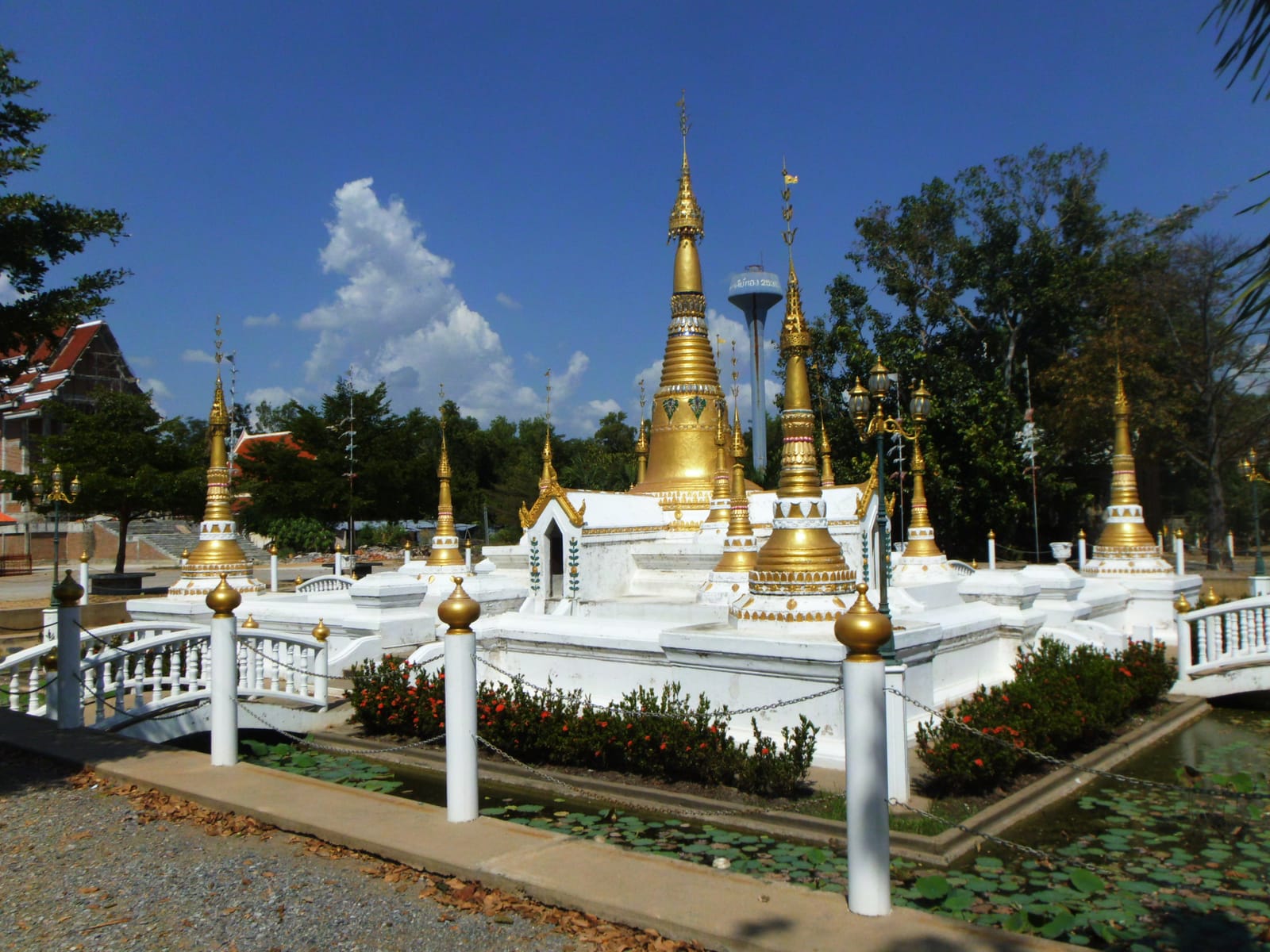
A Mon temple on the west bank of the Chao Phraya. The highlight is its golden Raman-style chedi, modeled on the Shwedagon Pagoda and the chedis of the Mon homeland. It's a spiritual center for the Mon people of Sam Khok, and the chedi photographs beautifully in soft light.
Wat Bot (Luang Pho To)
An old Ayutthaya-era temple, built around 1621 (B.E. 2164) by Mon people who migrated from Hongsawadi. It holds a large, revered Luang Pho To Buddha image, and the riverside setting is quiet and calm. Locals come to pay respects regularly.
Check this before you go
Many of the old riverside temples are free to enter, but some keep the ordination hall closed outside chanting hours or on weekdays. If you want to see the murals inside, going in the morning or on a weekend means you're more likely to find a monk or staff member to open it up. Dress modestly, covering shoulders and knees as usual.
Want more out of Pathum Thani? Book tours & activities
Booking online ahead on Klook or GetYourGuide is usually cheaper than the gate and skips the queue. Pick only the experiences you actually want — prices and availability are shown live on each site.
Mon details that make the temples more fun to read
The charm of Pathum Thani's Mon temples is in the small details, and knowing them beforehand makes wandering around a lot more fun. Keep an eye out for these as you go from temple to temple.
- Hong (swan) pillar — a tall pillar topped with a swan figure, set in front of the temple as a symbol of Hongsawadi, the Mon homeland. You'll see it most clearly at Wat Hong Pathummawat.
- Raman-style chedi — tiered, stacked bases with a slender bell, different from a typical Thai chedi. Wat Chedi Thong is the one to look at.
- Sam Khok water jars — red earthenware that was once one of the town's export goods, picked up by Chinese junks to sell elsewhere. Today they're the town's signature souvenir.
- Centipede flag — a long flag patterned like a centipede that the Mon use to decorate during merit-making festivals, often seen around the end of Buddhist Lent and Songkran.
Local signatures and traditions that still happen
Pathum Thani's Mon culture isn't stuck in a museum. It still happens seasonally for real, so if you come at the right time you'll see the genuine thing.
Tak Bat Phra Roi boat alms
A Thai-Raman tradition over a hundred years old, held around the end of Buddhist Lent. Monks are invited onto boats that drift along the river so people on both banks can offer alms. Wat Hong Pathummawat is the main host every year.
Mon khao chae
A Mon Songkran dish of cooked rice soaked in chilled jasmine-scented water, eaten with fried side dishes. It used to be made as an offering to monks and respected elders, and you can find it around the Mon communities in April.
The lotus and the province's name
The lotus is the province's symbol, dating back to when King Rama II saw lotuses blooming all over the town of Sam Khok. You'll still see lotus ponds around the province, and lotuses remain a common offering at merit-making ceremonies.
Want to see the real traditions? Plan around the calendar
Tak Bat Phra Roi takes place after the end of Buddhist Lent (around October), with the different riverside temples taking turns on different days. Check the province's or district's page before you go. Khao chae and the Mon festivities are liveliest during Songkran in April. Come at another time of year and you can still tour the temples, you just won't catch the boat procession.
A relaxed one-day riverside temple route
If you've only got one day and want both old temples and the riverside mood, this loop is easy to drive. Start in town and work your way up to Sam Khok. The total distance isn't far, and each stop is only a few kilometers from the next.
Pathum Thani town → Sam Khok along the Chao Phraya
You can do it by taking the Red Line train to Rangsit station and transferring, but the Sam Khok riverside temples are fairly spread out, so renting a car or driving yourself is the smoothest option. It also leaves room to stop at a cafe or an old market along the way.
Want a place to stay near town as a base for the temples and the river?
See 10 Pathum Thani hotels →