🔄 Updated 21 Jun 2026
If you've ever seen photos of long-nosed ghost masks in red and yellow at a Thai festival, that's Phi Ta Khon. It isn't put on just for show — it's Dan Sai's big annual merit-making event, known collectively as Bun Luang, which bundles together the Bun Phawet sermon (the recitation of the Vessantara Jataka), the Phi Ta Khon parade, and the Bun Bang Fai rocket festival. The charm of it is that this is a real tradition the locals do themselves — not a show staged for tourists. So you get carnival-level fun and genuine reverence for the sacred, all in the same event.
What is Phi Ta Khon, and where does it come from?
Legend ties Phi Ta Khon to the Vessantara Jataka — the story of Prince Vessantara. When the prince and his wife Matsi left the forest to return to the city, the forest spirits and creatures who loved them are said to have disguised themselves and slipped in among the villagers to see them off. That procession of spirits trailing along is what became Phi Ta Khon. Some believe the name comes from "phi tam khon" (spirits following people), which later shifted in pronunciation to Phi Ta Khon.
The people of Dan Sai play Phi Ta Khon for several reasons at once: joining the procession that welcomes Vessantara back into the city in the Buddhist sense, joining the rocket festival that asks for rain in the sixth lunar month, playing simply for the fun of it, and — at the deepest level — playing so that misfortune and illness latch onto the Phi Ta Khon and are then floated away down the Man River, driving the bad out of the town.
Want more out of Loei? Book tours & activities
Booking online ahead on Klook or GetYourGuide is usually cheaper than the gate and skips the queue. Pick only the experiences you actually want — prices and availability are shown live on each site.
What are Phi Ta Khon masks made of?
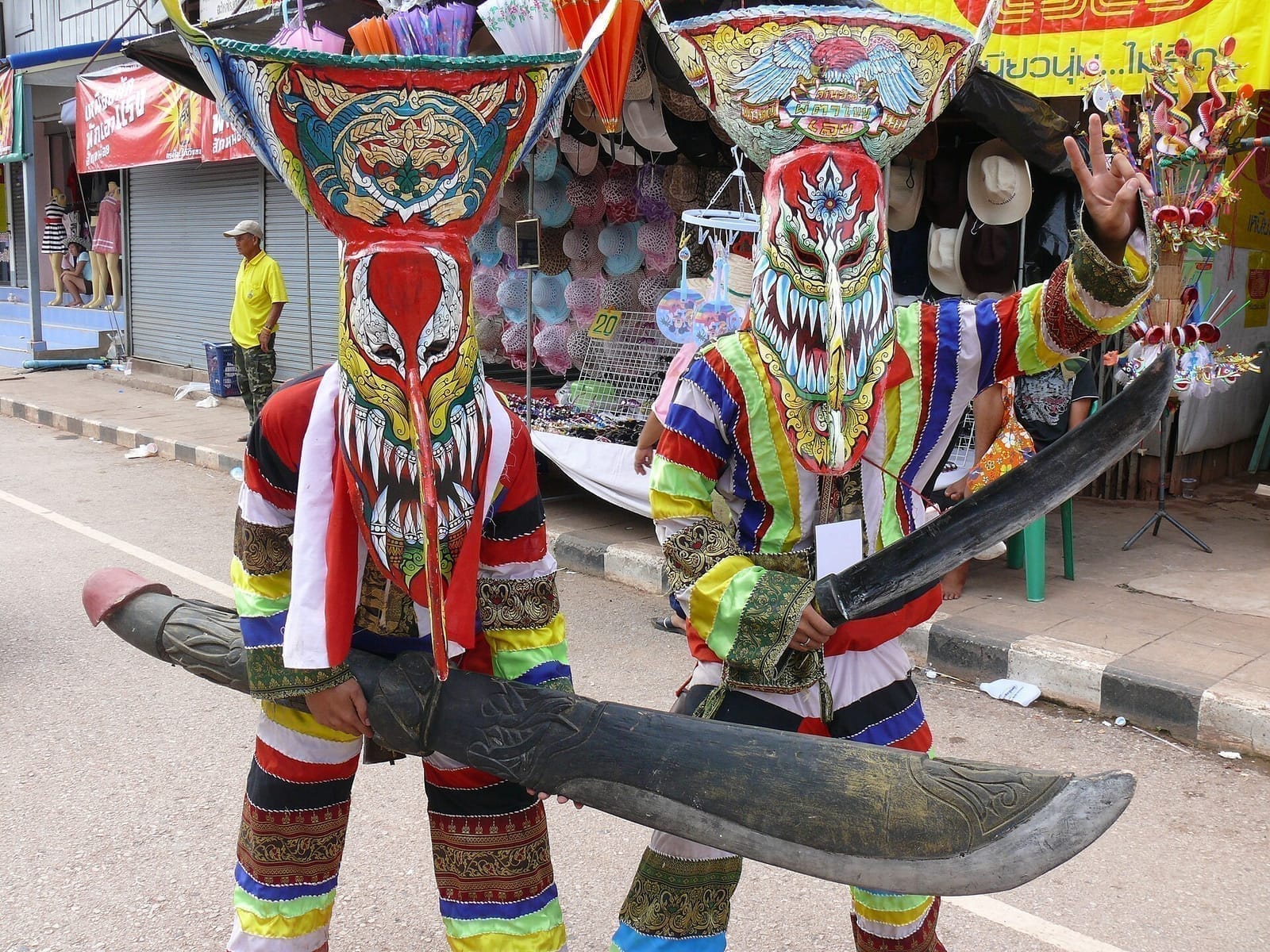
The heart of the festival is the mask, and what's interesting is that it's made entirely from everyday household things. The top is made from a huat (a woven bamboo steamer used to cook sticky rice), bent and folded into a tall shape. The face is carved from a coconut husk or the base of a coconut frond into a long curved nose, with holes cut for the eyes, then painted in bright patterns. Makers design their own patterns and colors freely, so no two masks are ever alike. The costume is sewn from scraps of colorful cloth pieced together into strips.
- Phi Ta Khon Noi (small) — people in costume wearing the huat-and-coconut-husk masks, carrying a mak beng (wooden sword), dancing and parading down the street. Anyone can join; kids and adults all come out to have fun across the whole town.
- Phi Ta Khon Yai (large) — woven bamboo figures standing about twice human height, made one pair a year (a male and a female). They're considered sacred, governed by ritual, and not something just anyone can make.
- Mak beng — the carved wooden sword or weapon the Phi Ta Khon carry. Some are carved into shapes symbolizing fertility, in line with the rain-asking belief.
- Bells and jingles — tied at the Phi Ta Khon's waist, ringing constantly as they walk, shaken to tease the onlookers along the route.
When is it held during the year?
The Bun Luang festival and the Phi Ta Khon revelry have no fixed date, because the dates are set by Chao Pho Kuan and Chao Mae Nang Thiam, the town's spiritual leaders, who divine the auspicious days each year. Generally the festival falls around late June to early July, after Isan's sixth-month full moon — the start of the rainy season, which ties into the rain-asking rites. The most recent edition (2025) ran June 28–30, with the main parade landing on Sunday, June 29.
Check the dates before booking tickets
Because the dates shift every year, don't book your bus or flight based on last year's schedule. Wait for the announcement from Dan Sai district or the TAT Loei office, then lock in your dates. The dates are usually confirmed about 1–2 months ahead.
What happens over the three days?
Bun Luang is a three-day event with its own rhythm. Day one is the sacred rites, day two is the fun day when the most people come, and day three returns to merit-making. If you only have one day, day two is the one to come for.
Gathering day (Phra Upakhut invocation rite)
Phi Ta Khon parade day (the highlight)
Bun Phawet day (the kan lon procession)
How to get to Dan Sai
Dan Sai sits in the west of Loei province, about 80 km from Loei town, roughly a 90-minute drive. There's no airport in Dan Sai itself, so the easiest route is to fly into Loei or take a bus, then continue on to Dan Sai.
- By plane — fly from Bangkok into Loei Airport (only a few flights a day), then rent a car or catch onward transport into Dan Sai, about 1.5 hours. During the festival, book your tickets early since flights are limited.
- By bus — buses run from Bangkok's Mo Chit terminal to Loei and Dan Sai, taking around 8–9 hours. You can get off right at Dan Sai if you pick a route that passes through.
- Self-drive — from Bangkok via Phetchabun–Lom Sak, entering Dan Sai on Highway 2013, or you can come from Phitsanulok. The scenery along the way is lovely mountain country.
- From Loei town — drive the Loei–Phu Ruea–Dan Sai route, about 1.5 hours, stopping at Phu Ruea or Wat Neramit Wipassana on the way.
Traffic jams and full parking on parade day
On parade day the streets in central Dan Sai are closed for the procession and cars can't get in. Park outside the festival zone and walk in, or arrive early before the parade starts. If you stay in Dan Sai itself you'll have the easiest time, since you can just walk to the festival.
Where to stay during the festival — book ahead, no exceptions
Here's the honest part: there are very few places to stay in Dan Sai itself, and they fill up fast. Many are fully booked months ahead of the festival. Once you know the confirmed dates, book immediately. If Dan Sai is full, fall back to Loei town or the Phu Ruea area, both about a 45-minute to 1-hour drive to the festival.
Stay in Dan Sai town
Resorts and homestays around town, such as Phu Na Kham Resort and Hug Jung Loei Garden. Easy walking distance to the festival but the first to fill, and prices climb during the festival — starting from a thousand-plus into several thousand THB.
Stay near Phu Ruea
Mountain-view resorts with cool air, about a 45-minute drive to the festival. Good if you have a car, with more rooms than Dan Sai and a wider range of prices.
Stay in Loei town
Loei town has the widest choice of hotels and is easier to book, about a 1-hour drive to the festival. Good if you're booking late or want plenty of options.
Missed the festival dates? You can still experience Phi Ta Khon
If you come to Loei at another time of year, you can still get a feel for Phi Ta Khon culture at the Phi Ta Khon Museum at Wat Phon Chai in Dan Sai town, which displays a range of masks, the history of the Bun Luang festival, and ritual objects. Entry is free; donate as you wish. You can pair it with nearby Phra That Si Song Rak and Wat Neramit Wipassana for a tidy half-day Dan Sai culture trip.
Etiquette when you join the festival
Phi Ta Khon is fun, but it's a sacred merit-making event. The ritual parts — like the Phra Upakhut invocation or the bai sri ceremony for Chao Pho Kuan and Chao Mae Nang Thiam — should be watched with respect, without making noise or getting in the way. The parade itself is open for plenty of fun photos; the players are usually happy to be photographed and to tease the crowd anyway.
Want a full day-by-day Loei itinerary covering Dan Sai and Chiang Khan?
See the Loei travel guide →