🔄 Updated 21 Jun 2026
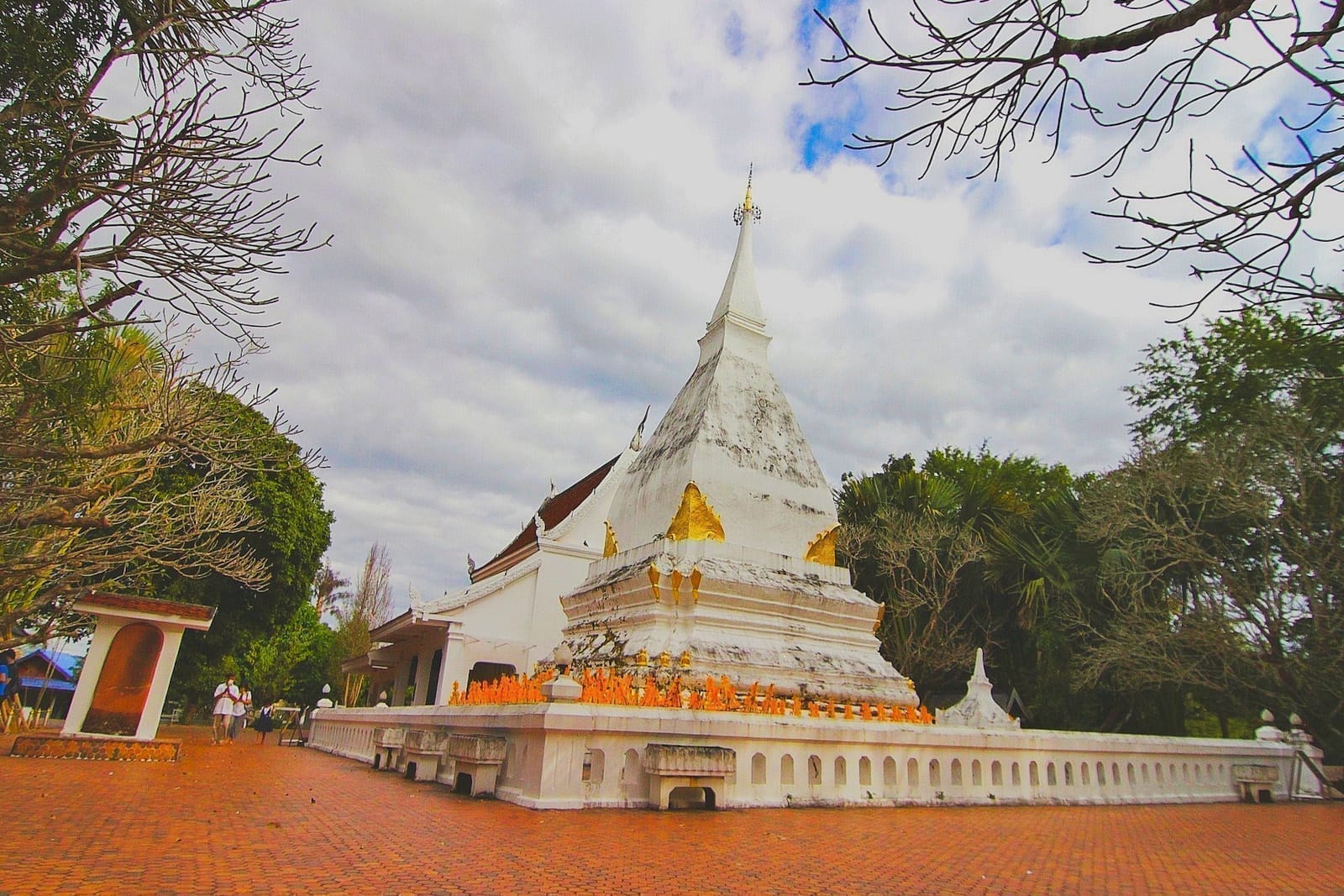
When people think of Dan Sai, the Phi Ta Khon festival usually comes to mind first. But the real heart of this town is Phra That Si Song Rak, a white Lan Xang-style chedi resting quietly on a rise above the Man River. Locals consider it the most sacred site in the province, and a steady stream of visitors come to pray for love and success. Before you go, though, there are a few customs worth understanding — otherwise you may travel all this way and miss the point.
History — the stupa of a Thai-Lao promise
Phra That Si Song Rak was built during the reign of King Maha Chakkraphat of Ayutthaya, together with King Setthathirath of the Lan Xang kingdom (Vientiane). Construction began in 1560 and was completed in 1563, taking around three years. At the time Burma was expanding its power, so the two kingdoms agreed to become allies and made a solemn vow never to cross into each other's territory and to support one another forever.
This spot was chosen because the stretch of the Man River near Dan Sai marked the rough midpoint between the two realms. The name "Si Song Rak" therefore means the love and bond between the two kingdoms. The stupa itself is a square brick-and-mortar chedi, broad at the base and tapering to a point — Lan Xang architecture similar to Phra That Phanom — standing about 19 metres tall. After more than 460 years it still stands just as proudly as ever.
Something many people don't know
The stupa is believed to enshrine Buddha images, scriptures, and relics of the Buddha. There is also a legend of "Nai Man and Nai Khong," two men who gave their lives to guard the stupa for eternity. Locals revere the place both in a religious sense and as a home for ancestral spirits watching over the town.
Want more out of Loei? Book tours & activities
Booking online ahead on Klook or GetYourGuide is usually cheaper than the gate and skips the queue. Pick only the experiences you actually want — prices and availability are shown live on each site.
Beliefs — what people come to pray for
Because the name contains the word "rak" (love), most people come to pray for their love lives. Many couples ask for a lasting relationship; others pray about keeping promises, reconciliation, or steady friendship — fitting, since this place is a symbol of a word kept for more than four centuries. Beyond love, people also pray for work, study, and success in life.
The usual offerings are flowers, incense and candles, and the "ton pheung" (beeswax tree), a local offering unique to the area. Those whose wishes come true often return to give thanks by offering a ton pheung at the annual festival. Stalls selling flowers, incense, candles, and beeswax trees line the path up, so it's easy to buy on the spot — no need to bring your own.
Rules you must know before you go
Phra That Si Song Rak follows customs that are stricter than the average temple. The most important one is about the colour red, because red stands for blood and war, which runs against the very purpose of the stupa — built to end fighting and create peace. For hundreds of years, no animal has been killed anywhere on these grounds.
- No red clothing — including red hats, red umbrellas, or carrying anything red into the stupa grounds. If you arrive in red, change or remove it first.
- Dress respectfully, as you would at any temple — no spaghetti straps, no shorts above the knee.
- Walking around the stupa follows a counter-clockwise (left-circling) custom here, the opposite of most temples. Check the signs or ask staff nearby.
- Women do not go up onto the inner terrace right beside the stupa, following long-standing tradition, but can pay respects from outside as normal.
- Keep it quiet and composed — this is a sacred place that locals hold in deep respect.
Bring a spare top
If you're not sure whether your outfit has any red in it, keep a plain cover-up in the car — it'll save you the worry. Some visitors turn up in a shirt with a small red stripe and have to walk back to change at the car, which wastes time.
The annual festival — beeswax trees on Visakha Bucha
The big yearly event is the Phra That Si Song Rak festival, held on the full-moon day of the sixth lunar month, which falls on Visakha Bucha Day. In 2026, Visakha Bucha lands in late May to early June. On that day the people of Dan Sai and Loei come together to bring beeswax trees as offerings.
A beeswax tree is built from a bamboo frame shaped into a triangle or a tiered prasat tower, then decorated with beeswax carved into floral patterns. Some make them by household, others by whole village, then parade them up to be offered. It's a beautiful sight you can only catch once a year. If you want to experience the real tradition, this is the best time to come — but it gets crowded, and accommodation in Dan Sai fills up fast, so book ahead.
Si Song Rak festival
Full-moon day of the sixth lunar month (Visakha Bucha), roughly late May to early June. Beeswax trees are paraded and offered — the busiest day of the year.
Phi Ta Khon festival
Another famous Dan Sai event, held around the seventh lunar month (June–July) near the stupa. Plan well and you could catch both festivals in one trip.
Best photo spots
The white stupa against the sky photographs well from every angle, but a few spots are favourites with locals and photographers.
- Straight-on from the front captures the full Lan Xang chedi shape. Morning light is softest and the sky is at its clearest.
- From the entrance staircase, you get the stupa as a backdrop framed by large trees on either side.
- Golden hour in the late afternoon, just before sunset, turns the white plaster walls a warm gold — far nicer than the harsh midday glare.
- Down by the Man River below — walk down for a quiet atmosphere with the town of Dan Sai as your backdrop.
About taking photos
The terrace around the stupa is sacred ground. Photos are fine, but keep it respectful — no climbing or striking inappropriate poses. And don't forget that the clothes in your shots can't be red either.
Getting there and opening hours
Phra That Si Song Rak is in Dan Sai town, about 80 km from Loei city, roughly a one-and-a-half-hour drive along Highway 203. If you're coming from Chiang Khan, you can carry on in the same trip. The route is a slightly winding mountain road but in good condition, and driving yourself is the easiest option. There's a car park at the temple.
- Opening hours roughly 06:00–18:00 daily. Entry is free, no admission fee.
- Best time — morning or late afternoon, when it's cooler and the light is better for photos than at noon.
- Pair it with Wat Neramit Wipatsana nearby, a striking orange laterite ordination hall — easy to visit right after.
- Souvenirs — Dan Sai has local products and small eateries to stop at along the way.
Plan a full trip around Dan Sai and Loei — see where to go, stay, and eat across the province.
See the Loei travel guide →