🔄 Updated 21 Jun 2026
If most of Kalasin's sights are dinosaurs and reservoirs, Ban Khok Kong is the other pole — slow travel that's all about time spent with the community. The village sits in Moo 5, Kut Wa subdistrict, Kuchinarai district, about 90 kilometres from Kalasin town, roughly a 1.5 to 2 hour drive. The people here are Phu Thai, an ethnic group that migrated to the foot of the Phu Phan range a long time ago. The village has around 600 residents who still speak Phu Thai, dress in Phu Thai clothing, and live the Phu Thai way day to day — not just for the cameras when tourists show up.
Who are the Phu Thai, and why is Khok Kong worth it
The Phu Thai (sometimes written Phu Tai) are an ethnic group that migrated from southern China through Laos and settled across Isan, spread over several provinces including Kalasin, Mukdahan, Sakon Nakhon, and Nakhon Phanom. What sets the Phu Thai apart is their weaving, their music, and the rituals they've kept alive. Ban Khok Kong is one of the villages that has held onto all of this most firmly, and it opens its doors to outsiders to learn at an unhurried pace.
Just as important, Khok Kong has been welcoming cultural tourists since 1998, so there's a real system in place — homestay rooms ready to go, a women's group that handles the food, and the village's own performance troupe. You don't have to worry about intruding, because the community genuinely set out to host people.
Want the full atmosphere? You have to stay over
Khok Kong's real charm is in spending the night, because the Baisri Su Khwan ceremony, the Pha Laeng feast, and the Phu Thai dance usually happen in the evening. Drop in for a day trip and you'll only get to walk around the village — you'll miss the whole night-time atmosphere. Contact the community ahead of time so they can prepare to host you.
Want more out of Kalasin? Book tours & activities
Booking online ahead on Klook or GetYourGuide is usually cheaper than the gate and skips the queue. Pick only the experiences you actually want — prices and availability are shown live on each site.
What you get staying with a Phu Thai family
The homestays here are real family houses. The host gives guests a room or a corner of the raised wooden house to sleep in, with a mattress, mosquito net, and blanket, and either a shared bathroom or the family's own. It's simple, rural Isan — not fancy, but clean and warm. What you get beyond a place to sleep is the chance to sit and talk with your hosts, see how they live, and wake up to a morning in a village at the foot of the hills.
- Baisri Su Khwan ceremony — elders and villagers in Phu Thai dress tie blessing strings around your wrist and wish you well. It's a warm, auspicious welcome, and a lot of people say it's the moment that stuck with them most from the trip.
- Pha Laeng feast — an evening meal eaten together sitting on the floor around a shared spread. The food is Phu Thai home cooking made fresh by the women's group — curries, larb, pon dips, steamed vegetables, chilli pastes — eaten with hot sticky rice.
- Phu Thai dance performance — the village troupe performs folk dances to live local music. Sometimes there's the ram krapo, a regional folk play you can still catch here.
- Yao ritual — a traditional Phu Thai belief ceremony tied to healing and calling back one's spirit (khwan). It's sometimes shown to share the community's beliefs and stories.
- Everyday-life activities — try weaving, basketry, harvesting rice in the paddies in season, or catching fish in the stream, depending on when you visit.
What to know about prices
The homestay itself runs in the low hundreds of THB per person per night. Packages that include the Baisri Su Khwan ceremony, the Pha Laeng meal, and the performance are usually arranged for groups, starting around 1,190 THB per person for a set that covers lodging and traditional meals. The price depends on group size and which activities you choose, so it's best to call the community and tailor it to your group — rates adjust to the actual plan.
Phu Thai weaving, learned at the source
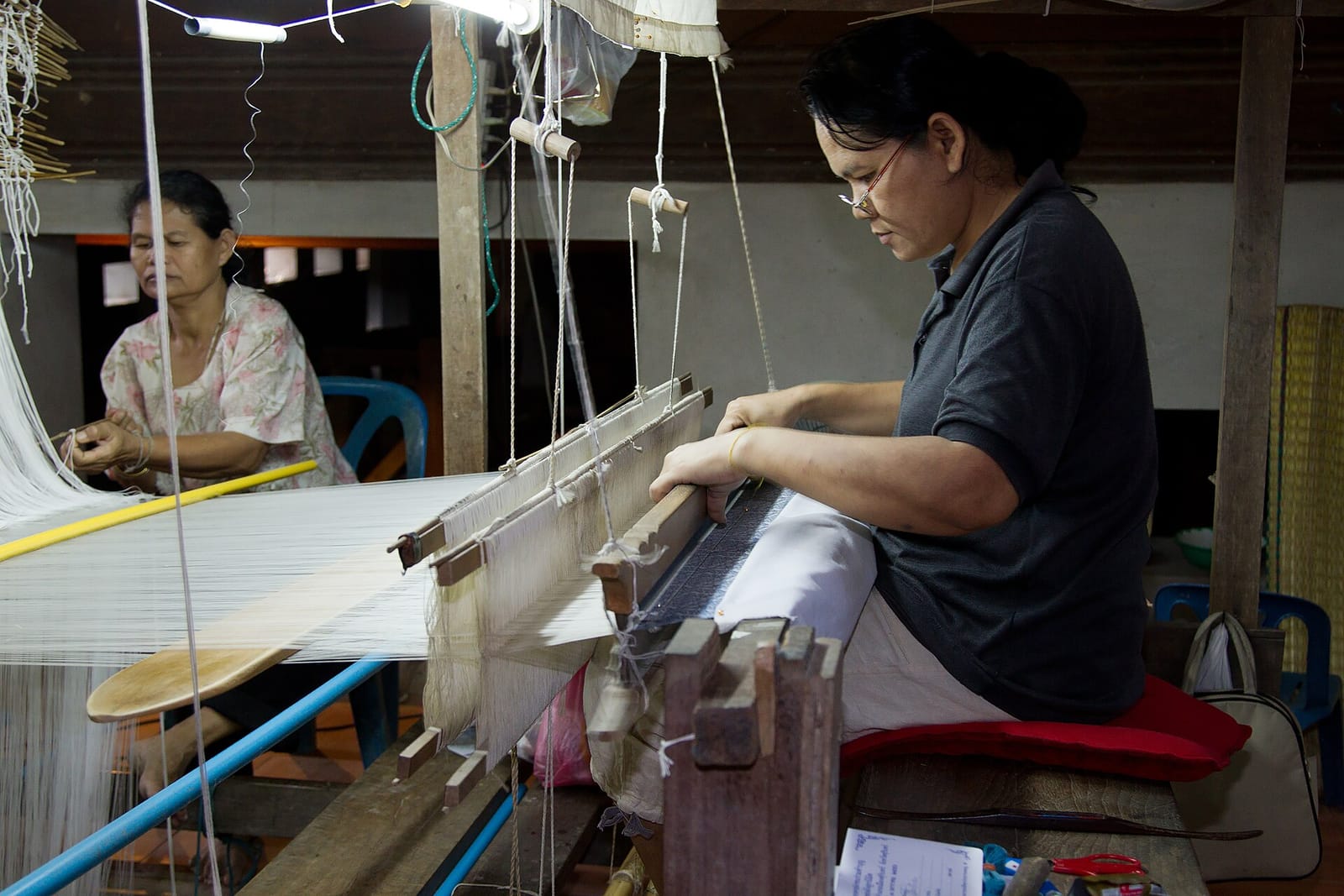
The Phu Thai are well known for weaving, and at Khok Kong there's a women's group that weaves as their regular work. What they make here centres on mudmee cotton and khit-patterned cloth, with traditional Phu Thai designs — some in natural dyes, some in chemical ones. Beyond lengths of cloth, they sew it into clothing, scarves, shoulder bags, and small pieces you can carry home.
If you're curious, you can ask to sit at the loom and try it yourself — the villagers are happy to teach. You'll see what goes into a single piece of cloth: tying the threads (mudmee), dyeing, and weaving one strand at a time. It's an activity kids and adults can do together, and you come away understanding exactly why handwoven cloth is worth what it costs.
- Mudmee cotton — the pattern comes from tying and dyeing the threads before weaving. Phu Thai designs tend to be geometric and follow the group's traditional motifs.
- Khit cloth — a technique that picks out the pattern by lifting individual threads, giving a fine raised design. It's popular for pillows, throws, and decorative pieces.
- Souvenirs — scarves, shoulder bags, and cloth bags start in the low hundreds of THB, while detailed handwoven lengths run into the thousands depending on the craftsmanship. Buying at the source gets you the real thing and supports the community directly.
Hiking Phu Pha Wua to Tat Sung and Tat Yao falls
Beyond the culture, Khok Kong has nature to walk too, since the village sits right at the foot of the hills. Phu Pha Wua forest park is nearby, with trails leading to Tat Sung and Tat Yao waterfalls, plus viewpoints like Pha Nang Khoi (sometimes called Pha Nang Aen). Villagers can guide you on nature hikes — a nice add-on that pairs well with staying the night.
When are the waterfalls best
Tat Sung and Tat Yao falls run full and look their best from late rainy season into early cool season, roughly August to December. The trails can get slippery when it's raining, so wear shoes with good grip. In the dry months (March–May) the water drops off a lot, so if you come then, lean into the village's cultural side instead.
Phu Thai food you have to try here
Phu Thai Pha Laeng food is hill-country Isan cooking — bold, homey flavours built mainly on ingredients from the community, made fresh by the women's group every meal. These are the dishes you'll run into most often on the spread.
- Bamboo-shoot and wild-vegetable curry — made with yanang leaf and greens from the forest and the back garden, with that mellow, rounded Isan flavour.
- Larb and koi — pork or beef larb tossed with toasted spices, fragrant with roasted rice, eaten with fresh vegetables.
- Pon and chilli dips — fish or mushroom pon, eaten with steamed vegetables. It's a centrepiece of the Phu Thai spread.
- Hot sticky rice — freshly steamed over a wood fire, more fragrant and softer than what you get in town.
- Seasonal local sweets — treats made from rice and fruit from the community, depending on when you visit.
Planning an overnight Khok Kong trip
The trip that works best for Khok Kong is two days, one night, so you get the full evening of culture and a morning hike. Here's a sample plan you can adjust as you go.
Arrive, welcome ceremony, Pha Laeng feast
Hike Phu Pha Wua, waterfalls, head home
You need to book ahead
Khok Kong is a community homestay, not a hotel you can just walk into and check in. You need to get in touch in advance so the villagers can prepare lodging, food, and the performance. Contact the Ban Khok Kong homestay group through the community coordinator (call 081-266-1620), or ask through Wat Khok Kong (call 084-733-0329). The bigger your group, the better the value and the more fully they can run the activities.
Getting to Ban Khok Kong
Ban Khok Kong sits deep in Kuchinarai district, in the east of the province. The easiest way to reach it is to drive yourself. From Kalasin town, take the road toward Kuchinarai, about 90 kilometres, roughly 1.5 to 2 hours. The last stretch is the road into the hill-foot village, so allow extra time and drive a little slowly.
- Drive yourself — by far the easiest, since public transport into the village is sparse. Set your map to Kut Wa subdistrict, Kuchinarai district.
- Fly into Khon Kaen and rent a car — the nearest airport is Khon Kaen, then it's about 2.5 to 3 hours' drive on to Kuchinarai.
- Bus to Kuchinarai — buses reach the district town, but for the last stretch into the village you'll need the community to pick you up, so arrange it in advance.
Want a base in town before heading in to the homestay
See the Top 10 Kalasin hotels →