🔄 Updated 21 Jun 2026
If you're working your way through the Khmer ruins of Sisaket, most people think of Prasat Sa Kamphaeng Yai in Uthumphon Phisai first, because it's the largest and best preserved. But Prasat Ban Prasat in Huai Thap Than is a different kind of place that feels nothing like it. It's small, quiet, and genuinely woven into the community rather than fenced off and separated from daily life. You walk into the temple grounds and there the old towers just are, with elderly locals chatting nearby — an atmosphere you won't get from the usual tourist temples.
What kind of temple is it, and how old
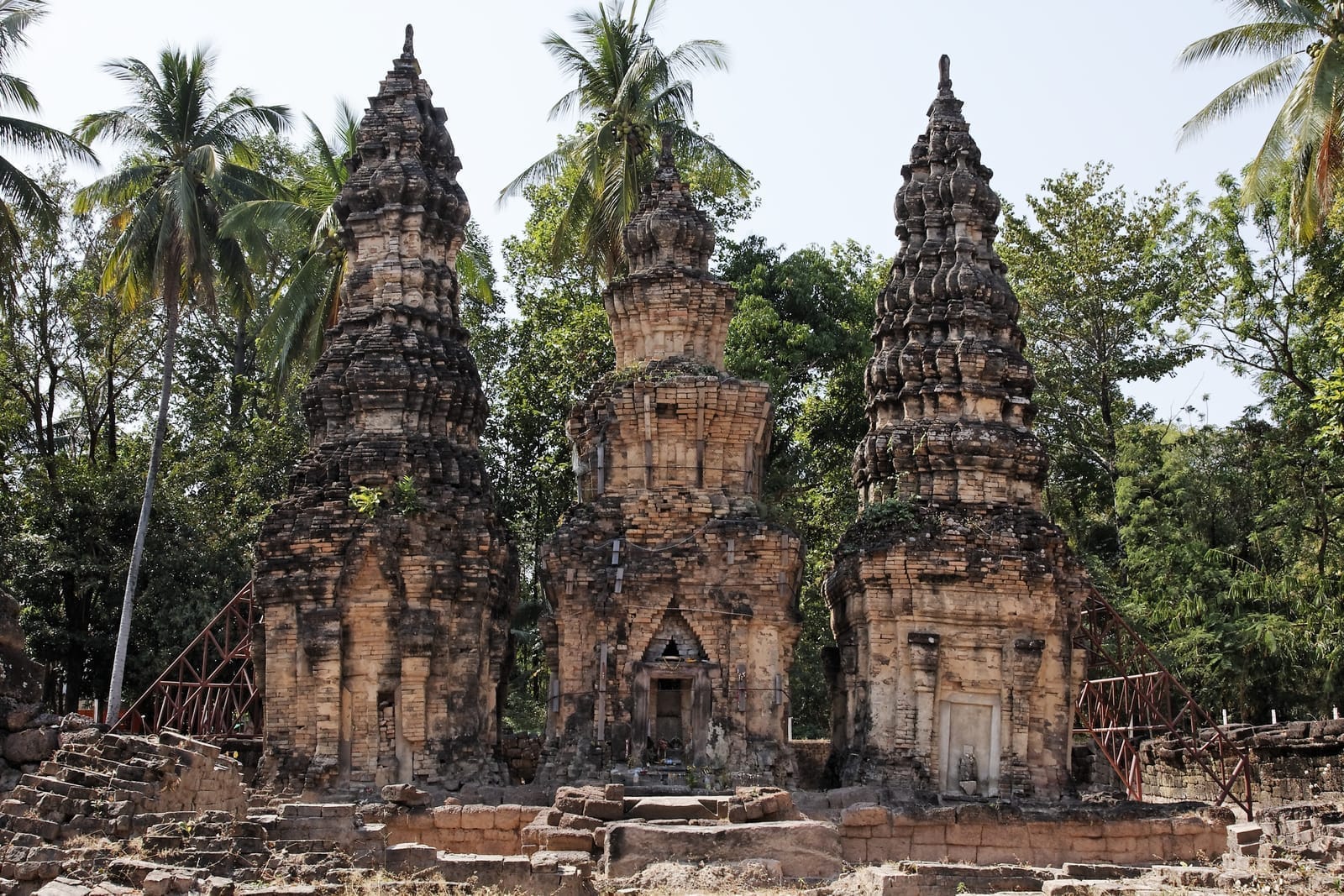
Prasat Ban Prasat also goes by Prasat Huai Thap Than or Prasat Ban Non That. It sits inside Wat Prasat Phanaram in Ban Prasat, Prasat sub-district, Huai Thap Than district. It's believed to have been built around the 11th century, during the reign of King Suryavarman I. Originally it was a Hindu sanctuary built to enshrine the Trimurti — Shiva, Vishnu and Brahma — following ancient Khmer belief.
The temple consists of three brick towers (prang) lined up on a north–south axis on a single laterite base, facing east. The central tower is larger than the two flanking it. A laterite wall surrounds the sanctuary on all four sides, with gopuras (entrance gateways) on the south and east. The style is Khleang–Baphuon, a Khmer style that was adapted in later periods. The side towers had their roofs and entrances added later. The Fine Arts Department has registered it as a national historic site since 1935.
- Materials — the towers are brick, while the base and walls are laterite, with sandstone used for some decorative details — the mixed materials are typical of later-period Khmer temples
- Layout — three towers on one base, north–south axis, facing east, ringed by a laterite wall and gopuras
- Age — thought to date to around the 11th century, or nearly a thousand years ago
Want more out of Sisaket? Book tours & activities
Booking online ahead on Klook or GetYourGuide is usually cheaper than the gate and skips the queue. Pick only the experiences you actually want — prices and availability are shown live on each site.
Khmer art details worth a closer look
The appeal of a brick temple like this is in the small details you have to get close to see, not in its scale. Look at the brickwork laid so tight you can barely spot a mortar line — an ancient Khmer technique of grinding bricks flush together with a tree-resin adhesive. Look too for the traces of stucco patterning and decorative niches that survive on the tower walls.
- The brickwork — bricks set so tight the joints are almost invisible, a signature of Khmer brick towers; look at a low angle when the sun is slanting and the brick texture stands out
- Sandstone door frames and lintels — in places you can still see sandstone door frames and traces of lintels that once carried carved designs; much has worn away, but you can still make out the outlines
- Gopuras and laterite walls — walk the perimeter to follow the wall line and laterite gateways, and you'll get a feel for how the Khmer sanctuary plan was laid out
- Shared laterite base — all three towers stand on a single base, which is what sets this temple apart from the usual single-tower sanctuaries
Get more out of the visit
Before you go, read up a little on the Trimurti and the meaning of the three towers. Once you're there you'll understand why there are three, and what each one once enshrined — far more rewarding than just standing around taking photos. And try to go in the morning or late afternoon, because the slanting light makes the brick texture and carved traces far clearer than the harsh midday sun.
A temple still alive with its community
What sets Prasat Ban Prasat apart from other ruins is that it isn't just an old relic. Locals here still regard the temple as sacred — people come to make vows about their troubles and believe their wishes are granted, so there's a steady stream of visitors paying respects. The temple is cared for as a spiritual anchor for the village, not just a photo spot.
The liveliest time is the Phra That worship festival, held on the full moon of the third lunar month every year (around February). Villagers gather to make merit and hold the celebration at the temple. If you want to see the place with real life in it, this is a good moment to come. But on an ordinary day you get the quiet stillness instead — a different kind of appeal.
How to get there, opening hours, and entry fee
The temple sits a fair distance from Sisaket town. Drive out of the city along Highway 226 (the Sisaket–Surin road) for about 39 km to reach Huai Thap Than district, then turn off onto a rural road for another 8 km or so to Ban Prasat. All told it's about an hour's drive. The temple is inside Wat Prasat Phanaram, and the temple signs are easy enough to spot.
- Getting there — easiest by your own car or a rental, since public transport into the village is limited. You could take the train to Huai Thap Than station and arrange local transport from there, but it isn't all that convenient
- Opening hours — it's a historic site within a temple, open during normal daylight hours, with no set closing gate, but go between morning and evening for the light and convenience
- Entry fee — free, no ticket. If you'd like to support the temple, you can drop something in the donation box as you see fit
- Time needed — it's a small temple; walking around it takes roughly 20–40 min. It's better as a stop along the way than as a full-day destination in itself
An honest heads-up before you go
This temple is small and on the quiet side — no guides, no visitor center, and few facilities. If you're expecting a grand temple like Phanom Rung, you may find it ordinary. But if you like places without crowds where you can study Khmer art up close at an easy pace, this one delivers. I'd suggest folding it into a trip that hits several temples, which makes it more worthwhile than coming for this one alone.
What to pair it with in a single trip
Because Prasat Ban Prasat doesn't take long to see, plan it as one stop on a route collecting Sisaket's Khmer ruins. Huai Thap Than sits right between Sisaket town and the Surin side, so it pairs easily with other temples.
Prasat Sa Kamphaeng Yai (Uthumphon Phisai)
The largest and best-preserved Khmer temple in the province, set inside Wat Sa Kamphaeng Yai. The lintels and towers are still in good shape. It's on the same route as Huai Thap Than, so it's an easy add-on.
Prasat Sa Kamphaeng Noi
A small temple beside the Sisaket–Uthumphon Phisai road. A quick stop to see the lintel and gateway, good to tack on if you pass it on the way back into town.
Sisaket town
On the way back into town, stop at Wat Phra That Rueang Rong, visit the Four Tribes Museum, or grab some local Isan food before heading off.
If you come during volcanic-soil durian season, roughly mid-June to August, you can spend the next day driving south to Khun Han and Kantharalak districts, taking in durian orchards, Wat Lan Khuat (the Temple of a Million Bottles), and Samrong Kiat Waterfall. That gives you a trip with temples, ruins, and nature all in one go.
Plan a fuller Sisaket trip — see more places to stay and eat
See the Sisaket travel guide →