🔄 Updated 21 Jun 2026
Prasat Sa Kamphaeng Yai sits within Wat Sa Kamphaeng Yai, in Sa Kamphaeng Yai subdistrict, Uthumphon Phisai district, about 26 km west of Sisaket town. It's a Khmer sanctuary built around the 16th Buddhist century (the 11th century CE) in the Khleang-to-Baphuon style. It was originally a Hindu sanctuary, later adapted into a Buddhist site once Buddhism gained influence in this area. What local people are proud of is that it still has more of its original elements intact than any other Khmer temple in the province — from the prangs and gallery to the library building and reservoir.
To be honest, the appeal here isn't the sheer grandeur you'd get at the big temples in Cambodia — it's how complete the layout is and how readable the carvings still are. A walk around takes roughly half an hour to an hour. It suits people who like looking at old stonework up close and want to understand what a single Khmer temple is actually made up of. Another plus is that it sits inside a working temple, so there's shade and easy parking — you're not crossing an open, sun-baked field the way you are at some other ruins.
What to make sure you see
The temple itself is made of brick prangs standing on a single shared laterite base, lined up north–south and facing east. The main prang is the central tower, surrounded by a gallery built of laterite and sandstone in a rectangular plan. Inside are the library building and traces of the old reservoir, and every corner keeps enough detail to make you stop and look.
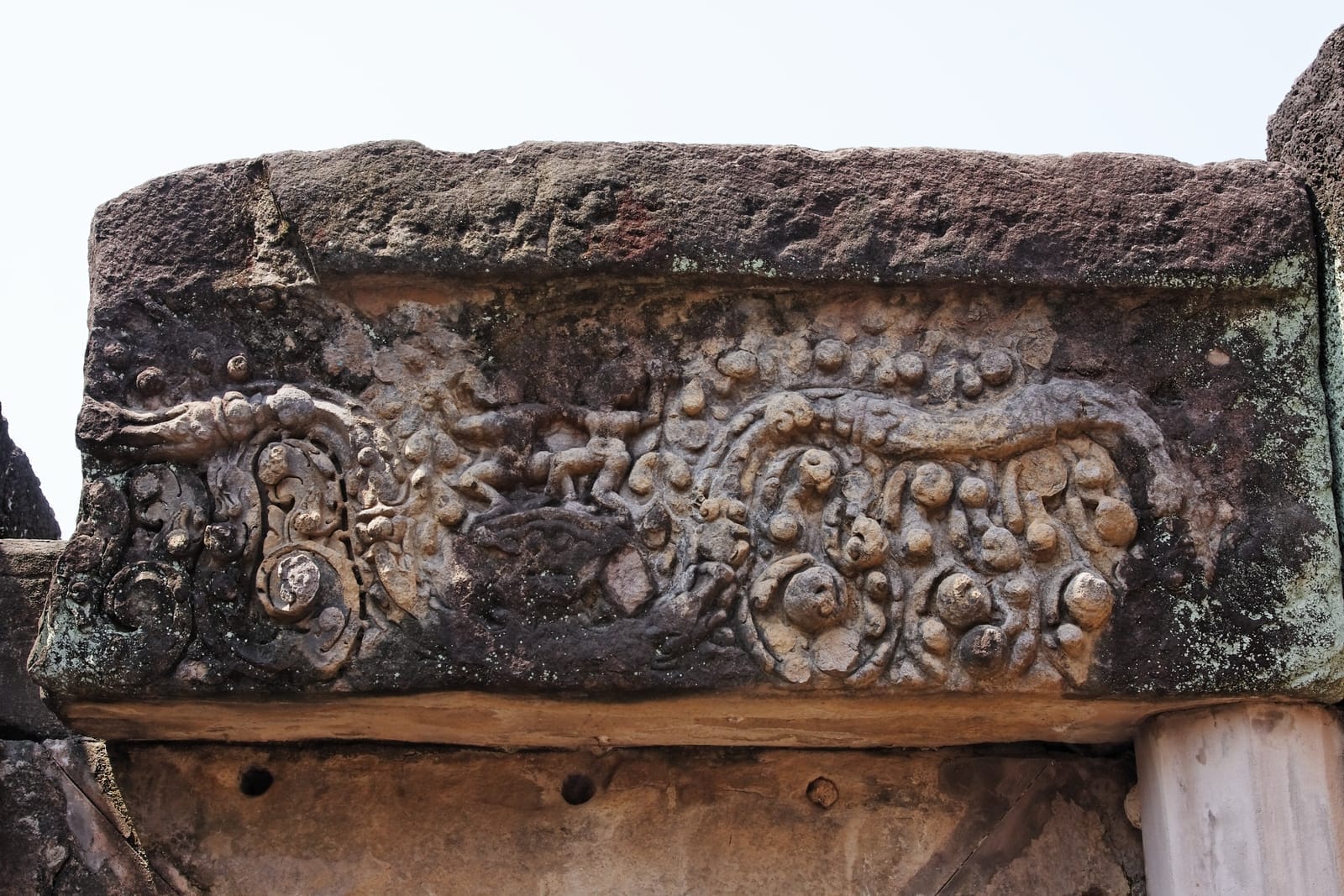
- 13 sandstone lintels — this is the real highlight here, carved with Hindu deities and scenes including Vishnu, Krishna, and Indra riding the elephant Erawan. It's one of the temples with the most surviving lintels in Lower Isan. Work through them one by one and you'll see each one tells a different episode.
- Brick prangs on one base — the brick prangs lined up on a shared laterite base give this place its memorable shape. Shoot wide so you catch the prangs and the gallery together for the classic frame.
- The enclosing gallery — the gallery wall, built of laterite and sandstone, frames the site in a rectangle. Walk along it and the Khmer temple plan becomes clear — how they positioned the central tower in relation to the entrance.
- Naga-sheltered Buddha image — excavations uncovered a sandstone meditating Buddha sheltered by a Naga, about 1.33 m tall, reflecting the period when the temple was converted to Buddhist use. It's now preserved and displayed in the temple.
- Bronze Nandikeshvara figure — a large bronze figure about 1.4 m tall was once excavated here, a rare find that confirms this was originally a sanctuary dedicated to Shiva.
Get the most out of the lintels
Many lintels sit high up and some are backlit at certain times. If you want to see the carving clearly, come in the morning or late afternoon when the light is angled — you'll read the depth of the carving far better than at midday with the sun straight overhead. Bring a zoom lens or use your phone's zoom to capture each deity more sharply. Look especially for the panel of Indra on the elephant Erawan and the Krishna scene.
Want more out of Sisaket? Book tours & activities
Booking online ahead on Klook or GetYourGuide is usually cheaper than the gate and skips the queue. Pick only the experiences you actually want — prices and availability are shown live on each site.
Entry and opening hours
The good thing here is that it sits inside a working temple that's open for merit-making as usual, so there's no official entry fee for the ruins — just walk in and look around. If you want to make merit or drop something in the temple's donation box, that's up to you. Hours follow the temple's, so daytime is fine to visit. We'd suggest late morning to afternoon to be safe, since very early or late in the day may coincide with temple activities.
- Entry fee — no official fee, since it's inside a temple. You can drop a donation in the temple box if you'd like.
- Opening hours — open during daytime as with any temple. Late morning to afternoon is best.
- Time to walk it — about half an hour to an hour to see everything.
- Facilities — there's a parking area in the temple grounds and plenty of shade; the temple restrooms are usable. Good as a stop along the way.
Getting there from Sisaket town
The temple is in Uthumphon Phisai district, about 26 km west of Sisaket town. You can go by car or by train. Driving is the most convenient, since you can park in the temple grounds and move on to other sites easily. If you don't have a car, take the Isan-line train to Uthumphon Phisai station for the district center, then catch local transport to the temple.
Self-drive
From Sisaket town head toward Uthumphon Phisai, about 26 km, roughly 30–40 minutes. You can park in the temple grounds — ideal if you plan to add other Khmer ruins or temples in the same day.
Train
Take the Isan line (Bangkok–Ubon) and get off at Uthumphon Phisai station, then catch local transport in the district to Wat Sa Kamphaeng Yai. Good if you don't have your own vehicle.
Hired car / motorbike taxi
If you arrive by train or coach into the district, a motorbike taxi or a chartered songthaew can take you to the temple. Short distance, not expensive.
Dress for a temple
Because the ruins are inside a working temple, dressing modestly will feel more comfortable — skip spaghetti straps or very short shorts. Parts of the temple grounds are uneven stone and laterite, so if you're with older travelers, watch your step. Midday sun is strong, so bring water and a hat.
A Sisaket Khmer-temple trail trip
Sisaket has Khmer temples and traces of Khmer civilization scattered across several districts. If you come to Sa Kamphaeng Yai and want to keep going, you can easily build a Khmer-temple trail. Below is a rough plan you can flex around your energy and time.
Temples near town + Isan food
Up to the border highlands (check conditions first)
On the Khao Phra Wihan / Pha Mo I Daeng border
The area around Khao Phra Wihan and Pha Mo I Daeng is a border zone that can be tense at times or closed off. Before planning a visit, always check the latest announcements from Khao Phra Wihan National Park and the news on border conditions. If you're unsure, swap in the Khmer temples and food in town instead — those are doable year-round with no restrictions.
What else to do nearby
If you use Sa Kamphaeng Yai as a starting point, you can branch off several ways — a Khmer-temple trail, local food, or souvenirs before you head home.
- Khmer-temple trail — Sisaket has Khmer temples and old temples spread across several districts, enough to fill a day-trip trail. If you like old stonework, you'll enjoy it.
- Spicy food in town — on the way back, stop at an Isan restaurant or for local khanom chin in town to wrap up the day at an easy pace.
- Volcanic-soil durian in season — mid-year brings Sisaket's volcanic-soil durian; stop at an orchard or a roadside stall if you come in season.
- Pick up souvenirs before you leave — shallots, garlic and local foods are the souvenirs people like to take home from Sisaket.
Plan a full day exploring Sisaket
See the Sisaket travel guide →