🔄 Updated 21 Jun 2026
Mention Khmer temples in southern Isan and most people picture Phanom Rung and Mueang Tam over in Buriram first. But Sisaket has plenty of its own. What makes the province fun to explore is that the temples aren't spread far and wide — several of them line up along the same stretch of road around Uthumphon Phisai and Huai Thap Than districts, only about 20–40 minutes' drive apart. That makes it easy to string them into a single temple-hopping route.
In this article we'll take you through them one by one in the order that drives smoothest, telling you straight what there is to see at each, how long it takes, and which ones are worth the stop. We finish with a 2-day plan you can adapt as you like.
The route at a glance — which temple is where
There are three main Khmer temples in Sisaket worth ticking off on this route. All are free to enter and they connect along one drive. Starting from Sisaket town, head toward Uthumphon Phisai first, then loop up to Huai Thap Than — that gives you the smoothest run.
- Prasat Sa Kamphaeng Yai (Uthumphon Phisai) — the biggest and best-preserved Khmer temple in the province, about 26 km from town. This is the main highlight of the trail.
- Prasat Sa Kamphaeng Noi (Uthumphon Phisai) — a small temple beside the Sisaket–Uthumphon Phisai road, originally an arogayasala, or Khmer hospital. A quick stop.
- Prasat Ban Prasat (Huai Thap Than) — three brick towers in the middle of a village temple. Quiet, with the feel of a temple still woven into everyday community life.
Order them for a smooth drive
If you're in your own car, we'd start with Sa Kamphaeng Noi since it sits right beside the main road early on, then move on to Sa Kamphaeng Yai in Uthumphon Phisai town, and finally loop north to Huai Thap Than for Ban Prasat. All three together — driving and walking — fill an easy half-day to a full day.
Want more out of Sisaket? Book tours & activities
Booking online ahead on Klook or GetYourGuide is usually cheaper than the gate and skips the queue. Pick only the experiences you actually want — prices and availability are shown live on each site.
Prasat Sa Kamphaeng Yai — the province's highlight
If you only have time for one stop, make it this one. Prasat Sa Kamphaeng Yai — known in old records as Prasat Sri Phrutthesuan — sits inside Wat Sa Kamphaeng Yai in Sa Kamphaeng Yai subdistrict, Uthumphon Phisai. It's the largest and most complete Khmer temple in Sisaket, thought to have been built around the mid-to-late 11th century in the Baphuon style of Khmer art, originally a Hindu sanctuary.
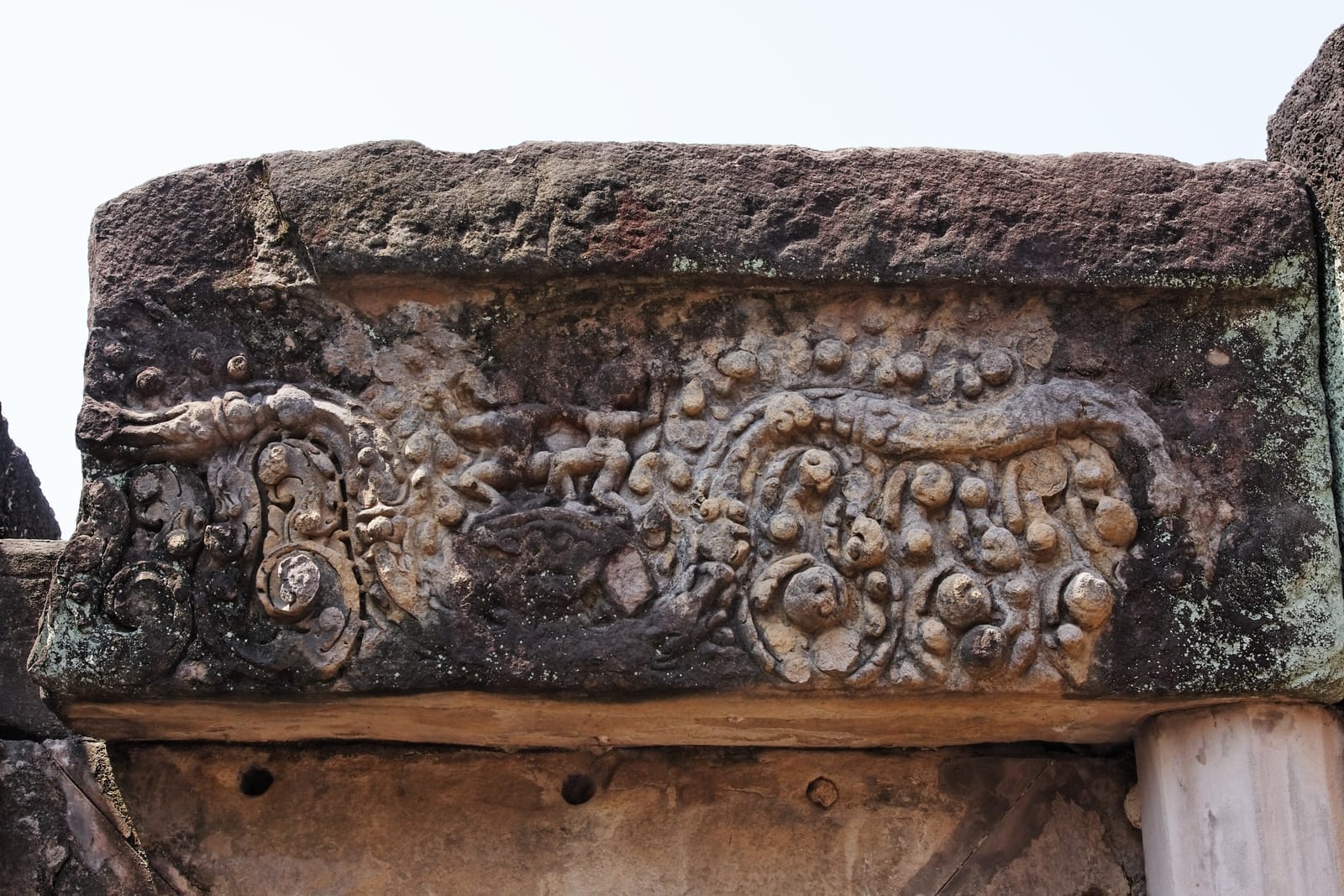
The temple is three towers on a single base, lined up north–south and facing east. The central tower is built of sandstone with brick accents, while the side towers are brick decorated with sandstone. Around them are a worship hall and an enclosing wall. What sets this place apart from the province's other temples is how many lintels and sandstone carvings survive, plus a large number of excavated pieces displayed in the temple's small museum.
- Lintel of Indra on Airavata — above the central tower's doorway, carved with Indra riding his elephant on a pedestal above a kala face. It's clear to read and photographs well.
- Lintel of Vishnu reclining — on the brick hall to the north, carved with Vishnu reclining on the serpent Ananta amid the cosmic ocean. A beautiful piece of Hindu storytelling.
- Lintel of Shiva and Uma — on the brick hall to the south, carved with Shiva and Uma seated above the bull Nandi.
- Excavated finds — digs here have turned up lintels of Shiva Nataraja, Krishna lifting Mount Govardhana, a Buddha sheltered by the naga, and terracotta votive tablets. Some are kept in the temple museum.
On getting there: the temple is about 26 kilometres from Sisaket town. Drive along Highway 226 toward Uthumphon Phisai, roughly 30–40 minutes. The temple sits within the wat grounds, entry is free with no ticket, and it's open during normal daytime hours. There's parking inside the wat. Walking around the temple and visiting the museum takes about 45 minutes to an hour to cover it all.
Make the most of the lintels
The lintels are the star here. Try going in the morning or late afternoon when the sun is low — the angled light brings out the depth of the carvings far better than flat midday glare. And if the temple museum is open, step inside, since many of the originals have been moved under cover to protect them from weathering.
Prasat Sa Kamphaeng Noi — the roadside Khmer hospital
Not far from Sa Kamphaeng Yai, Prasat Sa Kamphaeng Noi sits inside Wat Thep Prasat Sa Kamphaeng Noi at Ban Klang in Khayung subdistrict, beside the Sisaket–Uthumphon Phisai road. What makes it interesting is that this wasn't an ordinary sanctuary — it was an arogayasala, a community hospital from the Khmer period, built in the reign of King Jayavarman VII along Mahayana Buddhist lines.
The temple consists of a tower and a hall built of laterite, with a large pond out front. The tower, hall and pond are all enclosed by a laterite wall — this layout is the standard plan for a Khmer arogayasala found across southern Isan. There was once a lintel carved with Varuna, the god of rain, seated on a pedestal borne by three geese, in the Baphuon style, dating to around the 11th century.
- What stands out — it was an arogayasala, or Khmer hospital, so the plan differs from a typical sanctuary temple, with a large pond in front.
- Materials — built mainly of laterite, with the porous stone surface typical of arogayasalas from King Jayavarman VII's era.
- Time needed — small, about 20–30 minutes on foot. A good quick stop along the way.
- Visiting — within the wat grounds, free entry, easy roadside parking.
Straight talk
Sa Kamphaeng Noi is small and far less of its art survives than at Sa Kamphaeng Yai. If you're rushing, it may feel ordinary. But if you're curious about arogayasalas and want to understand how the Khmer organised public healthcare, this is an easy example to read, and it's right by the road, so it's a quick add-on that won't cost you time.
Prasat Ban Prasat — brick towers in the middle of a village
Round off the route at Huai Thap Than. Prasat Ban Prasat — also called Prasat Huai Thap Than — sits inside Wat Prasat Phanaram in Prasat subdistrict, Huai Thap Than. It's three brick towers on a single laterite base, lined up north–south and facing east. It's thought to date to around the 11th century in the Khleang–Baphuon style, originally a Brahmin sanctuary housing the Trimurti.
The appeal here isn't size, it's atmosphere. The temple is genuinely embedded in a living community — villagers still hold it sacred and come to pay their respects regularly. Walk into the wat and you simply find the old towers standing there, not fenced off and separated from daily life. Look at the brickwork, laid so tight you can barely see the mortar lines — that's the old Khmer brick-tower technique.
Getting there means another 8 kilometres or so from Huai Thap Than into Ban Prasat village. The temple is small, and walking around it takes about 20–40 minutes. Entry is free. If you want to see the temple at its most alive, the festival paying homage to the relic on the full moon of the third lunar month (around February) is especially lively. We've written the full details in our dedicated article on this temple.
Quick comparison — which to stop at first
Prasat Sa Kamphaeng Yai
The biggest and best-preserved temple in the province, with several lintels and a temple museum. If you can only do one, do this one.
Prasat Ban Prasat
Three brick towers in the middle of a village — quiet, few people, with the feel of a temple still part of community life. Good for those who like calm.
Prasat Sa Kamphaeng Noi
A roadside arogayasala, or Khmer hospital, with a pond out front. Less of its art survives, but it's a quick stop since it's right on the main road.
A 2-day plan — temples at an easy pace
All three temples together take less than a day on foot, but if you'd rather not rush and want to see more of Sisaket too, we'd give it 2 days and 1 night. Spend the first day on temples, the second on temples and food in town. Here's the route we'd put together.
Hopping the Khmer temples
Temples and food in town
The border situation to check before you go
If you're planning to extend the trip to Pha Mo I Daeng or Khao Phra Wihan National Park in Kantharalak district, we'll be straight with you: always check the situation first. This area sits right on the Thailand–Cambodia border, and there have been clashes along the frontier, leading the park to temporarily close the Pha Mo I Daeng viewpoint until things settle.
Check before you set off
Before heading to the Kantharalak–Khao Phra Wihan side, always check the latest announcements from Khao Phra Wihan National Park and the current border news. If it's still closed or the situation isn't safe, give it a miss for now. The Khmer temple route around Uthumphon Phisai–Huai Thap Than in this article sits well inland, away from the border, and is open as usual.
Getting ready before you set off
- Transport — a private or rental car is easiest. The temples are out in the outer districts, with limited public transport access.
- Best time — the cool season (November–February) is ideal; walking the temples in the open isn't punishing. In the rainy season the temples turn lush and green but get slippery.
- What to wear — comfortable walking shoes and a sun hat, since the temples are out in the open with little shade.
- Etiquette — the temples sit within wat grounds and are sacred to locals. Dress modestly and don't climb on the monuments.
- Cost — all three temples are free. Your main expenses are fuel and food, which makes this a very light-on-the-wallet history trip.
Plan a full Sisaket trip — see more places to stay and eat
See the Sisaket travel guide →