🔄 Updated 21 Jun 2026
Nakhon Phanom is one of the most ethnically diverse provinces in Thailand. Locals call it the land of 9 tribes and 2 nationalities (Tai Yo, Phu Tai, Tai Kha, Tai Kaloeng, Tai So, Tai Isan, Tai Saek, Tai Kuan, Tai Tat, plus Chinese and Vietnamese), and the group people picture first when they talk about Nakhon Phanom culture is the Phu Tai of Renu Nakhon — because the Phu Tai dance here is well known enough to be treated as the province's signature.
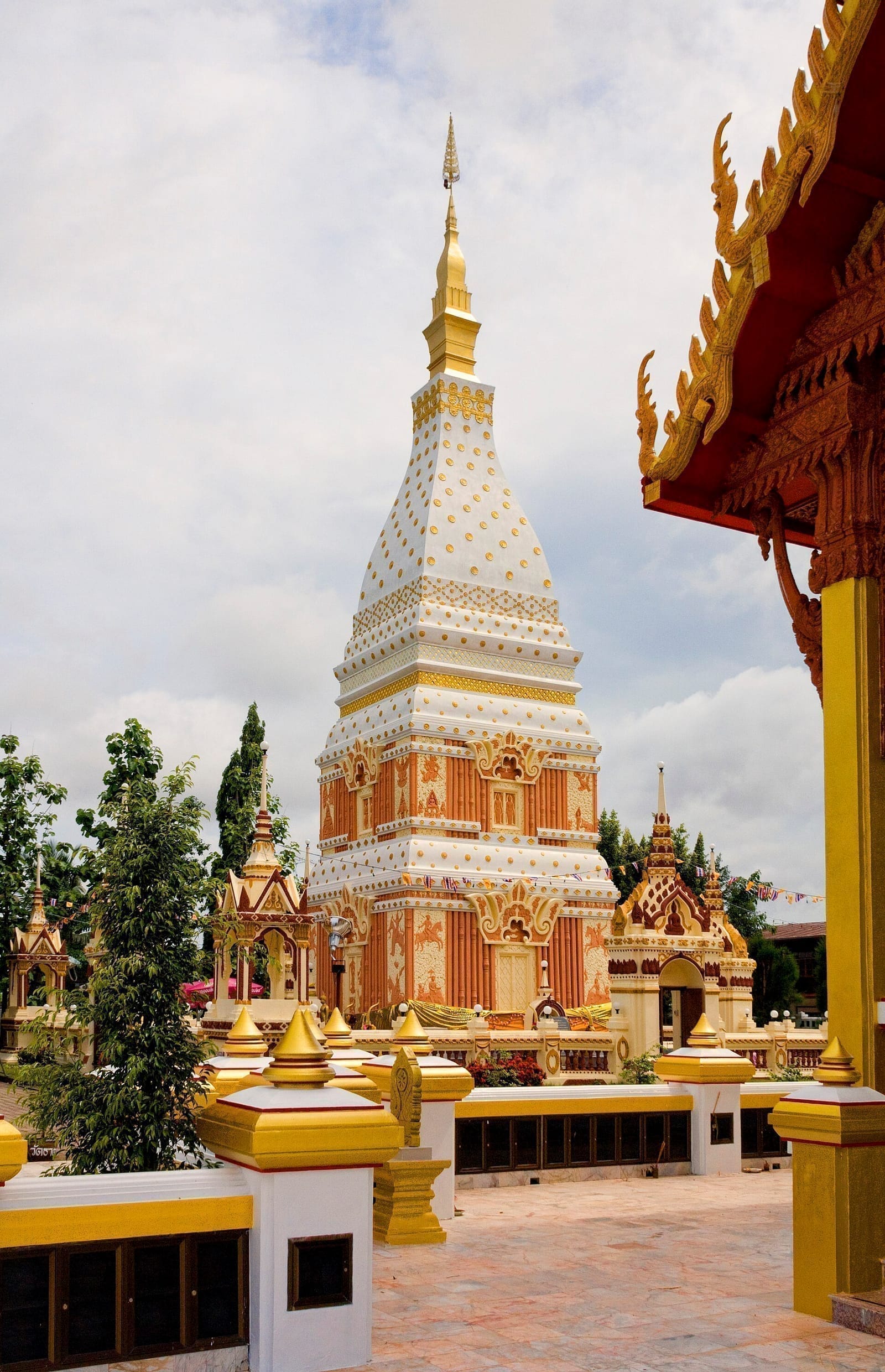
This article digs into the Phu Tai community of Renu Nakhon through its culture — the people, the language, the dance, the weaving, the food, and the local market. We've written a separate piece about paying respects at the pink Renu stupa. Coming here, think of it as cultural travel rather than a quick photo stop on the way through.
Who are the Phu Tai, and how did they end up in Renu Nakhon?
The Phu Tai (written either Phu Tai or Phutai) are a Tai-Lao ethnic group who originally lived around Sip Song Chu Tai and the left bank of the Mekong before migrating into Isan in several waves more than a century ago. Renu Nakhon is one of the largest and most tightly knit Phu Tai communities. People here still speak Phu Tai at home — it sounds close to Isan Lao but has its own accent and vocabulary.
What sets Renu Nakhon apart from a lot of cultural-tourism towns is that it isn't staged for visitors. Walk through the district and you'll see elders in hand-woven sarongs heading to the market, greeting each other in Phu Tai, with old wooden houses still standing. The culture here is the real thing, lived every day — visitors simply get to see it as it is.
- The Phu Tai language — still spoken at home and in the market, with a different accent from standard Isan Lao. Listen closely and you'll pick up the difference.
- Dress — hand-woven sarongs and dark long-sleeved tops trimmed with red, a traditional outfit people still wear at real merit-making events.
- Beliefs — Buddhism blended with ancestral spirit beliefs, including the yao healing ceremony (treatment by a folk healer) that you can still come across.
Want more out of Nakhon Phanom? Book tours & activities
Booking online ahead on Klook or GetYourGuide is usually cheaper than the gate and skips the queue. Pick only the experiences you actually want — prices and availability are shown live on each site.
The Phu Tai dance (Fon Phu Tai Renu Nakhon) — why it's famous
The Renu Nakhon Phu Tai dance is a paired dance for couples — real men and women, ten pairs or more. The movements are soft and flowing, built around extended arms and a turning torso. The women wear dark Phu Tai outfits trimmed with red, hair tied in a bun with a flower, and long metal fingernails on their fingertips so their hands trail out beautifully as they dance. It's the image people come to Renu Nakhon hoping to see at least once.
There's a story behind how this dance got famous. In 1955, King Bhumibol Adulyadej (Rama IX) and the Queen visited Phra That Phanom to pay their respects, and the province arranged a Phu Tai dance in their honor — refining the choreography into something more polished and systematic. From then on the Renu Nakhon Phu Tai dance became known nationwide and has been performed at major events ever since.
The dance has many figures, each named after nature in a rather charming way — like the flying barbet, the crow hopping on a clod of earth, the tiger leaving its den, the crocodile flicking its tail, and the rolling and swaying figures. The rhythm comes from a folk ensemble that isn't just the khaen but also the king drum, tap drum, long drum, gong, phang-haad gong, and kap-kaep clappers. The music is livelier than many people expect — not all slow and gentle.
How to time your visit to catch the Phu Tai dance
Straight up: the Phu Tai dance isn't performed every day. If you want to see a full group performance, aim for festival season — especially the district's merit-making and cultural events early in the year. If you're coming as a group or a study tour, arrange it in advance through the Renu Nakhon municipality or the community cultural center; they'll usually put on a welcome dance along with a bai sri su khwan blessing ceremony.
The Phu Tai welcome — bai sri, pha laeng, and ou rice wine
The Phu Tai are known for how they welcome guests. If you come as a group or land on a merit-making day, you'll get the full welcome. It starts with the bai sri su khwan ceremony — your wrist tied with white cotton thread for good luck — followed by a pha laeng meal, where local dishes are set out on a pha khao (tray or low pedestal table) and everyone gathers around to eat together. It's a warm, homey atmosphere that's hard to find in the city.
- Bai sri su khwan — a blessing and spirit-welcoming ceremony with your wrist tied in white thread, usually done before the feast begins.
- Pha laeng — a shared meal on the pha khao with pla daek chili dip, blanched vegetables, larb, koi, and Isan-style fish.
- Drinking ou — fermented rice wine in a jar sipped through a wooden straw, the traditional drink at Phu Tai merit-making events.
- Phu Tai dance — usually closing things out as a welcome dance, with a live folk ensemble if it's the full version.
Worth saying upfront: this full welcome is mostly arranged for groups who book ahead — it isn't something you'll just walk into any day. If you come solo or as a couple without arranging anything, set your expectations on walking the community, chatting with locals, and seeing real daily life, which has its own charm.
Phu Tai textiles — which patterns to buy, and how to tell it's hand-woven
Weaving is another heart of Phu Tai life. Almost every Phu Tai woman of the older generation could weave, and the community still has weaving groups producing cloth for sale. What you'll see most often are mudmee (ikat) sarongs with signature patterns, plus woven cloth in various designs. The high-end piece the province is known for is pha muk Nakhon Phanom (brocade cloth), with fine detail that takes a long time to weave — historically the cloth of nobles and the wives of senior officials.
- Mudmee (ikat) sarong — a hand-woven ikat wrap in a wide range of colors and patterns, a souvenir you'll actually use. Prices start in the low hundreds of THB and run into the thousands depending on the detail.
- Pha muk / brocade cloth — a high-end cloth with small flower motifs arranged in a single line, hard to weave and pricier than the rest, suited to serious textile collectors.
- Scarves and shawls — smaller woven pieces at gentler prices, good easy-to-carry souvenirs, starting in the low hundreds of THB.
- Naturally dyed cloth — some groups dye with indigo and bark-based colors, giving soft, easy-on-the-eye tones; the selling point is that it's skin-friendly and not loud.
How to buy the real hand-woven cloth
Hand-woven cloth won't be as perfectly smooth as factory cloth. Flip it over and you'll see knots and threads on the back that mark it as hand-woven. Buy from a community weaving group or an OTOP stall in the market and you'll get a fair price and can talk to the weaver directly. Don't push too hard on the haggling — a single hand-woven piece can take a week to make.
The market and local food of Renu Nakhon
Around the Renu stupa there's a community market to wander. The one people mention most is the Phra That Renu Nakhon Cultural Center Market (also called the Renu Nakhon Tong Chom market), which runs regularly on weekends and is busiest on Saturdays. It pulls together products from local occupational groups and OTOP makers across every sub-district of the area, with local food, woven cloth, and souvenirs at genuine local prices.
Renu jicama (man kaew)
The most famous local product of Renu Nakhon — big jicama bulbs, sweet and juicy-crisp. Peel and eat them fresh or take a bag home. Come to Renu and skip the jicama and it's like you never really made it here.
Som tam, grilled chicken & sticky rice
The classic Isan combo, and the market stalls do it punchy and full-flavored. The pla daek som tam here is fragrant and savory in a homey way, great with grilled chicken at a few baht a skewer.
Pla daek chili dip + local vegetables
Freshly pounded fermented-fish chili dip eaten with blanched and fresh seasonal vegetables — a true Phu Tai-Isan flavor that goes down easy with sticky rice.
Larb & koi
Pork or beef larb seasoned bold, dusted with toasted rice and kaffir lime leaf — a staple of the Phu Tai drinking circle and merit-making feasts. Order it with hot sticky rice.
Khao jee & local sweets
Sticky-rice patties brushed with egg and grilled fragrant over the fire, plus local sweets like khanom tan and khanom thian that vendors make themselves for the morning trade. A few baht a piece.
Woven cloth & OTOP goods
Stalls of mudmee sarongs, scarves, and Phu Tai-pattern souvenirs from the district's weaving groups — plenty of vendors to choose from in one market.
Honest heads-up
The market here buzzes in waves, depending on the day and the festival calendar. Come on a weekday afternoon and it can be quieter than you'd expect. Shops around the stupa are still partly open, but if you want the full market atmosphere with woven cloth and food in force, aim for a Saturday or a merit-making period.
Visiting the Renu Nakhon Phu Tai community over 2 days — a sample itinerary
If you're set on soaking up Phu Tai culture properly, allow a day and a half to two days and you'll get the full experience — paying respects, watching the dance, walking the community, buying cloth, and sharing a pha laeng feast. Here's an unhurried sample.
Arrive in Renu, pay respects, walk the community
Dig into the culture — Phu Tai dance and pha laeng
Round it out — nearby attractions and food
Phra That Renu Nakhon
The pink Monday-born stupa at the center of the Phu Tai community — the starting point everyone stops at first.
TemplePhra That Phanom
The great riverside stupa, on the same road as Renu, so you can pair the two in one trip.
FoodNakhon Phanom Isan food
A roundup of Isan food in Nakhon Phanom city — som tam, larb, river fish — before or after your Renu run.
Plan a trip across all of Nakhon Phanom — temples, good food, the Mekong
See the Nakhon Phanom travel guide →