🔄 Updated 21 Jun 2026
When people think of historic towns, Ayutthaya or Sukhothai usually come to mind first. But Sankhaburi, formerly known as Phraek Si Racha, is an old riverside town on the Noi River with such a dense cluster of ancient temples that archaeologists treat it almost as a textbook for stupa forms. The town sits in Sankhaburi district, about 20 kilometres from Chai Nat city, and the main temples are all in Phraek Si Racha sub-district, close enough to reach one another in a few minutes on foot or by car. It's a great spot if you like travelling slowly and seeing the real thing.
What makes Sankhaburi special is the octagonal stupa form known as the Sankhaburi craft tradition. You'll find it at four temples here — Wat Mahathat, Wat Phra Kaew, Wat Song Phi Nong and Wat Phraya Phraek — a style that's hard to see anywhere else, blending Dvaravati, Lavo (Lopburi) and early Ayutthaya influences together. Walk through them one by one and you'll really see how the art evolved.
Wat Mahathat — the heart of the old town
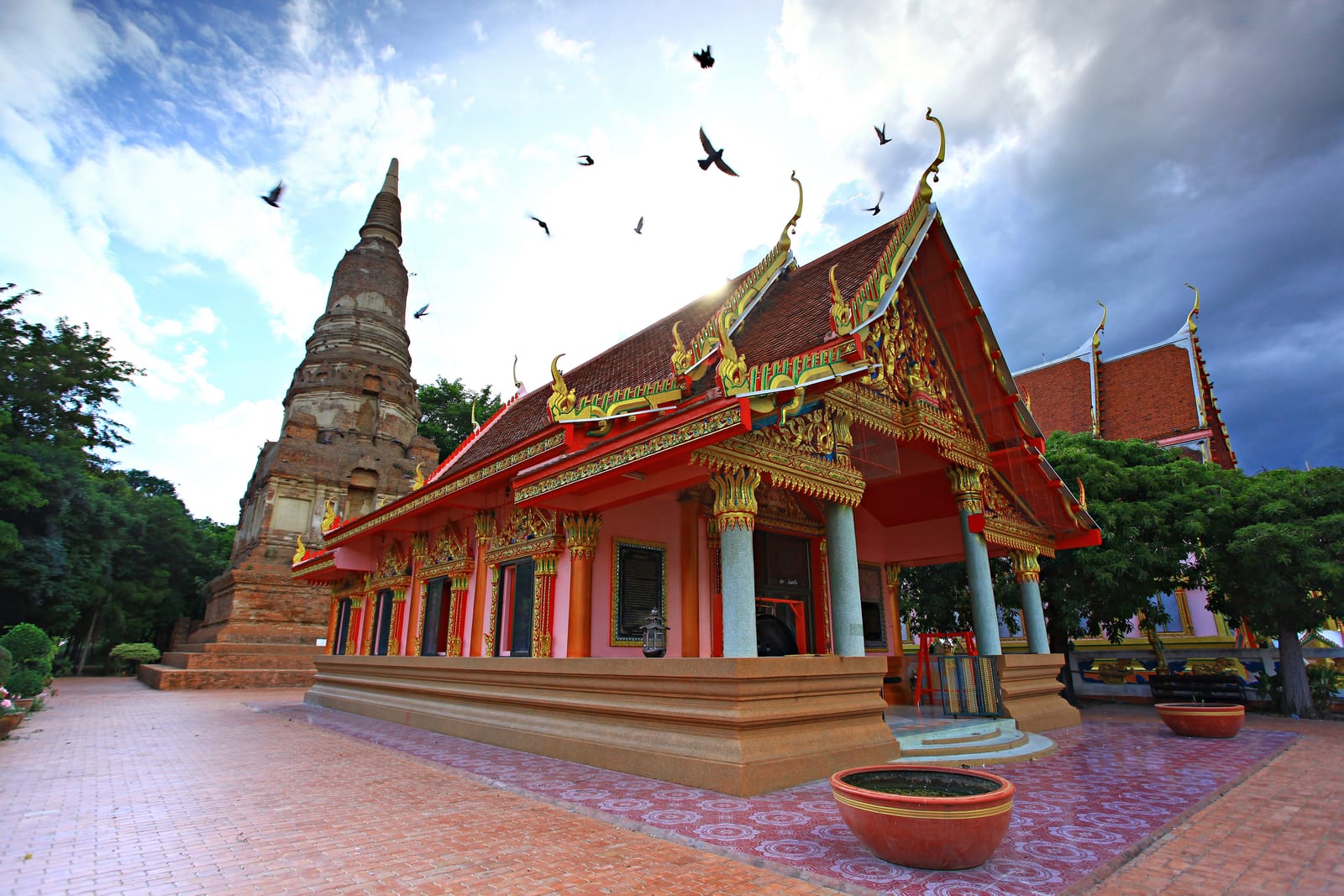
Start at Wat Mahathat in Phraek Si Racha sub-district, sitting almost dead centre in Sankhaburi town. Once called Wat Phra That or Wat Hua Mueang, it's the town's principal temple, much like the Wat Mahathat found in other ancient cities. It's believed to predate the Ayutthaya period and was later restored during Ayutthaya times. The highlights are its prang-style stupa with a star-gooseberry-petal finial, the row of octagonal subsidiary stupas beside the assembly hall, and the royal vihara that still houses a Buddha image in the Subduing Mara posture, known to locals as Luang Pho Mo or Luang Pho Lak Mueang.
On the temple grounds you'll also find the Chainat Muni National Museum, which holds antiquities from Sankhaburi town and the surrounding area. If you want to understand the background of the stupas and Buddha images you'll be seeing all day, it's worth stopping here first as your starting point.
- Prang-style stupa with a star-gooseberry-petal finial — a rare form; look up at the top, shaped like the segments of a star-gooseberry fruit
- Row of octagonal subsidiary stupas — lined up beside the vihara, the prototype of the Sankhaburi craft tradition
- Luang Pho Lak Mueang — the principal Buddha image in the royal vihara, where locals come to pray for blessings
Want more out of Chai Nat? Book tours & activities
Booking online ahead on Klook or GetYourGuide is usually cheaper than the gate and skips the queue. Pick only the experiences you actually want — prices and availability are shown live on each site.
Wat Phra Kaew — the queen of stupas
About 23 kilometres from Chai Nat city, Wat Phra Kaew in Village 10, Phraek Si Racha sub-district, has a stupa that some scholars rank among the most beautiful and best-preserved anywhere. It's a tall Lavo-style stupa blended with late Dvaravati form, with a redented base and recessed mid-section that pulls together several periods of art at once.
The name Wat Phra Kaew has an interesting backstory. It was originally called Wat Pa Kaew, a meditation site for forest-dwelling monks. Later, people found a tiny Buddha image the size of a fingertip, made of multicoloured glass, inside the stupa — it caught the light and sparkled, so the name Wat Phra Kaew (Temple of the Glass Buddha) stuck. The stupa stands in the middle of an open field, and it photographs beautifully in the slanting light of early morning or late afternoon.
Best time for photos
The Wat Phra Kaew stupa stands in a wide open field, and the midday sun is harsh and hot. Come before 9am or in the late afternoon — after 4pm the light goes soft and picks out the detail in the stucco work much more clearly.
Wat Song Phi Nong and Wat Phraya Phraek
Wat Song Phi Nong is an abandoned temple from the early Ayutthaya period, sitting almost in the centre of Sankhaburi town. Two structures remain today: one prang-style stupa and one castle-form stupa with an octagonal upper body. The name (literally 'Temple of the Two Siblings') is thought to come from there once being two temples standing side by side. Walking through, you get to see two different stupa forms in a single spot.
Wat Phraya Phraek, meanwhile, sits next to the grounds of Wat Phra Borommathat Mueang Sankha. It was registered as a historic monument back in 1935, and inside you'll find an octagonal principal stupa and a vihara enclosed by a low boundary wall, in early Ayutthaya style. King Rama V once visited this temple on his royal tour of Sankhaburi, and some of the antiquities excavated here are on display at the Chainat Muni Museum.
Wat Song Phi Nong
An abandoned early-Ayutthaya temple, with a prang-style stupa and an octagonal castle-form stupa left standing — easy to walk all the way around
Wat Phraya Phraek
Octagonal principal stupa and a vihara within a boundary wall; registered as a historic monument in 1935
A one-day walking route
All the main temples are in Phraek Si Racha sub-district, close together, with just a few minutes' drive between stops. You can do it as a relaxed half-day or full-day route. Below is the order we think flows best.
Start in the town centre
Finish with the queen of stupas
Getting there and good to know
- From Chai Nat city — take Highway 340 (Chai Nat–Suphan Buri) heading south for about 18 km to the Sankhaburi junction, then turn into the town
- Getting around — the easiest option is your own car or a rental, since the temples are spread out and local public transport is limited
- Hours — the historic sites are open-air and can be visited during daylight; the museum keeps its own opening hours, so check for closing days before you go
- Dress code — these are temples and historic monuments, so dress modestly and don't climb on the ancient stupas
Before you go
Bring drinking water and a hat or umbrella, as many of the sites are open fields with strong sun. Wear comfortable walking shoes, since the ground in places is bare earth and old brick. And leave yourself time to wander without rushing — that way you can actually read the Fine Arts Department information boards set up at each temple.
Plan a full day in Chai Nat — temples, the dam and riverside food
See the Chai Nat travel guide →