🔄 Updated 21 Jun 2026
The Sergeant Major Thawee Folk Museum wasn't built by the state — it's the work of one man who gathered everything by hand. Sergeant Major Thawee Buranakhet was a Phitsanulok native, born at Ban Khrong Tao Hai in Tambon Hua Ro. He served in the army as a draftsman, then trained in metal casting with the Fine Arts Department and learned sculpture under Professor Silpa Bhirasri, eventually becoming one of Thailand's finest casters of Phra Buddha Chinnarat replicas — copies that come remarkably close to the original. While he worked his craft, he travelled around collecting folk objects that people were starting to throw away and stop using, afraid that one day no one would remember how earlier generations had lived.
In 2023 he was named a National Artist in the visual arts, and before that he had been the country's first "master artisan-teacher." So the place we're about to walk into isn't just a warehouse of old things — it's one man's life's work, deliberately built to keep the roots of his region alive.
What's Inside
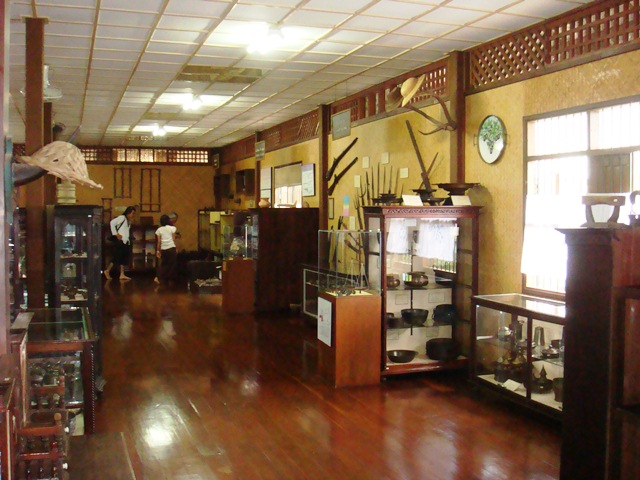
The exhibits fill several traditional Thai wooden houses set in a shady garden, with tens of thousands of objects loosely grouped by way of life. Take it slow and you can easily spend an hour here. These are the highlights people tend to love.
- Animal-trapping gear — snares, fish traps, basket traps and spring traps that people once used to find food in the fields and forests. Some are so cleverly designed they still impress visitors today.
- Basketry — carrying baskets, hampers, conical farmer's hats and woven mats made from bamboo and rattan, in the authentic style of the lower North.
- Tools for making a living — hand-powered water wheels for flooding paddies, wooden rice mills, foot-operated rice pounders, and farming gear from the days before machines.
- Pottery and kitchenware — pots, jars, water urns and clay stoves, the kind of household items that take you straight back to your grandmother's kitchen.
- Everyday objects — craftsmen's tools, musical instruments, children's toys and old clothing, mixed in throughout the different houses.
How to Get the Most Out of Your Visit
The objects here don't all come with detailed labels like a modern museum. If you're visiting with family, ask an older relative who saw these things as a kid to tell you about them — it's far more fun than reading signs, and the children get to see the real objects they've only met in school textbooks.
Want more out of Phitsanulok? Book tours & activities
Booking online ahead on Klook or GetYourGuide is usually cheaper than the gate and skips the queue. Pick only the experiences you actually want — prices and availability are shown live on each site.
The Burana Thai Buddha Foundry Across the Street
Almost directly across from the museum is the Burana Thai Buddha Foundry, which Thawee founded himself to cast Phra Buddha Chinnarat replicas that are sent all over the country. If the artisans happen to be working when you visit, you can watch the real process — sculpting the model, packing the clay mould, pouring the metal — something you rarely get to see. It's worth crossing the road to take it in, because it's the other half of the story: one half is the past Thawee preserved, the other is the living Buddhist art he created.
Hours, Entry Fee, and Getting There
- Hours: Tuesday–Sunday, roughly 08:30–16:30 (closed Mondays) — check the museum's Facebook page before you go in case the hours change.
- Entry fee: around 50 THB for adults, 20 THB for children (prices may vary).
- Location: Wisutkasat Road, within Phitsanulok municipality, just a few kilometres from the town centre and the train station.
- Getting there: take a red song thaew (shared truck) around town, grab a taxi, or drive/ride yourself, which is the easiest — there's parking available.
- Time needed: about 1–1.5 hours at an easy pace, including the Buddha foundry across the road.
Timing Tip
Most of the collection is inside the wooden houses and out of the sun, so the heat isn't an issue. But by late afternoon the light inside starts to fade, so if you're keen to photograph the exhibits, aim for mid-morning to early afternoon when the light is still good.
What to Pair It With Nearby
Wat Phra Si Rattana Mahathat (Phra Buddha Chinnarat)
Pay your respects to the city's revered Buddha, then see the casting behind it at Thawee's foundry — the two stories connect perfectly.
FoodNan Riverside Evening Market
After the museum in the daytime, come back in the evening to eat along the Nan River and wind down the day at an easy pace.
TemplesTemples Around Phitsanulok
Phitsanulok has several old temples close by, so you can string together a day of temple visits and art in one go.
In short, the Sergeant Major Thawee Folk Museum isn't a flashy attraction, but it stays with you long after you walk out — because it doesn't show off expensive treasures, it tells the story of ordinary people who lived on this land before us. It's perfect for anyone who wants to understand Phitsanulok more deeply than just visiting temples and taking photos.
Plan a full day in Phitsanulok — temples, museums, and food all in one.
See the Phitsanulok travel guide →