🔄 Updated 21 Jun 2026
Open a map of Lower Isan and you'll find Si Sa Ket sitting along the Phanom Dong Rak range that divides Thailand and Cambodia. That position made it a crossing point for many groups of people over hundreds of years, leaving it a province where four main groups live mixed together: Lao, Khmer, Suay (many of whom call themselves Kuy), and Yoe. Each group has its own language, beliefs and food, but they've lived together long enough to soak into one another — plenty of villages speak two or three languages under one roof. That's what makes Si Sa Ket more interesting than the drivers passing through usually realize.
This article isn't meant to be an ethnography textbook. The point is to help visitors understand what they're looking at — so when you spot an unfamiliar script on a market sign, run into a dish you've never heard of, or catch a festival with several different performances on one stage, you can enjoy it more and show proper respect to the people whose culture it is.
Who are the four tribes?
In short, Si Sa Ket's four tribes are groups who settled here in different eras along different routes. The Lao came from the left bank of the Mekong. The Khmer are an old local people whose roots trace back to the Khom (Angkorian) era. The Suay, or Kuy, are known for their skill with elephants and handicrafts. And the Yoe are the smallest group, but with a language and rituals clearly their own.
Lao
The largest group in the province, who migrated from the left bank of the Mekong. Isan Lao became the common tongue that people of every tribe use to talk to one another. Lao culture stands out for its merit-making festivals along the Heet Sip Song calendar, and for the long-khuang healing ritual tied to beliefs about ancestral spirits.
Khmer
An old local people descended from the Khom era, concentrated around Khukhan, Prang Ku and Phu Sing districts near the border. The local Khmer dialect (Northern Khmer) is still spoken at home. Their standout heritage is the stone sanctuaries and the temple-based merit ceremonies.
Suay / Kuy
The group famous for elephant lore — catching and keeping elephants, a tradition passed down for generations. The word 'Suay' comes from old tribute payments, so many people prefer to call themselves Kuy, which simply means 'people'. They're concentrated around Prang Ku and Khukhan, and the Kuy language belongs to the Mon–Khmer family.
Yoe
The smallest of the four tribes, found around Rasi Salai and Mueang district (Phon Kho, Tum). They have their own Yoe language in the Mon–Khmer family, close to Kuy but pronounced differently. They're known for indigo-dyed silk and for the village spirit-shrine (san pu ta) ceremonies.
About the names
Many people in the Suay group prefer to be called Kuy, because 'Suay' comes from an old tribute system rather than a name the culture chose for itself. If you get a chance to talk with locals, try asking how they'd like to be addressed — it's an easy way to show respect.
Want more out of Si Sa Ket? Book tours & activities
Booking online ahead on Klook or GetYourGuide is usually cheaper than the gate and skips the queue. Pick only the experiences you actually want — prices and availability are shown live on each site.
Language — four voices in one town
The easiest charm of Si Sa Ket to pick up on is the language. In daily life, people here switch languages depending on who they're talking to without even thinking about it. Isan Lao is the common tongue everyone can speak, but back at home or within the same village, many switch over to Khmer, Kuy or Yoe.
- Lao (Lower Isan) — the province's common language. It sounds like ordinary Isan but with its own accent and local words, and people of different tribes use it in the market and at work.
- Northern Khmer — a different accent from the Khmer of Phnom Penh, spoken around Khukhan, Prang Ku and Phu Sing. It has a clear rising-and-falling tone, and many words line up with the names of local dishes.
- Kuy (Suay) — part of the Mon–Khmer family, with lots of vocabulary about elephants and the forest. It's a spoken language with no script of its own.
- Yoe — close to Kuy but pronounced differently and leaning more toward Lao. It's used in a narrow circle and fewer young people speak it, so it's the one worth listening for closely if you get the chance.
To be straight about it, Kuy and Yoe are spoken languages that younger people use less every year. Visiting with genuine interest, asking respectfully, or buying directly from community makers are small ways to help keep these languages a place to stand.
Food of the four tribes — dishes hard to find elsewhere
Food is the shortest path to understanding the four tribes, because each group has traditional dishes built from the ingredients around their homes and cooked in different ways. Several are old recipes that nearly disappeared and have only recently been revived at cultural events and local eateries. Below are the dishes tied to each tribe that are worth seeking out.
Lawaek katam (rice-paddy crab om curry)
A Kuy local dish — an om-style curry made with paddy crabs pounded together with seasonings, rich and savory from the crab and wild herbs. The province has crowned it as its 'one province, one dish' flagship for local food. It nearly vanished before being brought back.
Sao-ang (khanom pad)
A legendary sweet of the local Khmer, made from stirred flour dough that's then grilled or warmed over the fire. The texture is chewy and lightly sweet — an old snack that many younger people have never tried.
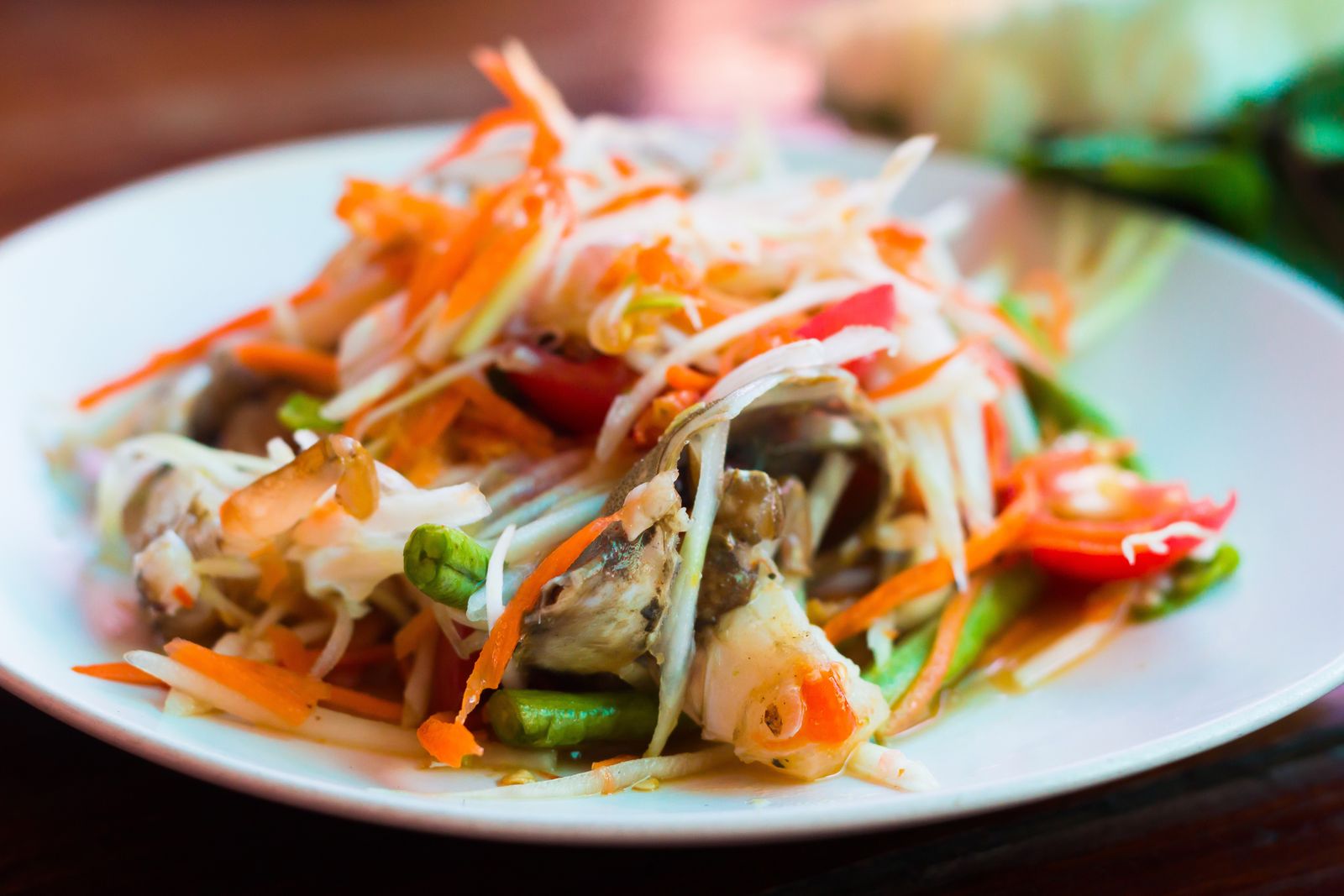
Bo katat (Si Sa Ket-style papaya salad)
A boldly flavored local som tam that's one of the province's signatures. The seasonings and the kind of heat set it apart from ordinary Thai-style tam, and you'll find it at local eateries around town.
Pla som & pon pla
From the Isan Lao side of the table, found in every kitchen. Pla som is fermented fish fried and eaten with sticky rice, while pon pla is a boiled-fish chili dip eaten with fresh vegetables — homey meals that fill you up and hit the spot.
Sticky rice + jaew + blanched veggies
The heart of every tribe's Lower Isan spread: hot sticky rice dipped in punchy jaew, eaten with blanched vegetables and grilled meats. It's the meal that shows every group eats much the same way — just seasoned by different hands.
Tilapia with sweet fish sauce & neem
A dish built on the tilapia the province is known for farming — fried crisp, drizzled with sweet fish sauce, eaten with blanched neem. A little bitter, a little sweet, and a plate that many local eateries do well.
Om & home-style offal soup
Lower Isan-style om curry with offal and meat, with seasonal e-rok and tiu greens. It's savory from the seasonings and lemon basil, and it's the kind of side you'll find at larb-koi eateries all over town.
Khao hang & Thung Kula jasmine rice
Si Sa Ket sits within the Thung Kula Ronghai plain, a source of top-grade jasmine rice. Khao hang is paddy that's steamed before milling, fragrant and high in nutrients. It makes a great souvenir to take home.
How to track down local food
Old dishes like lawaek katam and sao-ang aren't on every menu. The easiest time to find them is during the Lamduan Blossom festival in March, which has a four-tribe local food zone all in one place. Outside the festival, try asking local eateries in town or asking elders in the villages — many of these dishes need to be ordered ahead.
Festivals that still happen for real
If you want to see all four tribes come together in one place, a festival is your best shot, because the performances, food and woven textiles of all four groups end up under one roof. The biggest event and the province's landmark is the Lamduan Blossom festival.
Lamduan Blossom Festival — Si Sa Ket Four-Tribe Heritage
An annual event around March 11–15 at the Princess Mother's Park inside Si Sa Ket Agriculture and Technology College, timed to when the lamduan trees bloom and scent the whole garden. There are four-tribe cultural performances, a local food zone, and a market of woven textiles.
Light & sound show
The nighttime highlight of the Lamduan festival — the Sri Phruthethesuan civilization production, telling the story of the city's roots and faith. It runs in the evenings on the festival's final days, so check the schedule and book seats ahead.
Heet Sip Song merit-making + spirit-shrine rites
Beyond the big festival, each village still holds its own merit-making through the year — both the Lao merit cycle of Heet Sip Song and the san pu ta spirit-shrine ceremonies of the Yoe and Kuy. If your timing lines up, ask locals which village has an event on.
Making the most of the festival
The Lamduan festival gets crowded and the midday sun is strong, so go in the late afternoon into the evening to catch the performances and wait for the light-and-sound show at night. Bring cash to support local food and textiles straight from the community — prices are gentler than at souvenir shops.
Textiles and handicrafts of the four tribes
Another thing that captures each tribe's identity well is the weaving. Si Sa Ket has several lines of local cloth whose patterns and colors differ by group. The Yoe favor indigo-dyed silk; the Kuy and Khmer have their own mudmee and stamped-weave patterns. And the province's most famous of all is the volcanic-soil dyed cloth, which uses the area's red earth to produce its distinctive earth-tone shades.
- Volcanic-soil dyed cloth — the province's signature, dyed with volcanic earth from around Kantharalak–Khun Han for a soft reddish-brown. You'll find it at weaving groups and at festivals.
- Yoe indigo silk — a deep, plain indigo that's the signature of the Yoe groups around Rasi Salai and Phon Kho.
- Kuy–Khmer mudmee — traditional patterns tied to each village's beliefs and way of life, great for textile collectors.
- Kuy silverwork and craft — the Kuy are skilled craftspeople, so keep an eye out for silverwork and small handicrafts in the communities.
Where you can experience it yourself
Four-tribe culture can sound abstract, but there are real places you can walk into and experience it — museums, temples that reflect the diversity, and villages still living the old way.
Kuy People's Museum (Ban Ku, Prang Ku district)
A collection of objects and stories of the Kuy people, in Ban Ku, Ku subdistrict, Prang Ku district. It covers elephant lore, elephant keeping, and local wisdom — a good place to start understanding the Kuy before heading elsewhere.
Wat Phra That Rueang Rong (Mueang district)
A chedi blending all four tribes' art, with several floors inside. The lower level is a folk museum telling the ways of the Lao, Khmer, Kuy and Yoe, and you can climb up for a city view. It's near town and the easiest to drop by.
Princess Mother's Park (lamduan grove)
A public park with tens of thousands of lamduan trees, the venue for the Lamduan Blossom festival every year. Come in March and the blossoms scent the whole grove; outside the festival it's still a pleasant in-town spot for a stroll.
Yoe communities, Rasi Salai–Phon Kho
Areas where Yoe people still live and weave. If you really want to see the Yoe way of life, it's best to contact the community groups or go during a village festival, so you can witness the language and rituals for real.
Khom sanctuaries around Khukhan–Prang Ku
The heritage of the province's Khmer roots — Prang Ku and other sanctuaries in this area, most of them free to enter. You can wander and study the lintels and carvings at your ease — a place that links the Khom past to today's local Khmer people.
About the border
The cultural sights in this article are in safe areas and open as normal. But if you plan to continue on to Pha Mo I Daeng or the trail up to Preah Vihear in Khao Phra Wihan National Park, always check the park's latest announcements and the Thai–Cambodian border situation first, since there have been periods when tourism was temporarily closed. If it's still closed, stick to the in-town cultural route instead.
A two-day four-tribe culture trip
If you want to travel Si Sa Ket with culture as the main theme, two days and one night is just about right. Day one covers the town and the Khmer–Kuy thread over toward Prang Ku; day two follows the Yoe and the local food. Adjust the timing as you like, but a private car or rental is recommended since the spots are spread across several districts.
In town + Khmer–Kuy roots
Following the Yoe + local food
About getting around
The cultural sights are spread across several districts and public transport is limited, so this trip is easiest with a private car or rental. If you arrive by train or bus into the city, renting a car or hiring a driver for the day is the way to go — and if you intend to see community rituals or ways of life, coordinate with local groups beforehand so you don't disrupt the villagers' affairs.
Plan a full Si Sa Ket trip — find more places to stay, eat and explore
See the Si Sa Ket travel guide →