🔄 Updated 21 Jun 2026
A lot of first-timers aren't sure where to start in Surin, because almost all the highlights sit outside the city rather than clustered into one walkable district like most tourist towns. The thing that helps most is getting the big picture first — what Surin has and where it is — and only then planning your route. We'll walk through it one topic at a time, starting with when to come.
When Is the Best Time to Visit Surin?
Surin is good year-round, but the most comfortable stretch is the cool season, roughly November to February — cooler air, gentler sun, and you can walk the open-air temples without suffering. The hot season from March to May gets genuinely brutal in Lower Isan, so if you come then, stick to mornings and evenings and skip the midday heat. The rainy season from about June to October is green and quiet, but you'll need to factor in showers through the day.
The annual highlight is the Elephant Festival
If you want to see Surin as the elephant town it really is, aim for the Surin Elephant Round-Up, held every year in mid to late November at the elephant arena in town. There are elephant processions, shows with hundreds of elephants, and the famous elephant buffet banquet. This is the liveliest the city gets all year — but the trade-off is that rooms fill fast and prices climb. If you're set on coming during the festival, book your stay several weeks ahead.
Book the activities in your Surin trip ahead
Booking online ahead on Klook or GetYourGuide is usually cheaper than the gate and skips the queue. Pick only the experiences you actually want — prices and availability are shown live on each site.
How to Get to Surin
Surin sits about 450 km from Bangkok, with several ways to get there depending on your budget and time. The popular choices for first-timers are the train and the bus, because both drop you right in the city center with no long transfer.
- Train — the Lower Isan line from Bangkok to Ubon Ratchathani passes through Surin and stops conveniently in the city center, taking around 7–9 hours. It's great if you want a comfortable, budget-friendly ride, and an overnight sleeper gets you in by morning so you can head straight out.
- Bus — several departures a day run from Mo Chit, taking around 6–8 hours and dropping you at the Surin bus terminal in town.
- Self-drive — the most convenient way to tour Surin, since the main sights are outside the city. Take the Mittraphap Highway, then the Korat–Surin route, about 6 hours from Bangkok.
- Flying — Surin has no regular commercial airport, so most people fly into Buriram and drive on to Surin, about another hour. Good if you want to save travel time.
Getting around the province
Honestly, Surin is easiest with a car, because the elephant village, the temples and the silk village are in different directions and tens of kilometers from town. Public transport to these spots is limited and rarely runs on a fixed schedule. If you didn't drive in yourself, the smoothest option is to rent a car or hire one by the day from the city. Ride-hailing apps do exist in Surin but aren't as plentiful as in big cities, so don't plan to rely on them alone.
The Highlights Every First-Timer Should See
If you're here for the first time and want a Surin that feels like Surin, these five spots are the backbone, covering elephants, temples, silk and nature. You don't need to tick them all off in one trip — pick by how much time you have.
Ban Ta Klang Elephant Village
The heart of the elephant town — a Kuy community that has lived closely with elephants for generations. There's an elephant study center, an elephant museum, shows, and a feeding spot. It's the one place you can really see the bond between people and elephants up close.
Prasat Sikhoraphum
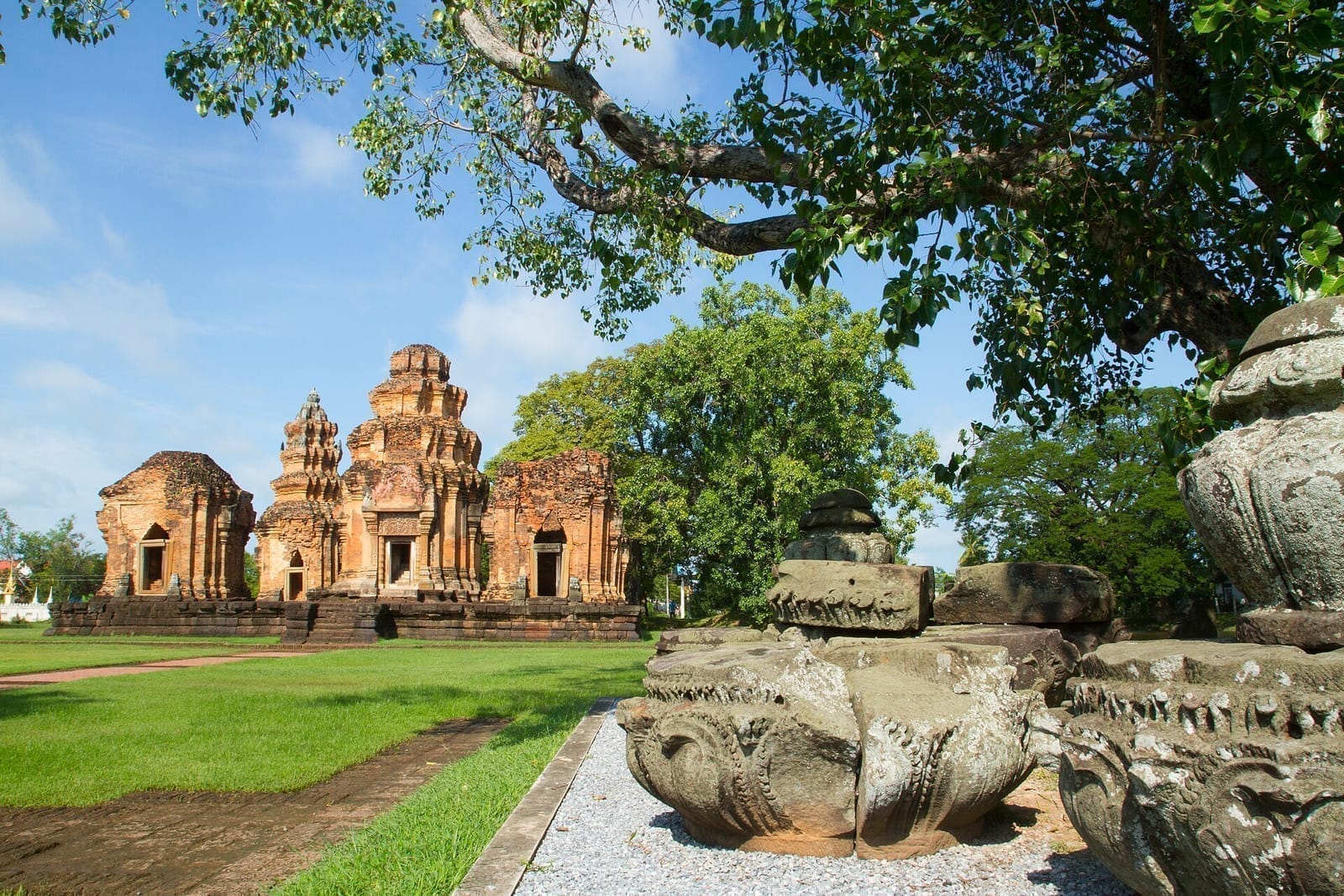
The most beautiful and best-preserved Khmer temple in Surin — five brick towers on a single base, with finely carved apsara lintels reminiscent of Angkor Wat. Come early for good light and fewer crowds.
Ban Tha Sawang Silk
A village known for high-grade gold-brocade silk that has woven cloth for important national occasions. You can watch the real hand-weaving on looms that take several people to work a single piece. Entry is free and you can buy silk to take home.
Phanom Sawai Forest Park
A low hill near town where locals go to pay respects and catch the breeze. There's a large Buddha image, a stone bell, and views over wide fields below. Best as a morning or evening stop to dodge the midday heat.
Huai Saneng Reservoir
A reservoir near town that locals call the Sea of Surin — open, easygoing, and great for sitting in the breeze to watch the sunset close out the day. There are waterside restaurants for a relaxed meal.
Beyond these five, the city itself has Wat Burapharam, the town's principal temple and home to Luang Pu Dulya, plus the Phraya Surin Phakdi monument — both easy stops to pay respects and snap a quick photo during the day, and easy to combine with a meal in town.
The Local Food You Have to Try
Surin is an Isan town, so the food is bold and satisfying, but it has one specialty many people don't know about: Vietnamese-style kuay jab, thanks to the local community of Vietnamese descent. On your first visit, start with these three.
- Vietnamese kuay jab — Surin's signature dish: chewy rolled noodles in a clear broth with minced pork, egg and Vietnamese sausage, eaten with Chinese crullers. A great light breakfast or lunch you shouldn't miss.
- Country Isan food — som tam, larb, nam tok, tom saep, grilled pork neck, grilled chicken with sticky rice. Easy to find at both old-school spots in town and the markets, with proper bold Isan flavor.
- Khanom jeen nam ya — a country breakfast of rice noodles in a rich curry sauce, eaten with plenty of fresh veg. Filling and cheap, and easy to find at the morning markets.
- Mu kratha — the dinner where locals get together: an affordable DIY grill-and-hotpot buffet, perfect for closing out a long day of sightseeing.
About the restaurants
Many of Surin's long-running Isan spots open only at certain hours and some sell lunch only. If you've got your heart set on a particular place, check its opening hours and days off on its Facebook page before heading out — it's more reliable. Don't trust old opening times from old reviews, because local spots change their hours often.
Souvenirs Worth Taking Home
Surin has souvenirs that are genuinely of the province, not the generic gifts you find anywhere. These three are the real deal.
- Surin jasmine rice — Surin is a source of high-quality jasmine rice with a geographical indication: fragrant and soft, a gift that never disappoints anyone and keeps for a long time.
- Si Narong single-clove garlic — single-bulb, single-clove garlic with a strong aroma and sharp flavor, a specialty from Si Narong district, sold both fresh and processed as pickled garlic.
- Gold-brocade silk — a bigger-ticket gift but well worth it. Buy it at Ban Tha Sawang for genuine hand-woven cloth — a great special gift or something to keep for yourself.
You'll find these souvenirs at gift shops in town and near the train station. If you want genuine silk at a good price, it's best to buy it right at Ban Tha Sawang village, while the in-town shops have plenty of rice and garlic to choose from.
Recommended Plans for First-Timers
If you'd rather not work out the route yourself, here are ready-to-use plans, already ordered to keep your time on the road to a minimum. There are two versions: two days, one night for a weekend, and three days, two nights for those with more time. Pick whichever fits your holiday.
A full day in the elephant town of Ban Ta Klang
Khmer temple, silk and souvenirs before heading home
Day three for more temples and nature
The Border Situation First-Timers Need to Know Before Planning
We have to be straight with you, because first-timers often run into outdated info: the Ta Muen Thom temple group and Chong Chom market that old blogs love to recommend aren't open as usual right now. They sit along the Thai–Cambodian border, which is still affected by the border situation — the crossing remains closed and the area is under military control. If you see old reviews inviting you on a day trip to Chong Chom, don't go by them; always check the latest news on the crossing's status first.
The good news is that all the main sights in this guide — the elephant village, Prasat Sikhoraphum, Ban Tha Sawang, Phanom Sawai, Huai Saneng and the in-town spots — are not along the border and can be visited as normal. On a first trip, just steer clear of the border zone, focus on the spots within the province, and you can enjoy Surin to the full without any risk.
Ready to book a place to stay or want to see more of what to do in Surin?
See the Surin travel guide →