🔄 Updated 21 Jun 2026
Before we get into the days, it helps to see the big picture and why the plan runs in this order. The four spots are spread across different sides of the province. The elephant village is the farthest, about 58 km north of town; Sikhoraphum Temple sits roughly 34 km to the east; Ban Tha Sawang and Huai Saneng are both close to the city. Good light at each one comes down mainly to timing. Elephants are fun to shoot in the late morning when there's a show and the elephants are out walking; the orange-brick temple glows warm in the early-morning or late-afternoon sun; silk shoots well indoors all day; and Huai Saneng only gives you golden light in the evening. So we've set it up as two days and one night, with each spot landing in its own light window — plus a single-day version for anyone short on time.
What this plan lets you photograph
The main plan is two days and one night. Day one hits the elephant village in the morning to catch the elephants out walking and the show, then drops down to Sikhoraphum Temple in the late afternoon when the brick is warm. Day two captures the silk at Ban Tha Sawang in the morning, then closes the trip at Huai Saneng in the evening for sunset. If you've only got one day, there's a condensed version that strings together the spots that pay off most. Every block can be shifted to suit your own pace.
Day 1 — Elephants + Sikhoraphum Temple
Morning at Ban Ta Klang Elephant Village for shots of elephants and the mahout way of life; late afternoon down at Sikhoraphum Temple for the brick towers and apsara lintels.
Day 2 — Silk + Huai Saneng at dusk
Morning shooting the gold-brocade looms at Ban Tha Sawang; afternoon rest in town; close the evening at Huai Saneng for sunset over the reservoir.
One-day condensed (if you're short on time)
Morning at Sikhoraphum Temple, a stop for silk at Ban Tha Sawang, then Huai Saneng for sunset — three different looks in a single day.
Book the activities in your Surin trip ahead
Booking online ahead on Klook or GetYourGuide is usually cheaper than the gate and skips the queue. Pick only the experiences you actually want — prices and availability are shown live on each site.
Day 1 — Ban Ta Klang Elephant Village, elephants and their mahouts
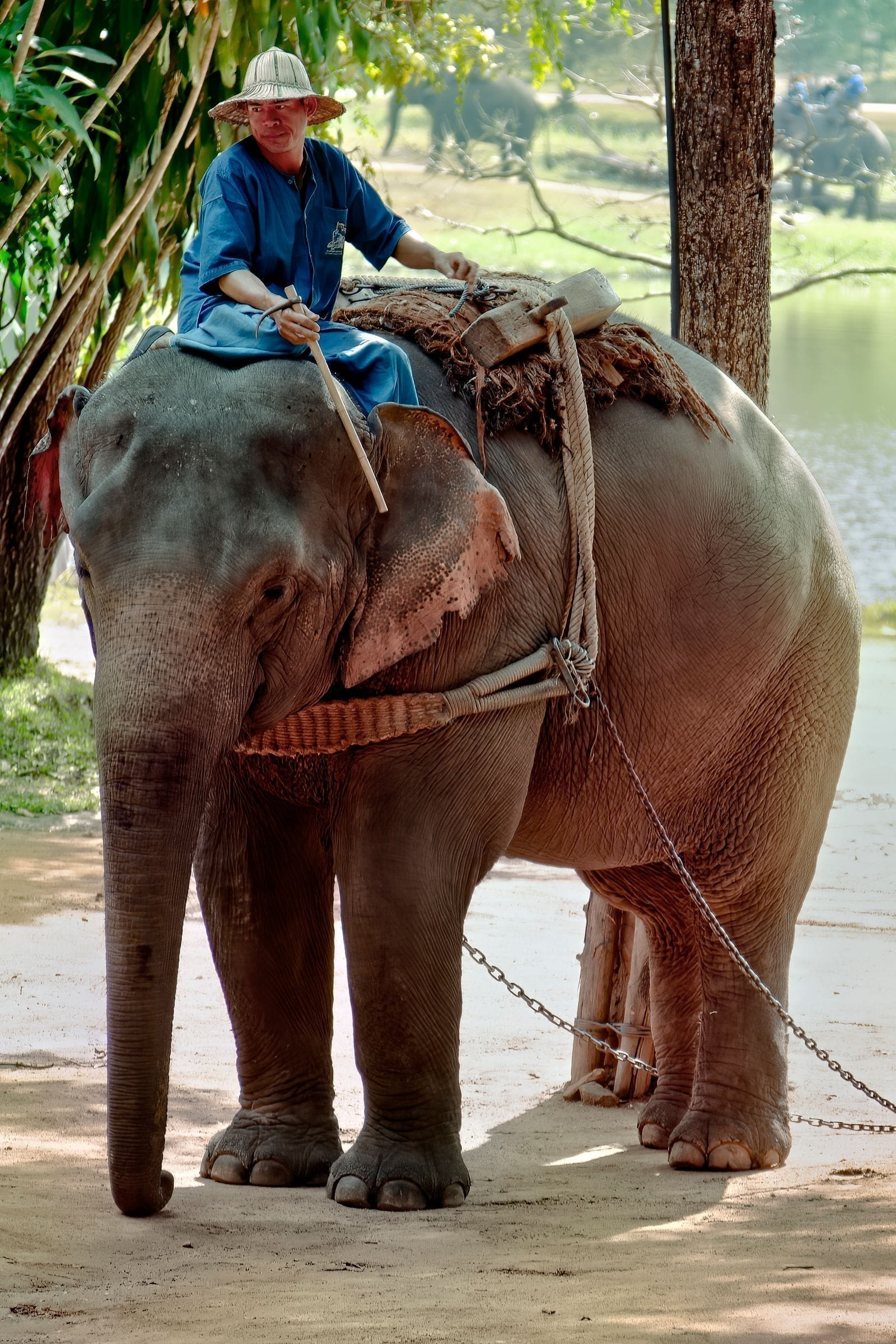
Day one starts at the farthest spot in the plan, Ban Ta Klang Elephant Village in Krapho subdistrict, Tha Tum district, about 58 km from Surin city — roughly an hour and a half by car. This is a Kui elephant-keeping village with hundreds of elephants living within the community, one of the largest concentrations in Thailand. The appeal for photographers is getting elephants together with their keepers in a real village setting, not a closed-off elephant camp; the elephants wander around the houses. There's an elephant study center where you can learn about them, plus an elephant show twice a day at 10:00 and 14:00. Open daily 08:00–17:00. Entry for Thais is 50 THB for adults, 20 THB for older children, 10 THB for small children; foreigners 100 THB.
The angle people shoot most is the elephants crossing the village clearing in the morning — you get the full elephant against the village backdrop. Another is during feeding, when an elephant reaches its trunk in close for a sweet close-up. The show itself is good for storytelling shots and catching the action. Morning light before ten is soft and not too hot, so if you make the 10:00 show you'll get both good light and all the elephants out.
Ban Ta Klang Elephant Village + Sikhoraphum Temple
How to photograph the elephants well and with care
The elephants at Ban Ta Klang are real village elephants that have lived with their keepers for years. When shooting, don't get too close or fire a flash in an elephant's face. Follow the mahout's lead on which ones you can approach and which to give space. If you want to feed one or shoot up close, have the keeper there with you — it's safer for both people and elephants. Shots taken from a respectful distance usually come out more natural anyway.
Sikhoraphum Temple — brick towers and Surin's finest apsara carvings
Sikhoraphum Temple sits in Rangaeng subdistrict, Sikhoraphum district, about 34 km east of town. It's a Khmer temple of five brick prang towers built on a single laterite base, with a moat on three sides. The draw for photographers is the carving. The lintel of the central tower depicts a ten-armed Shiva Nataraja in the dancing pose, considered one of the most beautiful and complete lintels in Thailand. The doorframe pillars are carved with apsaras holding lotus flowers and door guardians, detailed enough that people love shooting close-ups of the linework. Open daily 08:00–16:30. Entry is 10 THB for Thais, 50 THB for foreigners.
The popular angle is the full temple shot from the front, the eastern entrance side, where all five prang line up. If there's water in the moat during the rainy season you'll get a nice reflection. Another is standing close to a doorframe pillar and shooting the apsara with a person as the subject, for a more storytelling, historical feel. The light that makes the orange brick warmest is the early-morning sun before nine or the late afternoon after four — midday's direct sun is flat and brutally hot.
Day 2 — Ban Tha Sawang gold-brocade silk, color and pattern
Day two starts at the Ban Tha Sawang gold-brocade silk village in Tha Sawang subdistrict, Mueang district, close enough to town to reach in under half an hour. This is home to the Chansoma gold-brocade silk weaving group, famous for weaving silk in the old royal-court style using a huge number of heddles, to the point that it has woven cloth for major national events. You can watch the whole process from reeling and dyeing through to weaving on the loom, and there's a silk museum to look around. Open daily 08:30–17:00; watching the weaving is generally free.
For photographers, you can shoot here indoors all day without fighting the sun. The shot people take most is the weaver's hands with the gold silk threads on the loom — a detailed, craft-style image. Another is a large piece of gold-brocade silk, intense in color and dense with pattern, used as a backdrop or held as a prop. Natural light from the weaving-shed windows brings the silk's color out warm and sharp. If you want a souvenir, you can pick up a scarf or a small piece; prices run from a few hundred up to tens of thousands of THB depending on how fine the pattern is.
Ban Tha Sawang silk + Huai Saneng sunset
Getting the silk's color to come out right
Gold-brocade silk has metallic gold thread that catches light. A direct flash creates bright hotspots that wash out the pattern. Instead, turn the cloth toward natural light from a window or the weaving-shed door, then tilt it slightly so the gold thread catches the light in lines. The silk's color comes out warm and the pattern reads clearly. Including the weaver's hands gives the shot more of a story than bare cloth. Ask the weaver's permission before shooting up close — it's more courteous.
Huai Saneng — closing the trip with a reservoir sunset
Huai Saneng Reservoir in Chaniang subdistrict, just about 5 km from town, is a fitting place to close a photo trip. Locals call it the Sea of Surin because the water is so wide. The dam crest runs about 4 km as a paved road that's easy to walk and shoot from — water on one side, rice fields on the other. Entry is free. The highlight is the evening at sunset, when golden light spreads across the wide water for silhouettes and sky reflections — a warm tone that stands out on your feed.
The angle people shoot most is standing on the dam crest facing out over the water, getting a long horizon with the sun sinking into it. Another is shooting a person as a silhouette against the orange sky. If you want the full light, come and sit waiting from around 17:00, because the golden window arrives fast and fades quickly — give yourself time to set up and find your angle first. There are fish restaurants and cafes along the reservoir where you can sit and wait for the light.
The best light window for each spot
Whether a photographer gets the shot or not comes down mainly to timing the light. Elephants shoot well in the morning before ten, when the light is soft and you catch the show. Sikhoraphum's orange brick is warmest in the early-morning sun or after four in the late afternoon. Silk shoots well indoors all day. Huai Saneng has to be the evening, from five onward, to get golden hour. Avoid shooting in the direct midday sun, where images go flat and hot. That's why this plan times each spot to its own light window.
Restaurants and cafes along the way worth a shot
Beyond the four main spots, there are places to sit, rest, and shoot along the route to refuel through the day. We've picked ones that fall on this plan's path. Prices are rough ranges — check at the shop, since they shift by day and season.
Khrua Rim Chon Huai Saneng
A restaurant right on Huai Saneng that locals often recommend, with fresh fish and a punchy lime-steamed fish. Sit by the water in the cool breeze — it's a good spot to wait for the sunset light and frame the food with the reservoir view.
Voyage Cafe
A cafe on the Ban Khok side with a view over rice fields and Huai Saneng. Simple, warm decor with both an air-conditioned zone and garden seating, plenty of photo angles — good for chilling before heading out for the evening light by the water.
Cafes in Surin town
In town there are several specialty-coffee cafes with photogenic interiors — good for an afternoon break out of the harsh sun while you wait for the evening light. Grab a coffee to recharge before heading out to Huai Saneng.
Lower-Isan restaurants in town
Cap the day with a proper dinner. Lower-Isan spots in town do som tam, larb, koi, grilled chicken, and local Surin Khmer dishes — bright, colorful plates that shoot well for the feed, at friendly prices.
Straight talk on the spots along the way
The Huai Saneng waterside restaurants and the cafes around town are local places — hours and menus shift by day and season. Some only get busy in the evenings and on weekends, so if you come on a weekday afternoon you may find a few not yet open. Check the shop's page or call ahead, and if you're coming as a group on a weekend evening, leave buffer time for a table.
Only one day — how to get three different looks
If you've only got one day but want several different looks, cut the elephant village — the farthest spot — first, then line up the three spots on the eastern side and near town by the light. Start the morning at Sikhoraphum Temple while the brick is still warm, stop at Ban Tha Sawang silk in the late morning to shoot indoors, then close at Huai Saneng in the evening for sunset. You get a historical shot, a craft shot, and a landscape all in one day.
Temple + silk + Huai Saneng at dusk
Getting ready, getting around, and what to pack
On getting around: the four spots are spread across different sides, and there's no public bus that reaches every site directly. The smoothest way is to drive yourself or rent a car in town, since you'll be running between the elephant village to the north, the temple to the east, and the spots near town. If you're not driving yourself, hiring a car with a driver for the day is the easiest option for photographers — you can time things to the light and not worry about waiting for transport, especially out at the elephant village, which is farther from town than the rest.
- Base — stay in Surin town; it's easy to get out to each spot and come back to sleep in town.
- Getting around — driving yourself or hiring a car with a driver is smoothest; no public bus reaches every spot.
- Elephant village — about 58 km from town, open 08:00–17:00, elephant shows at 10:00 and 14:00, entry 50 THB for Thais.
- Sikhoraphum Temple — about 34 km from town, open 08:00–16:30, entry 10 THB for Thais.
- Ban Tha Sawang silk — near town, open 08:30–17:00, watching the weaving is free.
- Huai Saneng — about 5 km from town, free entry, best in the evening at sunset.
- What to pack — camera or phone with a spare battery, hat, drinking water, sunscreen, since several spots have little shade.
Dressing for the camera at each spot
If you want your shots to read as a matching set across the whole trip, pick solid colors that contrast with the scene. At the orange-brick temple and at Huai Saneng in the evening, white, cream, or light-blue tops stand out nicely against the background. At the elephant village and the silk-weaving shed, plain colors won't steal attention from the subject — avoid busy patterns that clutter the frame. Comfortable walking shoes matter, since you'll be on dirt clearings and the dam crest.
Plan the rest of your Surin trip — where to stay and what to eat
See the Surin travel guide →