🔄 Last checked 25 Jun 2026 · details and hours can change — check the venue before you go
📍 All restaurants on the map
Tap a pin for the spot + nearby stays
If you ask which neighborhood in Bangkok packs in the most to see, plenty of people give it to Yaowarat / Chinatown — because just a few blocks of walking can change the scene all day long. Start at the red-and-gold Chalermphrakiat Gate at the Odeon Circle, which acts as a welcome gate into Chinatown; next comes Yaowarat Road, or "Dragon Street," running about 1.5 kilometers and lighting up with Chinese neon signs along both sides once the sun goes down. Turn into the lanes and you hit Sampheng Market, a wholesale strip that's been trading for over a hundred years, old shrines tucked away in narrow alleys, riverside communities like Talat Noi full of street art and a vintage Fiat, all the way to Song Wat Road, where a younger crowd has turned old shophouses into cafes and galleries. The charm is that it's all clustered tight and walkable, no need to keep grabbing a ride. Whether you're here to make merit, take photos, shop or eat, you can do it all in one trip.
What makes Yaowarat special beyond other neighborhoods is the real thing you won't find anywhere else. Wat Traimit enshrines the "Golden Buddha," a solid-gold image weighing over 5.5 tons that Guinness records as the largest in the world, and the upper floor of the Phra Maha Mondop also holds the Yaowarat Heritage Center, telling the story of the Sampheng-Yaowarat Chinese community from its pioneer days · Wat Mangkon Kamalawat, or Leng Noei Yi, is an old Chinese temple where people stream in all year to clear bad-luck years and ward off misfortune, while Leng Buai Ia Shrine in Itsaranuphap Alley has ancient Chinese plaques dating to the Ming dynasty — some sources call it the oldest Chinese shrine in Thailand. And So Heng Tai Mansion in Talat Noi is a 200-year-old Chinese timber house whose central courtyard still runs a diving school you can watch over a coffee. All of this is why travel media around the world rank Bangkok's Chinatown among the neighborhoods you have to see at least once.
Wat Traimit Withayaram Worawihan (Golden Buddha)
If you want to start your Yaowarat trip with a little ceremony, Wat Traimit Withayaram Worawihan — known to everyone as the "Golden Buddha Temple" — is the most fitting place to begin. It stands tall on the corner of Charoen Krung Road and Mitthaphap Thai-Chin, near the Chalermphrakiat Gate and the Odeon Circle, like the first door before you step into Chinatown. The Phra Maha Mondop itself is a gleaming gold marble building in an applied-Thai style, eye-catching from a distance, and many reviewers say that just reaching the front of the temple already gets you several lovely photos. It suits the merit-makers, the history lovers and the foreign visitors who want to capture one of Bangkok's famous landmarks alike.
The unmissable highlight is the "Golden Buddha," Phra Phuttha Maha Suwan Patimakon, a Sukhothai-era image of pure solid gold weighing over 5.5 tons, recorded in the Guinness Book as the largest solid-gold Buddha in the world. Even more remarkable is the tale of its move, when the plaster casing covering the image cracked open and revealed the gold hidden for hundreds of years. Up in the mondop you can pay your respects to the actual image up close, while the lower floors hold the Yaowarat Heritage Center and an exhibition recounting the legend of the gold's discovery — a leisurely walk-through that brings the early days of the Sampheng-Yaowarat Chinese community vividly to life.
On the entry fee, there's a small thing to understand. Thais can go up to pay homage to the Golden Buddha in the mondop for free, while foreign visitors pay around 40 baht for the golden Buddha section, plus another 100 baht or so for the heritage center and exhibition — roughly 100–140 baht in total, which most reviews say is worth what you get to see. The mondop is open daily for prayers around 08:00–17:00, but the museum/heritage center closes on Mondays, so if you're set on seeing the full exhibition, avoid Monday.
The location is very easy to reach — it's just a few minutes' walk from MRT Hua Lamphong, or you can take a taxi/motorbike taxi and get off at the Odeon Circle. Once you've paid your respects, you can walk straight through into Yaowarat Road and roll on into an evening food tour without moving the car. Bear in mind it's a sacred site, so dress modestly, cover your shoulders and knees, and remove your shoes before going up to the mondop. It gets especially busy on holidays and during Chinese festivals, so coming a little earlier makes photos and prayers far more relaxed.
Wat Mangkon Kamalawat (Wat Leng Noei Yi)
When it comes to Chinese temples in the heart of Yaowarat, the first name that comes to mind is "Wat Mangkon Kamalawat," widely known as "Wat Leng Noei Yi." An old temple dating to 1871 on Charoen Krung Road, it's one of the most important Chinese Mahayana temples in Thailand. The temple is laid out in the style of a Chinese imperial palace, with a guardian-deity hall at the front, followed by the central ordination hall and the deity shrine. The architecture is southern-Chinese Teochew style, and the spot many love to shoot is the carved dragon woodwork and the tiled-roof finials done in remarkable detail. The contrasting red-and-gold backdrop looks great under bright daytime sun and during festivals when the whole temple is hung with lanterns — it suits the spiritual crowd, the merit-makers and people who love photographing architecture equally.
Most people come here to ask for blessings, clear a bad-luck year, ward off misfortune and pay homage to Cai Shen Ye (the God of Wealth), with the period after Chinese New Year especially packed. In the main shrine there are three large principal images, along with bodhisattvas and many other deities to pay respects to. Plenty of real reviews note that after the renovation, you can no longer light incense inside as you once could; it's pleasantly air-conditioned, so you can walk and pray without the heat or the sting of incense smoke. Some even say it feels "like stepping into China," because every corner is done in full detail.
On cost you can relax, because entry is free with no admission charge — just a donation box for those who wish to give, plus sets of incense, candles and bad-luck-clearing offerings you can buy outside the temple for anywhere from tens to low hundreds of baht per set. Getting here is very easy: take the MRT to Wat Mangkon station, leave by Exit 3 and walk on just 3-4 minutes more. It's open daily 06:00-18:00. We'd suggest coming in the morning or on a weekday if you want a calm atmosphere and lovely photos without the crowds.
This temple stays popular because it brings several things together in one place — ancient sacred heritage, the bad-luck-clearing rite people trust, a heart-of-Chinatown location where you can walk straight on to the great Yaowarat food, and Chinese-style photo angles that look good in every season. The thing to know is that during Chinese New Year and the vegetarian festival it gets extremely crowded and parking around the temple is limited, so coming by MRT is more convenient, and you should dress modestly since it's a sacred site.
Yaowarat Road (walking street / night street food)
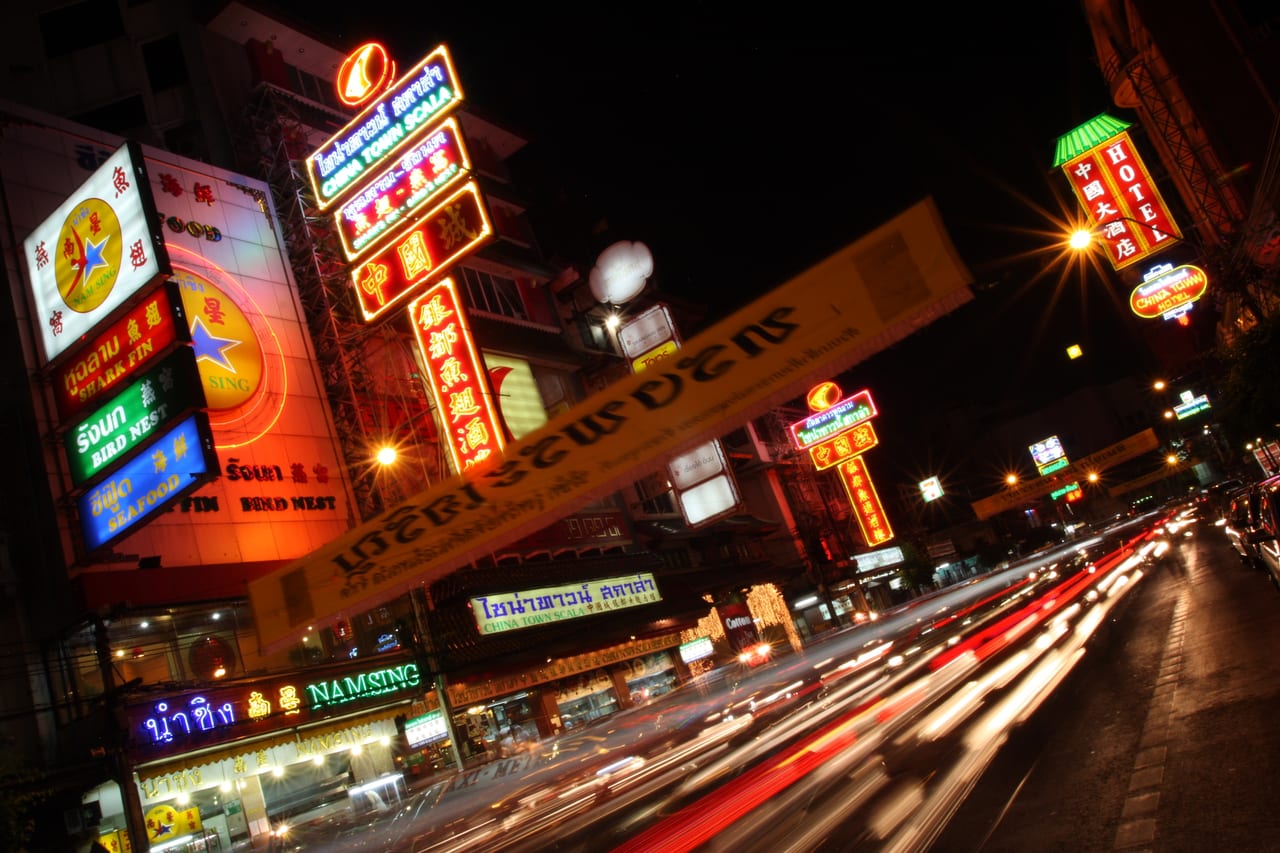
If you're after the image of nighttime Bangkok the whole world talks about, Yaowarat Road is the answer — the Dragon Street running about 1.5 kilometers through the heart of Chinatown. By day it's a quiet stretch of gold shops and dried goods, but once the sun sets the Chinese neon signs along both sides light up the whole length, turning it into both an iconic night photo spot and a foodie heaven at once. It's perfect for anyone who wants to graze their way along, couples into photos, groups of friends, and foreign visitors who want to see the Bangkok that never sleeps. Google gives it 4.6 stars from over 1,700 reviews, with most agreeing the atmosphere is buzzing and there's more food than you can finish in a single night.
The unmissable highlight is the photo angle in the middle of the road in the early evening, with the red-and-yellow Chinese signs lined up as a backdrop — many come specifically to capture that vintage red tone here. On the food side there's a long line of stand-outs, from stir-fried chicken noodles, fish congee, shark fin and bird's nest, wonton noodles, braised goose, fish balls and roasted chestnuts, all the way to sweets like glutinous rice balls in ginger syrup and tao tueng. Legendary big-name spots like Jay Fai, Thip Samai and Hua Seng Hong are around here too, and if you like trying the unusual there's fried insects to take on. Walk from one end of the street to the other and there's something to stop for at nearly every step.
The road itself is free with no entry charge — the budget comes down to how much you eat. Most street-food dishes run around 50–150 baht, while seafood spots or special dishes like shark fin climb into the hundreds to the thousands. One thing real reviews point out is that Friday-Saturday nights get so crowded the walking slows to a crawl, some famous spots have queues, and a few roadside stalls don't post prices, so ask clearly before ordering. If you want an easier stroll, try a weekday or a Monday night when it's less crowded.
The location is in Samphanthawong district, from the Ratchawong intersection to the Chaloem Buri intersection, easiest to reach by MRT — get off at Wat Mangkon station and walk a few minutes to the top of the road, or get off at Hua Lamphong and walk about 500 meters. The real charm kicks in from 6pm onward, when the stalls go up and the lights come on. This place stays endlessly popular because it brings over 200 years of Chinese history, the colored lights of night, and street food that world media rave about all into one spot. Come, and you go home with both lovely photos and a full stomach.
Chalermphrakiat Gate (Odeon Circle / Chinatown Arch)
If you're after the clear-cut "starting point" of Yaowarat, this is the place — the Chalermphrakiat Gate in the middle of the Odeon Circle, where Yaowarat, Charoen Krung and Mitthaphap Thai-Chin meet. The red-and-gold gate stands about 12 meters tall, made of granite imported from China, topped with twin dragons facing each other. Yaowarat locals call this the "dragon's head," because the whole of Yaowarat Road is likened to the winding body of a dragon. It was completed and opened on 5 December 1999 to mark the 72nd-birthday celebrations of King Rama IX. It suits the photo crowd, the landmark lovers, and anyone who wants one lovely shot to open a Chinatown trip.
The angle almost everyone comes to capture is standing on the circle side and framing the red gate with the "golden spire of the Phra Maha Mondop" of Wat Traimit (the Golden Buddha Temple), just a few hundred meters away, as the backdrop — getting both red and gold in one shot. Travelers' reviews all agree it's lovely by both day and night; in the evening the gate is lit a warm orange-gold, cutting against the neon shop signs along both sides of the road, an image of Yaowarat many will recognize. If you like a buzzing atmosphere, we'd suggest coming from dusk into the night when it's crowded and the lights are beautiful, then walking straight on into Yaowarat for street food.
The gate is public space in the middle of the circle, free to visit and photograph with no entry charge, open to see 24 hours a day. The budget for the whole trip comes down to transport and the great food nearby. The easiest way to get here is the MRT Blue Line, getting off at Wat Mangkon or Hua Lamphong and walking on, because traffic around here is heavy and parking is very hard to find — many reviews warn alike not to drive yourself unless you have to.
One thing to know: the gate sits "in the middle of the circle" with traffic going around it constantly, so to get close or cross over to photograph it you need to watch the cars and wait for the right moment at the lights. Most people shoot from the footpath on the Wat Traimit side or from the mouth of Yaowarat, which already gives you the full composition. Once you've arrived and grabbed a couple of angles, you can stroll straight into Yaowarat at ease. It's a Chinatown-opening landmark you shouldn't miss.
Talat Noi
Talat Noi is an old Chinese community along the Chao Phraya, just down from Sampheng toward the Samphanthawong district. Walk into Charoen Krung Soi 16-22 and you find another world — narrow, winding lanes full of street art on the walls of old houses, old engine repair shops (the Sieng Kong yards), and the everyday life of the neighborhood still going on right beside the art. It suits the photo-walkers, the cafe crowd, and anyone who wants to see another side of Bangkok that isn't staged. Reviews agree the draw is that "you find art whichever way you turn," with an old atmosphere that's still alive.
The unmissable thing is the "vintage Fiat" (an orange Fiat 500) parked rusting by a brick wall near So Heng Tai Mansion, which has become the neighborhood's signature photo spot and the first image that comes up when you search it on Google Maps · next is the street-art wall in Charoen Krung Soi 22, with work by both Thai and foreign artists (several pieces from the 2016 Bukruk festival), So Heng Tai Mansion, a 200-year-old Hokkien Chinese house with a diving pool in the middle, and the Sieng Kong yards lining up old engines into a raw, accidentally lovely scene.
The neighborhood itself is free to wander with no entry charge — the art walls and the Fiat are in public space open 24 hours a day (So Heng Tai Mansion/cafes have their own hours and some ask you to order a drink), so the real budget comes down to coffee and snacks as you like. It's located in Samphanthawong district near Yaowarat, walkable from MRT Wat Mangkon, or take the Chao Phraya Express Boat to Ratchawong pier and walk on about 10 minutes. The midday sun is fairly strong, so reviewers suggest coming in the morning or late afternoon for easier photos and fewer crowds than on weekends.
The popularity shows in a Google score of around 4.5 from several hundred reviews, with people loving that it's a "real" neighborhood rather than a built-up tourist spot. The thing to know is that the lanes are narrow and locals' cars and motorbikes pass through, so step aside and photograph with respect for a residential space — some corners are people's actual homes, and not every wall is one you can go into — and comfortable shoes help a lot, as the old lanes are uneven underfoot.
🛏️ Find a stay in Yaowarat-Chinatown and explore morning to night without rushing back
Yaowarat is a neighborhood you can explore from morning prayers, through the daytime markets, all the way to the street food after dark — stay over a night and you can take in the temples, Talat Noi, Song Wat and Dragon Street without hurrying · the area has stays for every budget, from stylishly designed hostels in old shophouses starting in the low hundreds, to boutique hotels and branded riverside properties. Most are walkable to MRT Wat Mangkon or Hua Lamphong, making it easy to carry on to Sao Ching Cha, Siam or the airport · we've picked the good-value stays in Yaowarat-Chinatown and compared prices across 3 sites for you. Book ahead during Chinese New Year or high season for better rates and to be sure of a room.
Sampheng Market
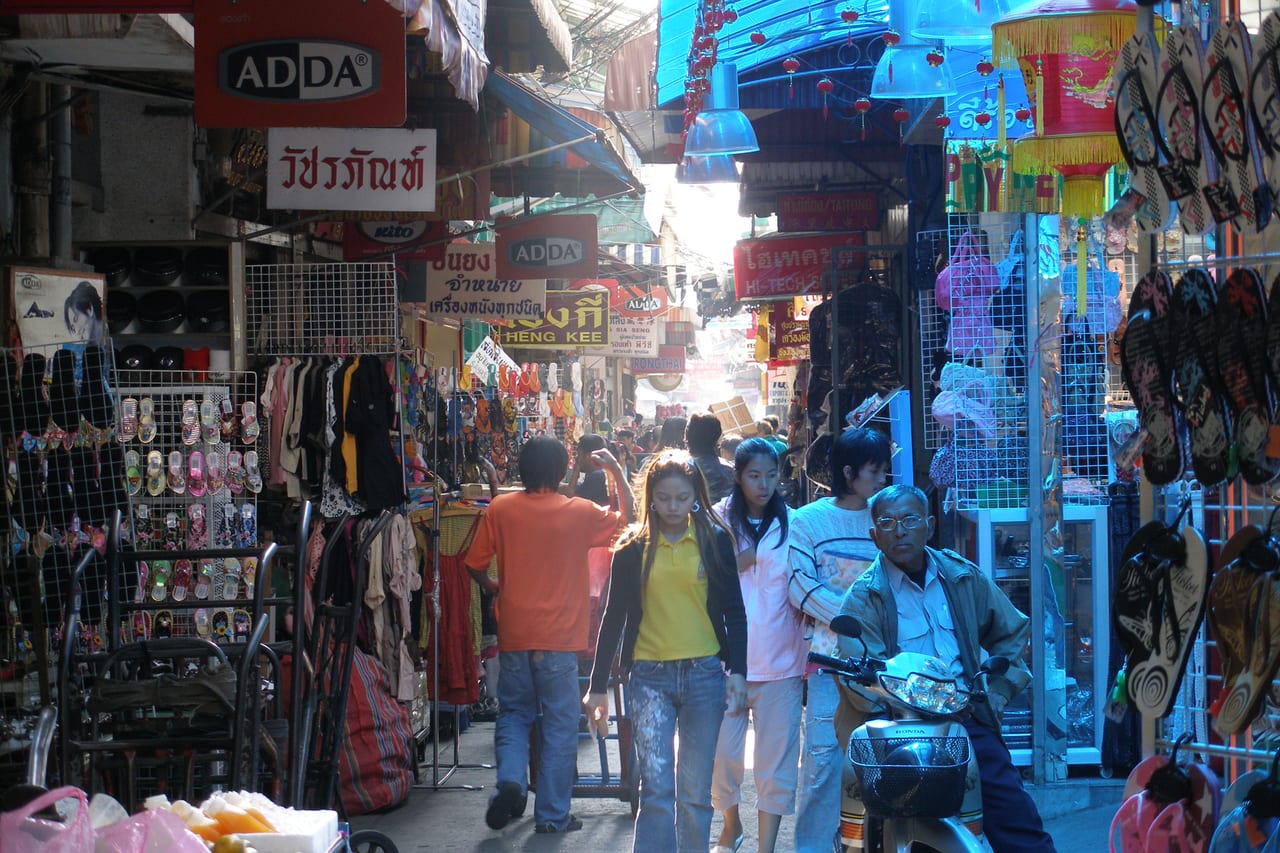
Sampheng Market is a legendary wholesale alley that has run alongside Yaowarat for over a hundred years — a narrow lane (Soi Wanit 1) you walk through one or two people at a time, packed on both sides with wholesale shops from one end to the other. If you love squeezing through a crowded market the real Chinatown way, this is heaven. On Google it gets 4.4 stars from over 1,000 reviews, with many agreeing the goods really are cheap, especially if you buy by the dozen or the pack. It suits online sellers, people hunting for shop decor or wedding favors, and anyone who simply wants to wander and soak up an old downtown market atmosphere.
The goods are roughly split into zones — one side leans toward stationery, gifts, toys, cards and gift boxes, the other toward accessories, hair clips, earrings, necklaces and cosmetics, with fabric, party supplies, balloons, phone cases and ribbon tucked in everywhere. The must-do is to compare prices across 2-3 shops before buying, because a lot of the same goods repeat down the whole alley but prices move, and don't forget to stop at the street food among the stalls — both snacks and cold drinks to cool off as you walk.
Entry is free with no charge — the budget comes down to how much you carry home. Small items start in the tens of baht, and buying by the dozen makes them cheaper still. It runs parallel to Yaowarat Road, about a 5-10 minute walk from MRT Wat Mangkon. The market has two shifts: daytime, 8am-5pm, suits tourists and first-timers because the shops are fully open with goods on clear display, while the night shift until around 2am is genuine bulk wholesale by the case, busier and requiring large quantities.
It stays endlessly popular because it's the source of cheap goods that get resold across the whole country. The thing to know is that the alley is narrow, the crowds are heavy, and pushcarts of goods are passing through the whole time, so watch your bag and valuables, expect it to be hot and a bit of a squeeze, wear comfortable shoes, carry cash, and allow plenty of time to walk. You'll go home with a haul on a budget that beats buying retail anywhere else for sure.
Song Wat Road
Song Wat Road is an old trading street about 1.2 kilometers long, running parallel to Yaowarat and along the Chao Phraya, behind Sampheng in the Samphanthawong district. It used to be a quiet stretch of warehouses and dried-goods shops that tourists walked past without noticing, but in the last few years a younger crowd has joined hands with the veteran shophouse owners under the name "Made in Song Wat," gradually turning the old buildings into cafes, craft shops and galleries. From a starting point of 10 shops in 2022, it's now grown to over 60. It suits the photo-walkers, the cafe-hoppers, and anyone who wants to see an old neighborhood from a fresh angle. In 2023 Time Out magazine even ranked Song Wat among the coolest neighborhoods in the world, pushing its name out to foreign visitors too.
The unmissable highlight is the street art along the whole street, especially the black-and-white elephant by the artist ROA, which is a photo landmark. Step into the little lanes and you find galleries like PLAY art house, which is free to enter, while the cafe crowd has plenty to choose from — Songwat Coffee Roasters for specialty coffee, Aiga, a two-story restaurant-cafe known for its desserts, A Pink Rabbit + Bob with lovely pastry, and matcha spots like CÉRÉMONIALE up a narrow staircase in an old building. The charm here isn't luxury but the raw feel of the original buildings paired with sharp design, chill and photogenic all the way down. Real Google reviews score it around 4.5 stars, mostly praising the lovely art walls and the shops' character.
On budget, walking the street to see the street art is free with no charge, but to sit in a cafe drinks run about 80–150 baht, with desserts in the same range. To get here, take the MRT Blue Line to Wat Mangkon station, Exit 1, then walk on a little. The best time is mid-morning to afternoon, since most cafes and galleries open around 10:30–18:00, with a few long-running old restaurants opening from about 9am. By early evening many shops start closing, leaving only a few riverside bars buzzing on.
The thing reviews agree on is that Song Wat is still a working trading street with traffic, narrow footpaths and a bit of disorder in places, so walk with a little care for the cars, and on weekdays some shops may be shut — we'd suggest checking the opening days of the spots you want, and dodging Monday-Wednesday when some cafes close. Coming mid-morning on a weekend gives the best atmosphere, with all the shops open, lovely light, and not too packed. Easy to pair with Yaowarat or Talat Noi in a single day.
I'm Chinatown
If you're out walking and eating around Yaowarat and run into sun or rain, I'm Chinatown is the most convenient air-conditioned escape. It's a Modern Chinese-style mixed-use building several stories tall, standing among the old buildings of the neighborhood; inside, the first 3 floors are a community mall with restaurants, cafes, big-name shops and familiar brands, while the upper floors hold the ASAI hotel and a condo. The spot many come to check in at is the dragon's head and the contemporary Chinese decor corners that photograph well. It suits anyone exploring Yaowarat who wants a proper place to sit and rest, families, and people driving in, since it's just steps from MRT Wat Mangkon, Exit 1.
The unmissable highlight is the food zone spread across about 2 floors — separate individual shops rather than a combined food court — from boat noodles, noodles and dim sum, all the way to big names like MK, Yayoi, Hachiban Ramen, KFC, Starbucks, Krispy Kreme, ChaTraMue, and a large Yi Fang bubble-tea branch. If you like sweets there's Mixue at easy prices, and several reviews mention the mango-kiwi smoothie at around ~50 baht a cup as good value. Beyond food there's Daiso, Watsons, a Let's Relax spa and Jetts Fitness, a 24-hour gym, so you can do it all in one building.
On cost, entry is free with no charge, and the food budget runs in the low hundreds per meal depending on the shop you pick. The car park holds over 300 cars, open 24 hours at around 40 baht/hour, with free periods under the mall's promotions. The mall itself opens 10:00–21:00 daily. The location is a big advantage, since you walk from MRT Wat Mangkon without baking in the sun, and it's near Wat Mangkon Kamalawat and Wat Traimit, ready to carry straight on into Yaowarat.
It's popular because it's a rest stop that fits a Yaowarat trip nicely — by the rail, air-conditioned, with clean toilets on the 2nd floor and 24-hour parking. The thing to know is that the scale is a compact community mall, not a big shopping center, so don't expect the sheer number of shops you'd get at Siam. Come to escape the heat, sit and rest, eat well and grab some Chinese-style photo corners, and you'll get the most out of it. During Chinese New Year and the vegetarian festival it gets especially crowded.
Leng Buai Ia Shrine
Leng Buai Ia Shrine (龍尾古廟) is a Teochew Chinese shrine that many call the oldest Chinese shrine in Thailand. It hides in Itsaranuphap Alley (Charoen Krung Soi 16) in the Sampheng-Yaowarat area, just a short walk along a narrow lane past the market stalls. It suits the spiritual crowd looking for a mystical, quiet spot amid the chaos of Chinatown, and people who love genuine ancient Chinese architecture, not newly made replicas. The principal deity is "Leng Buai Ia," the dragon-tail deity, enshrined alongside his wife.
The unmissable highlight is the shrine itself — a single building with a glazed-tile roof, two ceramic dragons facing each other on the ridge, and the entrance pillars wound with dragons, all very finely modeled. Many reviews praise the shrine as small but lovely and beautifully maintained. The ancient Chinese plaques inside date back to the Ming and Qing dynasties, there's an old bell, and most special of all is an incense burner bestowed by King Rama V. People come to pray for prosperity in trade, for wealth and fortune, and anyone whose children are hard to raise comes to ask for easy child-rearing, while those without children yet come to ask of Jiu Tian (the Goddess of the Ninth Heaven), who has lately become well known for granting children.
The atmosphere inside is solemn and calm, the smell of incense hanging against the bustle of the street outside. Entry is free with no charge — just bring a small amount for incense and candles. It's open daily around 07.00-17.00. It's close to MRT Wat Mangkon (Wat Mangkon station), an easy walk on, and it's on the same line as other shrines in Yaowarat, so you can pay homage at several in a row.
One thing to know: the alley is fairly narrow and a touch hard to find, so look for signs or ask the people around. The shrine is a sacred place still used for actual rituals, so dress modestly, be composed, and photograph with respect. During Chinese New Year and important worship days it gets especially crowded — lively, but more packed than on a weekday.
So Heng Tai Mansion
If you're wandering Talat Noi and want a corner that feels like you've stepped into an actual Chinese film, "So Heng Tai Mansion" is an unmissable pin. It's a timber mansion of an old Chinese family that has stood with this neighborhood for over 200 years (several sources date it to the early Rattanakosin era), built in the "four wings around a courtyard" form — two-story timber houses on all 4 sides enclosing a stone courtyard in the middle. The whole house is made of Chinese-carved timber with barely a nail used. The current descendants still actually live here and open part of it to the public as a semi-cafe. It suits architecture lovers, vintage-photo fans, and anyone who wants to escape the chaos of Yaowarat and sit quietly for an hour.
The highlight that sets this apart from any other old house is the "pool in the middle of the courtyard," which the descendants dug to run as a diving school back in 2004. The sight of a diving pool sitting in the middle of an ancient Chinese timber mansion is so unexpected it's become the signature. Some reviews say bluntly it "doesn't quite fit," but many feel the charm lies precisely in that one-of-a-kind quality. Order a drink downstairs and you can walk up to see the upper wings; the best photo angles are the red timber doors, the Chinese lanterns, the wooden stairs and the balcony looking down on the courtyard pool, with the light from mid-morning to afternoon at its loveliest.
On the entry fee, it's 50 baht per person, which you can redeem for a drink — effectively a maintenance fee for the old house. The menu is simple coffee and tea: a latte/cappuccino around 90 baht, Thai tea around 80 baht, lime soda around 60 baht. You don't come here to eat seriously but for the atmosphere. It's located in Soi Wanit 2 (Soi Duang Tawan), deep inside Talat Noi, and many reviews warn the entrance is a little hard to find, almost easy to lose in the lane, so we'd suggest opening a map and following the pin. It's open daily 09:00–18:00, closed Mondays.
The Google score sits around 3.8 from over a thousand reviews, a fairly mixed rating, because people expecting a polished, pretty cafe may be let down by the worn, aged condition of the house. Some criticize the drinks as pricey for the taste, but if you see it as paying to walk through a living 200-year-old Chinese house, it's worth the experience. The thing to know is there's no parking on site — most people park at River City (about 600 meters away) or take the MRT to Hua Lamphong then walk/grab a motorbike taxi into Talat Noi — and dress a little modestly, since it's still a house where people actually live.
🎟️ Book Yaowarat tours & tickets ahead (food tours / Chinatown tours)
Yaowarat is a lot more fun with someone to walk you around or queue for you — especially if you're in a group or it's your first time and you don't know where to start · evening Yaowarat street-food tours come with a guide who takes you from one stand-out spot to the next, telling you the story behind each dish so you don't waste time wandering to find it yourself · the temple-and-prayer crowd has half-day Chinatown tours that take in Wat Traimit, Leng Noei Yi and Talat Noi with someone to explain the history · and if you want an evening Chao Phraya cruise or to book tickets ahead and skip the queue, pick a package through Klook and GetYourGuide. Booking online ahead is more convenient and usually gets you a better price than on the spot.
💡 Know before you visit Yaowarat-Chinatown, Bangkok
Taking the MRT Blue Line to Wat Mangkon station is the most convenient — from the station you can walk straight to Wat Mangkon, Sampheng and Yaowarat Road, while Wat Traimit is near MRT Hua Lamphong · within the neighborhood the streets are narrow and traffic is heavy, especially in the evening, so walking or calling a Grab is smoother than driving yourself.
Large restaurants, cafes and malls like I'm Chinatown take cards and QR payment, but the street-food stalls on Yaowarat Road, the wholesale goods in Sampheng and the small shops in the lanes mostly take cash only — keeping small ฿20–100 notes on hand is the most convenient.
Wat Traimit, Wat Mangkon, Sampheng and Talat Noi are pleasant to explore in the morning to afternoon, before the crowds and the worst heat · while the charm of Yaowarat Road's street food comes in full after 17:00, when the stalls open and the neon signs light up. Plan to finish on the eating side in the evening for the best atmosphere.
Wat Traimit, Wat Mangkon and the various shrines are sacred sites, so dress modestly, cover shoulders and knees, remove your shoes where required, and keep your voice down · in old narrow-alley shrines like Leng Buai Ia, photography is fine but avoid disturbing people who've come to pray for blessings.
Wat Traimit, the Yaowarat Heritage Center and the larger malls and cafes have English information signs and menus, so foreign visitors get around easily · but many street-food stalls and wholesale shops in the lanes speak mainly Thai and Chinese, so pointing at pictures or using a translation app makes ordering easier.
Wat Traimit closes on Mondays and charges foreigners an entry fee (around 40–140 baht), So Heng Tai Mansion closes on Mondays too, while I'm Chinatown usually closes on Thursdays · check the opening days and times with each spot's page again before you go so you don't make a wasted trip, especially if you're coming early in the week.
📋 Plan a worthwhile day in Yaowarat-Chinatown
Start a little early at Wat Traimit Withayaram to pay homage to the Golden Buddha and head up to the Yaowarat Heritage Center on the 2nd floor (open Tuesday-Sunday, closed Monday), then walk out to capture the Chalermphrakiat Gate at the Odeon Circle — the best angle frames the red gate with the golden spire of the Phra Maha Mondop as the backdrop. Follow with Wat Mangkon Kamalawat (Leng Noei Yi) to pray and clear a bad-luck year, which sits right by MRT Wat Mangkon.
Mid-morning to afternoon, slip into Sampheng Market to sweep up cheap wholesale goods, stop at Leng Buai Ia Shrine hidden in Itsaranuphap Alley, then walk the long way to the river to take in Talat Noi for street-art and vintage-Fiat photos, with So Heng Tai Mansion to sip a coffee in a 200-year-old Chinese house, followed by the old-building cafes of Song Wat Road · close out the evening at Yaowarat Road under the neon signs, taking on the street food in full (stalls start buzzing after 17:00). If you want to escape the heat, stop by I'm Chinatown for the air-conditioning along the way.
Exploring Yaowarat right into the night? Staying over in Chinatown for a night is far easier — wake up to make merit in the morning, walk the daytime markets, then take on the street food of Dragon Street after dark without rushing back. We've picked the stays in Yaowarat-Chinatown within walking distance of MRT Wat Mangkon, with prices compared across 3 sites.
See Yaowarat-Chinatown stays →