🔄 Last checked 25 Jun 2026 · details and hours can change — check the venue before you go
📍 All restaurants on the map
Tap a pin for the spot + nearby stays
The reason people keep coming back to Loei starts with the atmosphere. This is a mountain province that stays cool through most of the year, with the Mekong River stretching along the Lao border. Chiang Khan is the heart of the slow-travel scene here — the old wooden street along the Mekong transforms into a walking street every evening, and dawn brings alms-giving for sticky rice in front of the guesthouses. For nature people the options go wide: Phu Kradueng demands you hike up and earn the view, Phu Ruea holds the coldest mornings in Thailand when winter comes, and sea-of-mist viewpoints like Phu Thok and Phu Pa Po mean early alarms and mist rolling over the valley below. Mountains, Mekong, ancient temples — all in one province.
Several places on this list have gone from local knowledge to national landmarks. The Chiang Khan Skywalk at Phu Kok Ngiu is a glass-floor walkway extending 80 m above the Mekong, where you can look down and see the Wang River run into the Mekong in a two-tone boundary line — Thailand on one side, Laos on the other. Phu Pa Po earned the name "Loei's Fuji" because looking at Phu Ho from the viewpoint, the conical mountain against misty air genuinely does look like Fuji. And for history and culture, Phra That Si Song Rak in Dan Sai is a 460-year-old Lan Chang stupa built as a pledge of peace between Ayutthaya and Lan Chang — a place where wearing red anywhere near the shrine is still forbidden, as it did when the vow was made. Plan your route, pick your zones, and go.
Chiang Khan Walking Street
If you had to describe Chiang Khan in one image, it would be this street — the riverside walking street, a narrow road lined with two-storey wooden shophouses over a hundred years old that transforms into a market every evening. The full length of it becomes eat-and-stroll territory for well over a kilometre. It works for slow travelers, couples, families, or groups looking for something genuinely unhurried. People who have been consistently say the charm is the "calm atmosphere" that rarely survives at more popular destinations.
The highlights: street food on both sides of the walk, especially grilled skewered river prawns, khao ji (grilled sticky rice), coconut sweets, and miang kham. Mixed in are wooden café-houses and handmade souvenir shops. The riverside walkway behind the main street is a favourite sunset spot with views across to Laos. The one truly Chiang Khan ritual is the morning alms-giving — sticky rice offerings around 05:30–07:30, with merit sets for sale along the street. Longtail boat trips on the Mekong and bicycle rides through the old quarter are also available.
Free entry — no admission. What you spend depends entirely on how much you eat and buy. The street opens every evening from approximately 17:00–22:00. Crowds peak after 18:00 when the air cools. High season (November–February) is ideal weather but hotels fill fast — book ahead. On walking-street evenings the road is closed to vehicles; park at a temple nearby and walk in. Early morning is a completely different mood from the evening crowd.
Worth knowing: high season from November–February has the best weather but fills hotels fast — book accommodation ahead. On walking-street evenings the road is closed to vehicles; park at a nearby temple and walk in. An early morning walk gives you a completely different, quieter Chiang Khan from what you get at night.
Phu Kradueng National Park
If you listed the mountains Thais most want to climb at least once in their lives, Phu Kradueng is near the top. It's Thailand's second national park, located in Ban Si Than, Phu Kradueng District, Loei. The appeal is a mesa-top plateau — flat on top, covered in grassland and pine forest that you can explore for a full day. The hike is real but accessible to beginners who are prepared and determined.
The ascent begins on the "Lang Pae" trail — 5.5 km, with iron-rung sections on the steepest parts. At the ridge you hit the "Dragon's Back" (San Lang Mangkon), a spine of exposed ridgeline that feels like you're walking along one. From there it's about 3.5 km more across the plateau to the visitor centre and camping area. The two viewpoints not to miss: "Pha Lom Sak", the iconic jutting rock ledge with a signature pine tree pair — the best sunset in the park. And "Pha Nok Aen" for sunrise and the sea of mist. Google reviews rate it 4.7 from over 4,300 reviews; the most common verdict is "legs aching the whole way up, but the views made every step worth it."
Entry fees: Thais 40 THB adults / 20 THB children; foreigners 400 THB. Porters are available at 30 THB/kg if you prefer not to carry heavy loads. On top there are campsites, rental tents and bungalows, restaurants, and shower facilities. Winter nights at the summit drop to 13–15 degrees Celsius — bring warm clothing.
Critical planning info: the park is open only 1 October–31 May and closes 1 June–30 September for forest recovery. Peak season is late October to February. Book accommodation and campsites in advance; start your ascent early as the entry checkpoint closes around midday. Wear shoes with good grip since the trail is steep and can be slippery. Budget at least 2–3 days to reach all the major viewpoints comfortably.
Chiang Khan Skywalk (Phu Kok Ngiu)
The Chiang Khan Skywalk, also known as the Phu Kok Ngiu Skywalk, is a glass-floor walkway that extends over a cliff face above the Mekong River — 80 m above the water surface, roughly the equivalent of a 30-storey building. The bridge span is approximately 100 m long and 2 m wide, with three circular glass-floor zones where you stand directly over the water. Anyone who loves wide river views, families with all ages, or those looking for a visit that does not require climbing a mountain themselves — a vehicle shuttle goes up, no hiking necessary.
The visual everyone talks about is the "two-tone water" where the Wang River flows into the Mekong — a visible natural boundary line between Thailand and Laos, with the Lao side directly across. Behind the walkway is Phu Kok Ngiu's large golden Buddha, a walking-posture Phra Phuttha Loeilah Naphone over 19 m tall, for those who want to pay their respects. Reviews consistently describe a moment of wobbly legs on the glass before relaxing into the view.
Admission is approximately 60 THB per person, covering the shuttle vehicle up and down, protective fabric booties over your shoes, and insurance. Free parking at the lower lot, then a few minutes by songthaew to the top. Open daily 07:00–18:00. Located in Pak Tom Subdistrict, Chiang Khan, about 20 km from Chiang Khan town — roughly half an hour's drive.
The most popular time is early morning in cool season when mist can sit over the river, and evenings for the sunset behind the hills. Google rates it 4.5 from thousands of reviews. On busy weekends and holidays the glass walkway operates in timed groups with a waiting queue — coming on a weekday avoids it. Protective booties over shoes are mandatory for everyone before stepping onto the glass.
Kaeng Khut Khu
Kaeng Khut Khu is the paired landmark with Chiang Khan town — just 3–4 km from the walking street. The rapids are a cluster of large rocks breaking the surface of the Mekong at their clearest in the dry season; look across and you see "Phu Khwai Ngoen" on the Lao side as a perfect natural backdrop. The setting suits anyone who wants to sit by the Mekong, eat a relaxed dinner, watch the sunset, and pick up souvenirs. Google reviews give it around 4.5 stars from thousands of reviewers; the consensus is: calm, easy, not requiring any particular outfit or itinerary.
The must-do: the riverside restaurants lined along the bank, serving Mekong river dishes — dancing river shrimp (kung ten, live freshwater shrimp), fish laab, Mekong fish tom yam, and crispy raft shrimp. Sitting with a plate of food while looking at the river is the whole point. The genuine local souvenir is coconut candy (ma-phrao kaeo) — soft slabs of it from multiple vendors along the road. Try a piece from a few stalls before buying in bulk, as sweetness and texture vary. For the full experience, charter a longtail boat along both banks of the Mekong — approximately 800 THB for the whole boat, or about 100 THB per person if you fill a group of 10.
Free entry, open 24 hours, though the riverside restaurants are busiest from mid-morning to evening. The most beautiful time is February to May when water levels drop, exposing sandy beaches and rounded rocks near the water's edge. In rainy season the water rises and covers the rocks. Worth knowing: most restaurants are liveliest from mid-morning through evening — midday sun is strong, so bring a hat or go in the late afternoon. On long holidays parking can be tight; arrive early.
Phu Pa Po (Loei's Fuji)
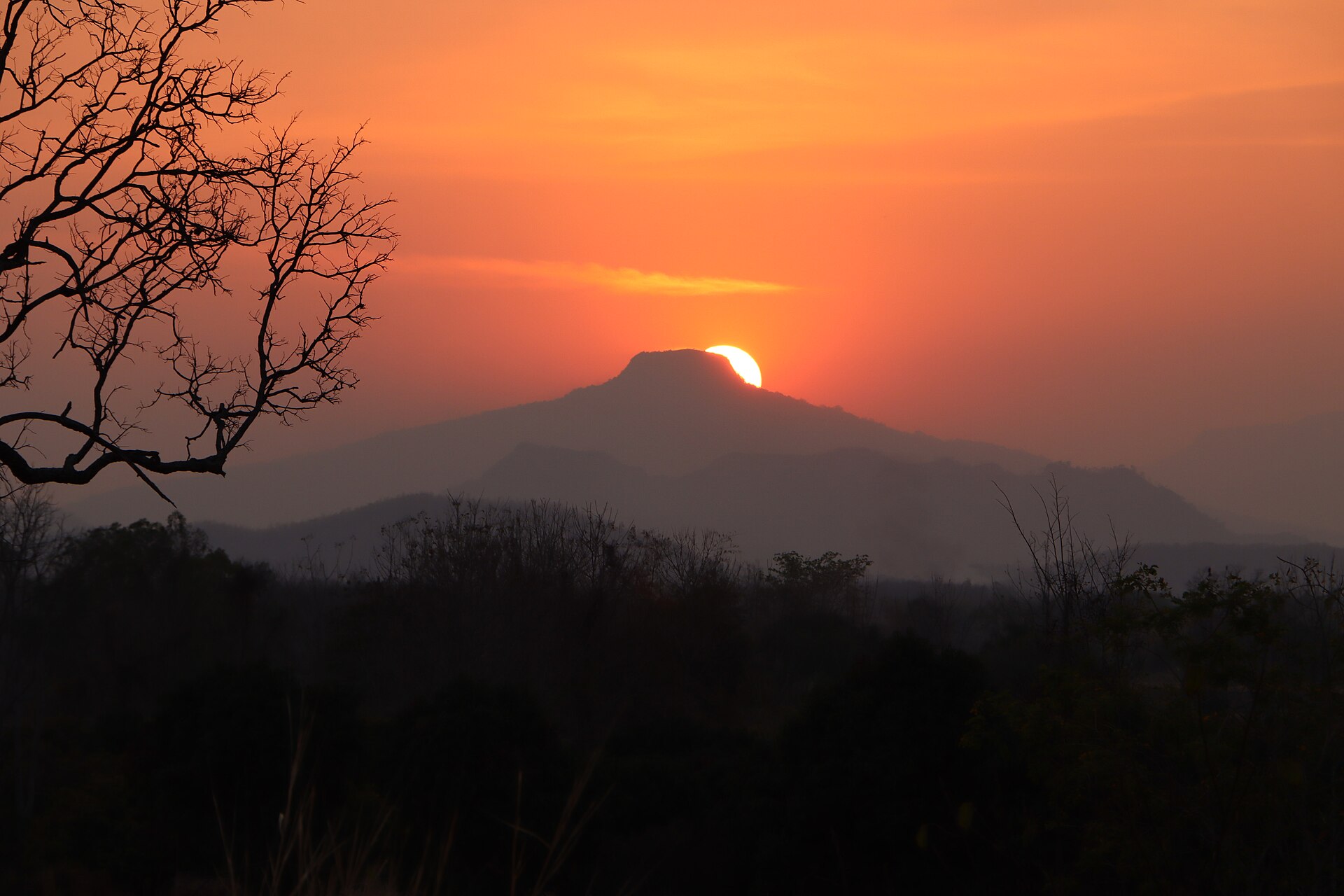
Phu Pa Po — locally nicknamed "Loei's Fuji" — is a viewpoint hill at approximately 900 m above sea level, in Ban Pha Wai Village, Puan Phu Subdistrict, Nong Hin District. What makes people from across the country talk about it is simple: from here, Phu Ho rises in front of you as a perfectly triangular conical mountain that looks almost exactly like Mt. Fuji, especially on days when a thin layer of mist drifts around the peak. It works for viewpoint and photography enthusiasts, anyone wanting quiet mountain air, and families looking for something different that doesn't involve a long hike.
There are four viewpoints across the hilltop, spaced about 200–300 m apart. Viewpoint 4 is the main draw — a short climb up a slope through the trees opens to a full 360-degree panorama where you can see Phu Ho, Phu Luang, Phu Ruea, and Phu Kradueng arranged in the distance. Many reviews describe the same thing: "slightly anxious getting there, then the view at viewpoint 4 and suddenly everything feels worth it." The absolute not-to-miss experience is riding the community e-taek up — converted farm tractors that bounce and rock over the dirt road in a way that cannot be replicated in any city.
Private vehicles are not permitted on the hill — park at the lower lot and board the e-taek run by the Ban Pha Wai community group, 60 THB per person round trip (revenue goes directly back to the community). Open approximately 05:00–18:00 daily; on high season some days the first run goes out before 05:00 to catch sunrise and sea of mist. There are a car park, shops, restaurants, and guesthouses around the lower area.
Phu Pa Po earns its popularity because it genuinely delivers a "Thai Fuji" that works, without flying anywhere. Best season is winter when the air is cool and sea of mist is likely, but the green slopes of rainy season and the golden fields of dry season each have their own character. Worth knowing: if coming for sunrise, bring a torch because the last section to viewpoint 4 is still dark and steep. Wear shoes you can climb in; expect a queue for the e-taek on busy days.
🛏️ Where to stay in Loei — base for Chiang Khan and the city
Loei's sights spread across several zones. To get the most out of Chiang Khan, staying on the Mekong riverside in the old town lets you walk the walking street and join the morning alms-giving easily. If your plan covers Nong Hin, Dan Sai, and Phu Ruea, staying in Loei city is more practical for day trips. There are wooden old guesthouse at very friendly prices through to mountain-view resorts. In winter, rooms fill fast — book ahead for the best location at the best rate.
Phu Thok Sea of Mist
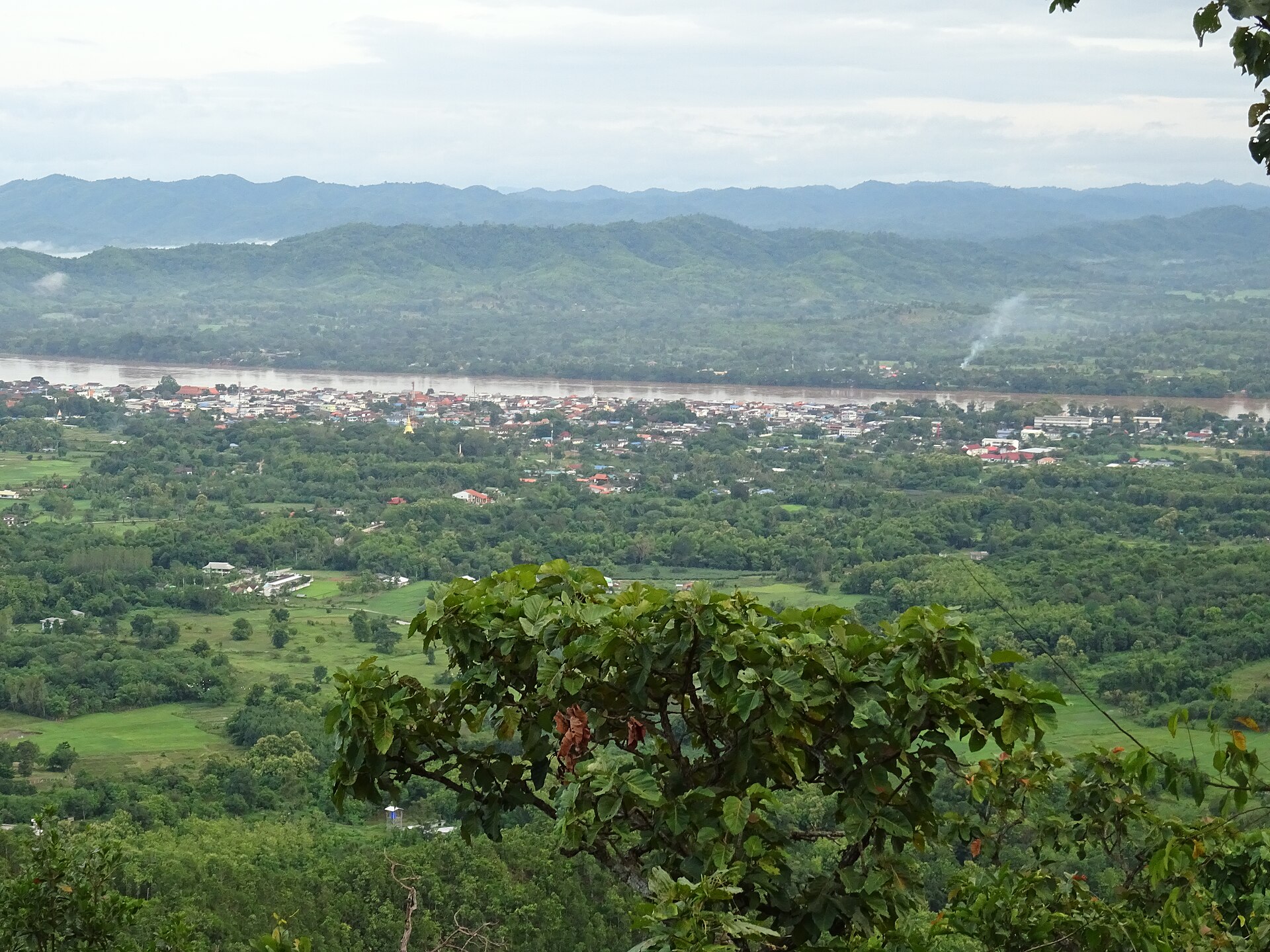
Phu Thok is Chiang Khan's most talked-about sea-of-mist viewpoint, just 3 km from town. The hilltop has an open 360-degree observation deck with views of Chiang Khan town, the curve of the Mekong, Kaeng Khut Khu, and the Lao town of Sanakhram on the opposite bank. Anyone visiting Chiang Khan who wants a genuinely beautiful morning moment should have this spot on their list.
The experience: thick sea of mist rolling over the valley and the Mekong, with a red sun disc rising over the Lao side at around 06:30. Reviews consistently recommend going before dark — around 05:00 to 05:30 — because the mist is heaviest and the crowd is smaller, giving you better photo angles. The wooden deck terrace facing the river is the prime spot; the light in those first minutes when the sun breaks through the mist is what people come for.
Private vehicles cannot go to the summit. Park at the lower lot (approximately 20 THB per vehicle), then board a local pickup truck up — 25 THB per person per the original fare, though multiple recent reviews report approximately 40 THB. The ride takes about 15 minutes. No additional admission charge; the income circulates back to the community, which runs the system in an organized way.
Best season is winter, roughly November to January, when the chance of full sea of mist is high. Some mornings the summit temperature drops to about 14 degrees — bring a warm layer. In dry season the mist is thinner or absent. Google reviews give it around 4.6 from several hundred reviewers. It works equally for couples, families, and photographers willing to set an early alarm for the soft first light of Chiang Khan.
Wat Neramit Wipatsana
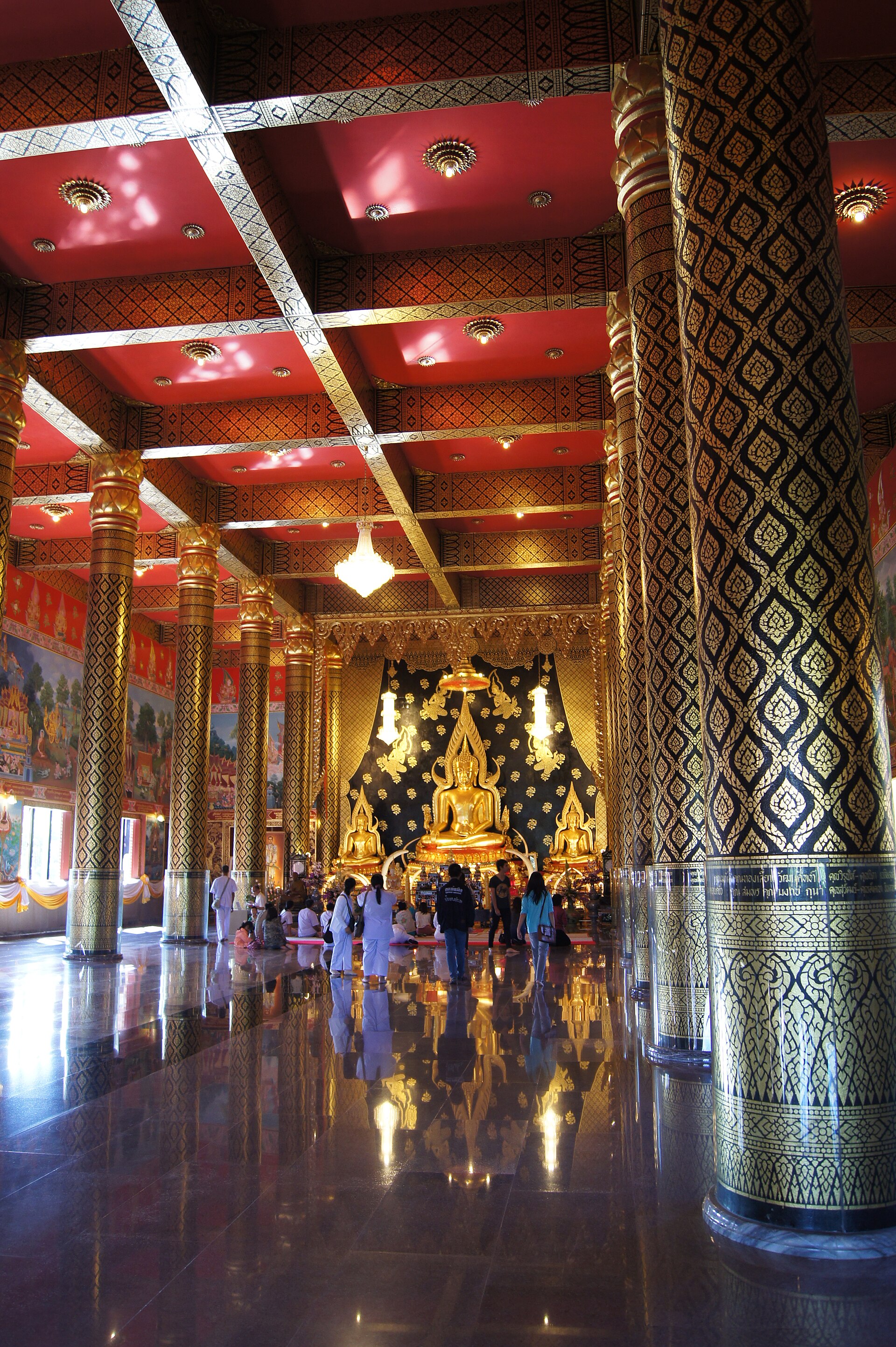
Wat Neramit Wipatsana is a hilltop temple in Dan Sai District, not to be missed by anyone exploring the Dan Sai side of Loei. What makes people mention it is the ubosot built entirely from laterite, the red-orange stone taking its natural color, creating a presence that is austere and visually striking in a way that plaster-and-concrete ordination halls rarely achieve. Inside, the main presiding Buddha is a replica of the revered Phra Phuttha Chinnaraj in Mara-subduing posture. Ideal for those who enjoy quiet temples, beautiful religious architecture, and visitors wanting to combine two temples in one stop — Phra That Si Song Rak is only a few hundred metres away.
Not to miss: the mural paintings inside the ubosot, executed by local Dan Sai artists over multiple years, depicting the life of the Buddha and ten past lives (tosachat). Black wooden pillars with gold detailing, a vivid red ceiling, and filtered light create an interior that several reviewers describe as more magnificent than expected. The other must-see is the laterite staircase leading up the slope — walk up and the view of the temple against the surrounding trees opens up. The grounds include a sala-la (shade pavilion) garden and sala trees.
Free admission. Two parking areas available — at the base and near the ubosot. Open approximately 06:00–18:00 daily. Easy to drive to from Dan Sai market; follow Kaeo Asa Road past Phra That Si Song Rak, then turn up the slope a short distance. Ideal to combine as a two-temple merit circuit in a single outing.
The temple is popular because laterite-stone ubosot of this type are genuinely rare. It consistently ranks as a highlight of Dan Sai. Worth knowing: it sits on a slope requiring a modest stair climb — wear comfortable walking shoes, dress modestly, and remove shoes before entering the ubosot. During the Phi Ta Khon festival in Dan Sai (annual) the area becomes particularly lively.
Phu Ruea National Park
When Thais talk about "the coldest mountain in the country," Phu Ruea National Park is the first name that comes up. Seen from a distance, the summit silhouette looks like the prow of a sailing ship cutting through a sea of hills — hence the name (Ruea = boat). The highest point stands at 1,365 m above sea level. The park works for anyone who likes cold air, morning light, and waking up early for the first rays — and for families who want to show children frost (mae kha ning) forming on grass blades on the coldest mornings, something genuinely rare in Thailand.
The highlight not to miss is "Pha Lon Noi", the most popular sunrise viewpoint. On clear mornings the sea of mist lies over the valley, with views extending toward Phu Luang, Pha Pha Sat, and across into Laos. From Pha Lon Noi, a nature trail of about 700 m at gentle gradient leads to the Phu Ruea summit and the "Hin Ruea Yai" (Great Ship Rock), the park's symbolic stone. Along the way you pass mountain pine forest, a natural rock garden, Pha Sam Thong cliff, and in late-rainy-to-early-cool-season the wild flower Proe Phu Ruea blooms across open ground.
Entry fees: Thai adults 40 THB, children free, foreigners 200 THB, plus a 30 THB vehicle charge. If you prefer not to drive up, a community enterprise shuttle runs at 10 THB per way (20 THB return). Open approximately 08:30–16:30; during high season the park opens earlier to allow time for the first light. Located in Nong Bua, Phu Ruea District, about 50 km from Loei city — an easy drive with camping and bungalow accommodation inside the park for those wanting to stay and catch the dawn.
The park stays popular because it packages everything cold-season mountain seekers want: cold air, sea of mist, sunrise, and layered hill views in one place. Google scores it 4.5 from thousands of reviews. Worth knowing: whether you get the mist depends entirely on the weather — check the forecast before going, dress very warmly, and arrive before dawn to secure a good spot at Pha Lon Noi.
Phra That Si Song Rak
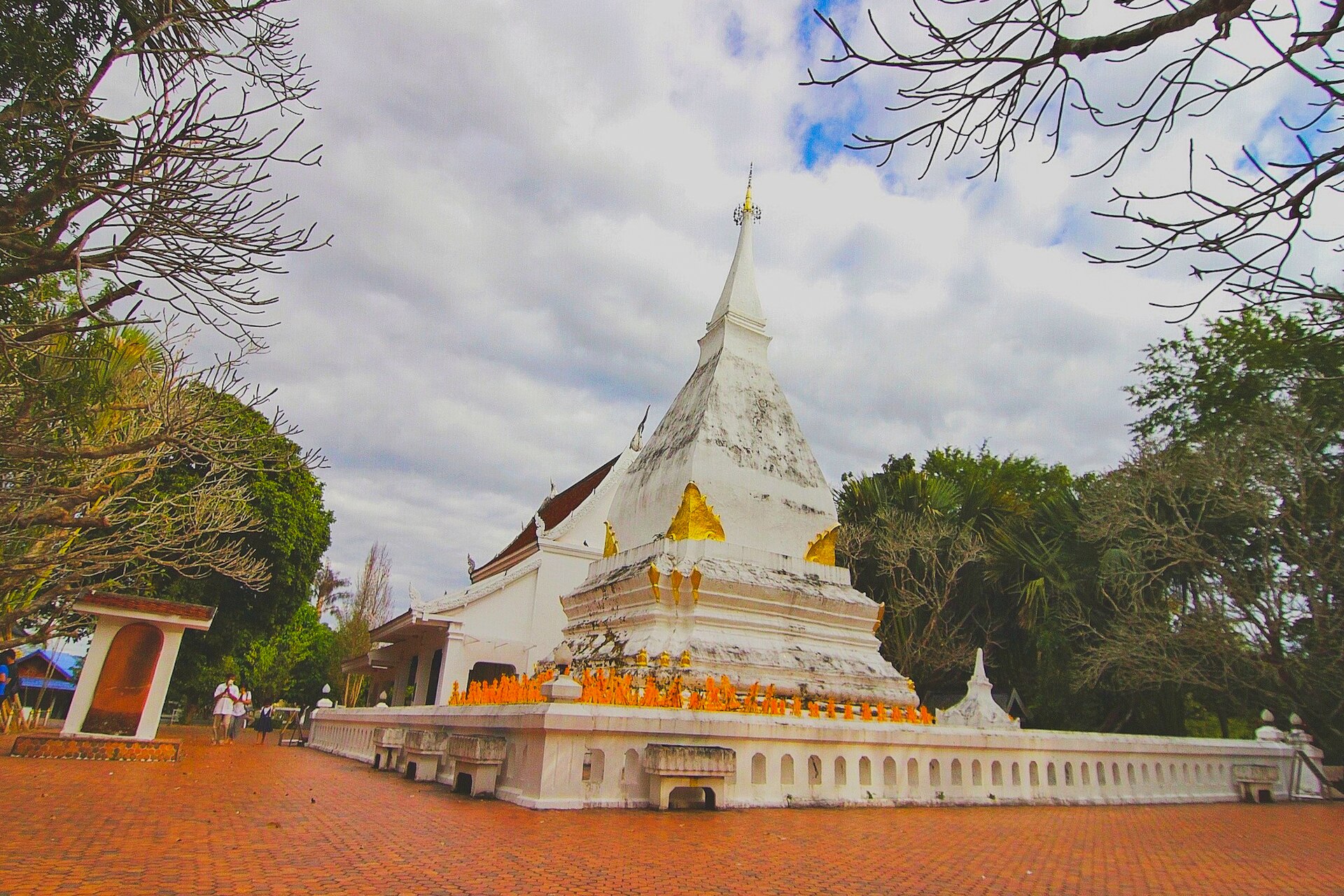
Phra That Si Song Rak is an ancient stupa on the Hman River in Dan Sai, Loei, unlike most stupas in Thailand in a fundamental way: it was not built to enshrine sacred relics. It was built as a "witness of a vow" — a physical pledge of peace between Ayutthaya (during the reign of King Maha Chakkraphat) and the Lan Chang Kingdom (under King Setthathirat). Construction began in 1560 and was completed in 1563. Over 460 years old today. Anyone who loves places with a story, with history, and who wants to seek blessings for love and friendship will find this deeply resonant.
The stupa is Lan Chang-style white plaster over brick, standing approximately 19 m tall — serene and composed, like a smaller Phra That Phanom. The most-discussed aspect in reviews is the strict tradition of "no red clothing or items" on the stupa grounds — red symbolizes blood as a consequence of war, which goes against the spirit of peace the stupa embodies. There are accounts of couples in red being asked to cover up. Prepare a non-red cover layer just in case. No shoes, no umbrellas, no hats are allowed on the upper terrace either.
The atmosphere above is very peaceful. Reviews consistently recommend coming in the morning — cooler air, fewer people, Saturday–Sunday is noticeably busier. Walk up the white naga staircase to pay respects, shake fortune sticks (sia chi), make a wish, and allow about 1–2 hours. No entry fee — donations by faith only. Open daily 06:00–18:00. Located about 83 km from Loei city along Highway 203 to Dan Sai. Pairs well with Phi Ta Khon Museum or Phu Thap Boek in the same trip.
Phra That Si Song Rak is popular because it is both the provincial symbol and the spiritual anchor for Dan Sai residents who call themselves "children of bees and candles." On the full-moon day of the sixth lunar month every year, the annual Somphotchan ceremony brings a bamboo-and-beeswax shrine (ton phueng) to be presented — an image that is very hard to see elsewhere. Worth knowing: local belief holds that women who are menstruating should not ascend the stupa, and as a sacred ground all visitors should dress respectfully and behave quietly throughout.
Suan Hin Pha Ngam (Loei's Kunming)
If you've seen photos of the stone forest in Kunming, China, and wanted to find something similar without flying internationally, Suan Hin Pha Ngam at Ban Pha Ngam Village, Puan Phu Subdistrict, Nong Hin District, Loei, earns its nickname "Loei's Kunming" reasonably. The site is pointed limestone karst formations of varying sizes rising up from flat ground across more than 7,000 rai of land in the Phu Ko-Phu Kra-Tae Wildlife Sanctuary. It works for hiking-with-character people, families who want an adventure that doesn't require a long trek, and photographers hunting for unusual angles.
The highlight is the guided walk weaving through rock passages with a local community guide — the path is maze-like, with some sections requiring climbing over ledges and ducking through cave openings. Rock formations along the route have been named after their shapes: Great Wall, stone chedi, crown rock, and natural photo frames. Reviews consistently agree: "the local guide knows every nook and cranny, navigates you through without getting lost, and adds stories about local beliefs and ancient trees like cycads along the way." A flower garden at the entrance gives another photo spot before the trail begins.
Entry fee: 100 THB per group (up to 10 people), plus 30 THB per person for the e-taek shuttle from the visitor centre to the trailhead. The actual walk is about 600 m and takes 1–2 hours. Open daily 08:00–16:00. From Nong Hin town, drive approximately 18 km further in. Google rates it 4.4 from over 1,700 reviewers — steady popularity as a standout attraction of Nong Hin.
Worth knowing: the sun here can be strong — multiple reviews suggest coming in the morning or late afternoon when the heat has eased. Wear shoes you can scramble in. Bring your own water. Always hire the local guide since the paths are complex; getting lost is a real possibility without one. Guide fees are additional at your discretion. Rainy season makes some sections slippery — extra caution required.
Book tickets and tours in Loei in advance
Loei's attractions are spread across districts and several hilltop spots need local shuttle connections. If you'd rather not drive yourself or are concerned about finding the right turnoffs, booking a guided Chiang Khan and Loei circuit through Klook or GetYourGuide is a practical option — multi-spot guided trips, hotel pickup and drop-off, and pre-dawn sea-of-mist packages where timing is already arranged. Booking online ahead also means your day slots together without wasted driving time.
💡 What to know before you visit Loei
Loei's sights are spread across different districts and public transport is limited. Renting a car or booking a guided tour is the easiest way to cover several spots in a day. Grab is not widely available outside the main town.
The local shuttle trucks and e-taek (modified farm tractors) up to Phu Pa Po, Phu Thok and Suan Hin Pha Ngam take cash only, and so do most street stalls on Chiang Khan Walking Street. Bring small notes.
For Phu Thok and Phu Pa Po, arrive by 5–6 AM in cool season to catch the sunrise and beat the weekend crowds. The viewpoints get busy fast on holidays.
This 460-year-old stupa in Dan Sai has a strict tradition: visitors must not wear or carry anything red inside the shrine grounds, as red symbolizes conflict. Dress respectfully as at any temple.
Phu Kradueng National Park only opens 1 October to 31 May, and you must hike up and down on your own (no cable car). Plan at least an overnight stay and pack for cold nights at the top.
Chiang Khan is used to visitors, but in smaller towns and at rural viewpoints English menus and signs are rare. A translation app helps, and locals are friendly and patient with travelers.
Plan your Loei trip by zone to make it count
Loei is best in cool season (November–February) when the air is cold and sea of mist is reliable, but the attractions are spread far apart — zone planning is essential. The Chiang Khan zone groups together easily: set your alarm for pre-dawn and head up Phu Thok for the sea of mist and sunrise (open from ~05:00, sun up ~06:30), then drop down to the Chiang Khan Skywalk at Phu Kok Ngiu (07:00–18:00), continue to Kaeng Khut Khu for a riverside fish lunch, and return to Chiang Khan Walking Street in the evening (~17:00–22:00).
The Nong Hin zone (Phu Pa Po + Suan Hin Pha Ngam) and the Dan Sai–Phu Ruea zone (Phra That Si Song Rak + Wat Neramit Wipatsana + Phu Ruea National Park) run in opposite directions from town — budget half a day for each. Phu Kradueng needs at minimum 2 days and 1 night on its own — it's a full hike with no cable car, and it's only open 1 October–31 May.
A multi-day Loei trip is much more relaxed with a good base. Chiang Khan's Mekong riverside and Loei city both have options from old wooden guesthouses to mountain-view resorts. Book ahead in winter — riverside rooms fill fast.
Check Loei hotel prices