🔄 Last checked 27 Jun 2026 · details and hours can change — check the venue before you go
📍 All restaurants on the map
Tap a pin for the spot + nearby stays
Ask a Bangkokian which part of the Thonburi side you can explore all day without a long ride, and plenty will say "Pinklao-Wang Lang" — this neighborhood sits at the foot of the Pinklao Bridge and the Rama VIII Bridge, just a moment's hop across from the Phra Nakhon side. Its charm is that everything clusters along the Chao Phraya River and Khlong Bangkok Noi within walking distance of one another. In the morning you stroll and eat at Wang Lang Market, mid-morning you step into Wat Rakhang to ring the bell for blessings and then take a cross-river ferry to admire the Phra Nakhon skyline, in the afternoon you drop by the Royal Barges Museum or Siriraj Bimuksthan, and come evening you sit out at Rama VIII Park to watch the sun set behind the golden cable-stayed bridge. This is what sets Pinklao-Wang Lang apart from the sightseeing districts on the Phra Nakhon side — it blends markets, temples, museums, malls and riverside parks into one area you can walk straight through.
This list has the real deals, guaranteed by time and reputation — the Royal Barges National Museum, which keeps 8 actual royal barges, the highlight being the Suphannahong Royal Barge with its magnificent golden-swan figurehead, the very vessel used in the real Royal Barge Procession; Wat Rakhang Kositaram, an Ayutthaya-era temple where people love to ring the bell for blessings of fame and renown, its ordination hall enshrining Luang Pho Yim Rap Fa, an image King Rama V himself once spoke of; Wang Lang Market, an eat-and-stroll riverside market gathering famous street food and youthful, budget-priced clothes; and the Siriraj Bimuksthan Museum, which tells the story of Bangkok Noi inside the old Thonburi Railway Station building and makes for a wonderful walk. For the shop-and-eat crowd there's Central Pinklao, freshly renovated with an IMAX cinema, The Sense Pinklao, a hub of late-night buffet restaurants, and Rama VIII Park on the Chao Phraya — scroll down to see each spot one by one and decide where to start your trip.
Wang Lang Market
If you had to pick a single spot that sums up the whole Wang Lang-Pinklao neighborhood, this is it. Wang Lang Market is the Thonburi side's liveliest eat-and-stroll, shop-as-you-go market on the Chao Phraya, tucked into the lanes beside Siriraj Hospital, running through several sois from Wang Lang Soi 1 all the way out to the Arun Amarin side. It's perfect for budget-minded eaters, Siriraj and Thammasat students, and travelers who want to see a real Thai market rather than one staged for tour groups. Nearly every review says the same thing — "tons to eat, fun to shop" — and you can wander all day without getting bored. The Google rating sits around 4.2 stars from a few hundred reviews by people who've actually walked it.
There's so much you mustn't miss that you should come hungry. Start with a neighborhood legend, "Orathai Sushi," where sushi starts at 5 baht a piece, sold for over a decade, with dozens of toppings to choose from, both a takeaway counter and a two-floor air-conditioned room to sit in. Follow it with boat noodles at 20 baht a bowl that genuinely fill you up, plump fragrant palace-style fried pork to eat with hot sticky rice, a big slice of Wang Lang bread you can barely finish on your own, and old-school sweets like Pa Tim's khanom thang taek, a fixture of the market for years. If you like snacks, there's grilled pork, fried fish balls, som tam and bubble tea — the full sweet-and-savory range across Thai, Chinese, Japanese and Vietnamese.
The other half of the market is the clothing zone. This place is known for youthful clothes both new and secondhand at prices a university student can manage, plus bags, shoes and accessories you can happily browse alongside the food. Entry is free, and a real eat-and-stroll budget of around 100–300 baht will leave you full and carrying a little something home. The charm of Wang Lang is that it's a genuine local market — narrow walkways, bustling crowds — but that's exactly the atmosphere you can't find in a mall.
It sits right by Wang Lang Pier / Phran Nok Pier. The most delightful way to arrive is by cross-river ferry from Tha Chang (near the Grand Palace) over to Wang Lang Pier in just a few minutes, or you can take the Chao Phraya Express Boat. It's open daily roughly 08:00–19:00, with the stalls busiest and most fully stocked from mid-morning into the afternoon, around 10:00–17:00. Good to know: some shops close on Mondays, and weekday midday-to-evening gets very crowded as Siriraj's doctors, nurses and students come down to eat all at once — if you want an easy stroll, avoid the rush hours.
Royal Barges National Museum
If you've ever seen images of the royal barge procession sailing the Chao Phraya and wished you could see the barges up close, the "Royal Barges National Museum" on Khlong Bangkok Noi, at the foot of the Pinklao Bridge on the Thonburi side, is the one place where you can. It's a boathouse that stores and displays 8 of the actual royal barges used in the Royal Barge Procession. It's perfect for lovers of history and Thai craftsmanship, photographers, and parents who want to bring their kids or foreign friends to see the real thing, found nowhere else. The display hall isn't large — about 30–45 minutes to see it all — but the grandeur per square meter is intense.
The highlight you can't miss is the "Suphannahong Royal Barge," its prow carved into a proudly raised golden swan, lacquered, gilded and inlaid with glass from end to end — the largest single dugout barge in the world, which once received a maritime heritage award from the World Ship Trust. Many reviews agree that walking in and meeting it in person gives you goosebumps, the bow-and-stern carving so exquisite you stand and stare for a long while. Beyond it are the Anantanakkharat barge with its seven-headed naga prow, the Narai Song Suban King Rama IX barge, and the Anekkachatphuchong barge, along with procession regalia like the kanya throne, golden oars and the oarsmen's ceremonial dress, laid out to make the real procession easier to picture.
Entry is very cheap — 20 baht for Thais, 100 baht for foreigners — but there's one thing to know before you go: to take photos you pay an extra camera fee of 100 baht (video 200 baht), which catches many people off guard, so brace for it. It's open daily 09:00–16:30 (closed over New Year and Songkran). The Google rating is 4.2 from over 600 reviews, reflecting how impressed visitors are by the beauty of the barges.
Good to know: the entrance is fairly hidden — you cut through a small lane in the canalside community — so first-timers often get a little lost. We recommend taking the Chao Phraya Express Boat to Phra Pinklao Pier (N12) and following the signs, or chartering a long-tail boat to dock right in front of the museum, which is easier to find. At times some barges may be covered or under restoration, so if you want to see them all looking their best, check the museum's page beforehand. The hall has no air-con; the breeze off the canal helps a bit, so coming in the morning makes for an easier stroll.
Wat Rakhang Kositaram
Wat Rakhang Kositaram, or just "Wat Rakhang" as people call it for short, is an old temple dating back to the Ayutthaya period, originally named Wat Bang Wa Yai, set on the Chao Phraya on the Thonburi side, behind the Wang Lang neighborhood in Siriraj subdistrict, Bangkok Noi district, directly opposite Tha Chang on the Phra Nakhon side. The name comes from the reign of King Rama I, when a fine-toned antique bell was unearthed at the temple; the king had it moved to Wat Phra Kaew and granted 5 bells in its place. This temple is perfect for the faithful who want blessings of fame, people in the arts, performance and trade, and travelers who want to pay respects at a famous temple alongside Wat Arun in a single trip.
The highlight you can't miss is to "ring the bell," following the belief passed down that whoever wants fame and renown should come ring the bell here, its resounding tone like an announcement to make you known. Another draw is the King Rama I-style ordination hall, which enshrines Luang Pho Yim Rap Fa, a beautiful bronze principal Buddha image in the meditation posture — so beautiful that King Rama V once remarked, "No matter which temple I visit, none is like coming to Wat Rakhang; the moment you step through the hall door, the principal image is smiling, welcoming the sky every time." There's also an antique wooden Tripitaka hall, originally a residence and lodging of King Rama I before his accession, holding mural paintings and gold-and-black-lacquer scripture cabinets by master craftsmen. People also come to pay homage to Somdej Phra Phutthachan (To Phrommarangsi), the former abbot who created the renowned Phra Somdej Wat Rakhang amulets.
The temple is free to enter, with no admission charge — only merit boxes for donations as you wish. If you'd like to ring the bell, make merit, or buy fish food at the landing, bring a little small cash, around 20–100 baht is plenty. A spot many people love is the riverside landing in front of the temple where you can feed the fish, with the Chao Phraya opening up wide to the Phra Nakhon side — a lovely place to sit in the cool breeze. Most reviews on Google and Wongnai rate it highly, praising how clean and shady it is, how kind the monks and staff are, and how peaceful the atmosphere feels even in the middle of the city.
It's very convenient to reach — take the cross-river ferry from Tha Chang (the Grand Palace side) straight to Wat Rakhang Pier, or come via the Wang Lang-Siriraj landing and walk on. It's very close to Wat Arun and Wang Lang Market, so you can easily string together a temple-hopping trip on the Thonburi side. It's generally open for visits around 08:00–17:00, while the temple grounds and landing stay open longer. Good to know: this is a sacred place, so you should dress modestly, covering shoulders and knees, especially to enter the ordination hall. Holidays and the New Year-Songkran festivals get fairly crowded, so a weekday morning gives you the most peaceful atmosphere and the best photos.
Central Pinklao
If you're on the Thonburi side around Pinklao-Bangkok Noi and ask which is the "main mall of the neighborhood," almost everyone says Central Pinklao, right at the foot of the Pinklao Bridge on Borommaratchachonnani Road. This mall has been part of Thonburi life for over 30 years and just had its biggest renovation in decades, fully reopening on 6 November 2025 (Central Pattana poured in over 1,700 million baht). It's perfect for anyone who wants to stroll, shop, eat and catch a film all in one place without crossing to the Phra Nakhon side. Bring the whole family — kids, adults and seniors can all get around easily.
After the renovation, the look has changed so much that many reviews say it's "like a completely different mall." The spot people photograph for social media most is the central atrium, with a high ceiling letting in natural light, decorated with Greco-Roman columns and a statue of Caesar Augustus carried over from the original — it looks far more upscale now. The thing you can't miss is the Major Cineplex on floor 5, revamped into 7 screens including an IMAX with Laser — a big, fully immersive screen, surround sound, comfortable sofa seats (movie fans say it's worth the ticket). Another highlight is the food zone, gathering over 500 well-known brands and more than 200 restaurants — Michelin spots, big chains, right down to street food in the relaxed Urban Living Room food-court zone.
Entry to the mall is free, with no admission charge, and your per-meal budget is very flexible — food-court dishes run 60–120 baht, sit-down restaurants around 150–300 baht. It's easy to reach: take the Gold Line to Bang Yi Khan station, then a short taxi or motorbike-taxi ride, or drive yourself — there's spacious multi-level free parking (a perk Thonburi locals love). It's open daily 10:00–22:00.
Good to know before you go: just after the reopening and on weekends it gets very crowded, and the lower parking floors fill fast, so a morning or weekday is easier. Some popular shops have long queues at lunch and dinner, so allow a little extra time. The store layout shifted after the renovation, so if you can't find an old favorite, just ask the information counter. If you're here for an IMAX film, book ahead on the Major app, as the good seats sell out fast.
Indy Market Pinklao
If some night you fancy a long eat-and-stroll on the Thonburi side without heading into town, "Indy Market Pinklao" is the first pin people around Charan Sanitwong-Pinklao think of. It's a foodie night market open since 2018 on Charan Sanitwong Road, around Soi 49–51, spanning over 8,000 square meters, split into a food-tent zone of over a hundred stalls, a container zone to sit and chill, and a clothing-and-bits zone. A spot many people love is the "shared seating zone," where you can buy from any stall and sit together — perfect for groups who each want something different, or a relaxed after-work date stroll.
On the food front it goes all-out, sweet and savory. The ones reviews mention most are "Muek Woi Wai" grilled squid with a punchy dipping sauce, 50–100 baht a skewer; mala-jim jum-shabu in the Mo-Fire-Cheese and Shabu Oud Pen Tor style, great-value sets for groups; BBQ pork ribs; Je Fen grilled pork at 5–6 baht a skewer; right through to walk-and-eat sweets like rainbow crepes, bingsu, stir-fried ice cream, khai lum, cream-cheese mochi, and bubble tea. Most prices sit in the tens to low hundreds of baht, so 150–250 baht leaves you comfortably full with no heavy planning.
Location is the real advantage here, as it's right by MRT Bang Yi Khan (Blue Line BL05), Exit 1, a walk away. If you drive there's a big parking lot, free for the first 30 minutes, then 20 baht an hour after that. It's open daily roughly 18:00–24:00 (some stalls start from early evening, 16:30) — a market that stays open late, where you can sit and chill until midnight.
Its popularity shows in a Google rating of around 4.3 stars from over 4,000 reviews. Most people praise the variety of food, the friendly prices, and walkways that aren't as cramped as the famous markets in town. Good to know: the stalls in a night market rotate and change a bit by season, and some have days off (for instance some grilled-pork stalls close on Tuesdays), so if you're after a specific stall, check its page first. Friday-Saturday gets crowded, so coming in the early evening makes for an easier stroll.
🛏️ Book a place to stay in Pinklao-Wang Lang and compare prices first
Want to explore Pinklao-Wang Lang at an easy pace without rushing back? Booking a night in the Pinklao area or just across on the Phra Nakhon side is far more convenient — wake up early to eat-and-stroll Wang Lang Market before the crowds, drop by Wat Rakhang while the sun's still soft, then work through the museums and riverside parks all day. Compare stay prices across sites (Agoda · Booking · Trip.com) and pick the room that's the best value in the location you like best — many places booked now go for better rates than walking in on the day.
Siriraj Bimuksthan Museum
If you're strolling around Wang Lang-Pinklao and want a cool spot that gives you both knowledge and good photos, the Siriraj Bimuksthan Museum is well worth a stop. The building is the former Thonburi Railway Station (the old Bangkok Noi Station), restored to keep its antique character. Step inside and you'll find a hall that was once the ticket office, giving the feeling of stepping back into old Bangkok. It's perfect for fans of history and architecture, people who like a quiet museum walk, and families wanting to bring kids to learn in a way that isn't as frightening as the anatomy side of the medical museum.
The highlight many people mention is content that overflows the building's size, telling the story of the Bangkok Noi canal mouth and Wang Lang from the Thonburi period to the present. There are artifacts actually unearthed on site during construction, a huge model Chinese junk in the trade room, the history of traditional Thai medicine and the founding of Siriraj Hospital, right through to a mock-up of canalside community life and an operating room you can step into. The displays use modern multimedia and lighting, so the walk never gets dull. Just outside, next to the riverside Chaloem Phra Kiat Park on the Chao Phraya, sits a steam locomotive on show — a popular photo corner.
On entry fees, Thai adults pay 80 baht, children 25 baht, foreigners 200 baht. If you also want the medical museum across the way, there's a combined two-museum ticket that's cheaper than buying separately. It's open Mondays and Wednesday-Sunday, 10:00–17:00, closed Tuesdays and public holidays, with ticket sales closing around 16:00. Allow 1–2 hours to walk it. There are English signs, so foreign visitors can follow along.
Good to know: the museum is inside the grounds of Siriraj Hospital, very easy to reach by Chao Phraya Express Boat to the Railway/Wang Lang Pier, or by cross-river ferry from Phran Nok Pier. But if you drive, hospital parking can be fairly tight on weekdays. Most reviews praise it as worth it and better done than expected. Some rooms close for renovation at times, so check the page before you go to avoid a wasted trip.
Rama VIII Park & Bridge
If you want a riverside park in the middle of the city that's easy to walk, with great views and not a single baht to enter, Rama VIII Park at the foot of the bridge on the Thonburi side is where people around Pinklao-Bang Yi Khan love to come in the evening. The park stretches along the Chao Phraya, with walking-running-cycling tracks, a playground, a skate rink, exercise machines, frangipani arbors and riverside pavilions to sit and catch the breeze. It suits the exercise crowd, families bringing kids to run around, couples chilling out, and photographers who come to capture the bridge. The real draw is the view across the river to Phra Sumen Fort and Bang Khun Phrom Palace on the Phra Nakhon side — a beauty you won't get from an ordinary park.
The star here is the Rama VIII Bridge, a single inclined-pylon cable-stayed bridge strung with golden-yellow cables in a fan shape. At sunset especially, the water turns orange-gold against the bridge's silhouette — the shot many people come to wait for. At 18:00 the bridge lights switch on (lasting until 21:00), and the pylon and cables glow gold, reflected on the water's surface, becoming one of the Thonburi side's most popular night photo spots. Real reviews agree the view is lovely, the breeze cool, the atmosphere relaxing, and the running track well kept — one of the highest-rated running parks. The Google Maps rating sits at 4.5 from over five thousand reviews, proof people come and leave happy.
Entry is free with no gate fee — just bring a little for water and snacks. The park is open daily 05:00–21:00, with the prettiest and most popular time being dusk into the early evening when the bridge lights come on. It's located on the Thonburi side at the foot of the Rama VIII Bridge on Arun Amarin Road, Bang Yi Khan subdistrict, Bang Phlat district, near Pinklao-Bang Khun Phrom, easy to reach whether you drive or take a boat. Good to know: parking is limited, and holiday evenings get crowded, so if you want a good bridge shot without jostling for a spot, come a little before sunset and stay on for the bridge lights afterward.
Wat Amarintharam Worawihan (Luang Pho Bot Noi)
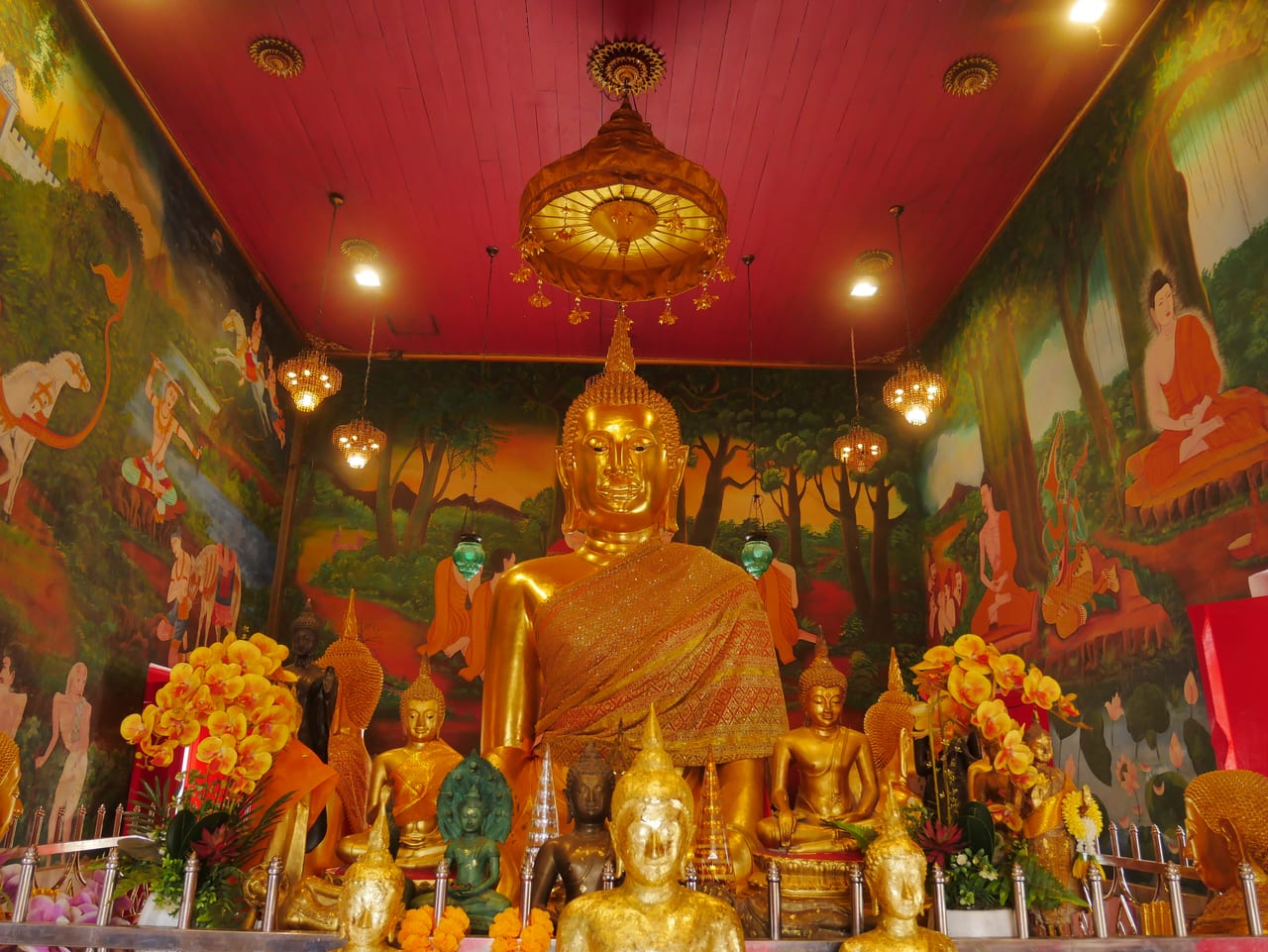
Wat Amarintharam Worawihan, which people around here call "Wat Luang Pho Bot Noi" out of habit, is an old temple from the Thonburi era, originally named Wat Bang Wa Noi, the counterpart to Wat Bang Wa Yai (Wat Rakhang). It sits on Khlong Bangkok Noi right beside Siriraj Hospital, so anyone walking from Wang Lang Pier reaches it in a few minutes. In the Thonburi period King Taksin had it restored and raised to a royal temple; later King Rama I rebuilt the entire temple. It's perfect for those who like temples with a story, coming to make wishes, or stopping to pay respects while visiting a patient at Siriraj.
The highlight is "Luang Pho Bot Noi," a Sukhothai-style stucco principal Buddha in the Subduing Mara posture, lacquered and gilded, enshrined in a small chapel that survived the bombing of the Second World War (when Allied forces struck the Thonburi-Bangkok Noi railway station next door and the temple was nearly leveled, leaving only the vihara and the Buddha-footprint mondop). Another thing many people try is the "elephant lifting" fortune test — you lift it twice, and if it comes up the first time it usually won't the second, in line with your wish. Students preparing for exams, especially aspiring doctors, love to come make wishes, apply gold leaf, and offer lamp oil.
Another angle that made this temple famous is its link to the legend of "Khu Kam." Monks at the temple pass down a story that a Siriraj medical professor once said the real Kobori died at Siriraj; the canalside Bangkok Noi setting, the railway station and the wartime atmosphere all match the scenes in the novel, so Khu Kam readers love to drop by and soak up the mood of the neighborhood.
Entry is free, open daily roughly 08:00–16:30 (sometimes into the evening). There's a little parking at the temple, but on holidays we'd recommend parking near Siriraj or taking the cross-river ferry, which is more convenient. The atmosphere is quiet and shady, an easy temple stroll you can finish in under an hour — ideal to pair with Wang Lang, Siriraj Bimuksthan, or a Khlong Bangkok Noi boat ride in a single trip.
Siriraj Medical Museum (Congdon Anatomical / Forensic Medicine)
If you're into the macabre, medical science, or things you don't get to see elsewhere, the Siriraj Medical Museum is a pin worth walking through at least once. It's actually a cluster of several rooms inside the Siriraj Hospital buildings on the Thonburi side, near Wang Lang Pier. The two rooms people talk about most are the Congdon Anatomical Museum, which holds over 2,000 real organ specimens — the nervous and full-body arterial systems, human embryos, right down to conjoined twins — and the Songkran Niyomsane Forensic Medicine Museum, which displays real-case evidence, the body-identification process, and a zone on identifying victims of the tsunami.
The highlight many people come to see is the skeleton of Professor Dr. Songkran Niyomsane, the museum's founder, who donated his body as a teaching aid, alongside the prepared cadavers used to teach anatomy showing every layer for real. Most reviews agree it's "less scary than you'd think" but intense and full of learning; many use the words goosebumps and awe in the same breath. It's a place that displays things with respect for the donors, never made to look revolting. Science and medical students, or parents wanting to open an older child's eyes, tend to like it especially.
On budget it's not expensive — Thais pay 80 baht, children 25 baht, foreigners 200 baht. It's open Mondays and Wednesday to Sunday, 10:00–16:30, with ticket sales closing at 15:30, shut on Tuesdays and public holidays. It's easy to reach by Chao Phraya Express Boat to Wang Lang Pier, then a walk into the hospital. Good to know: some rooms have no air-con, using fans and windows, so a hot day can feel a little stuffy. Photography inside is strictly forbidden, and the content is fairly strong, not suitable for small children or the faint of heart. Allow 2–3 hours to see it all. English signage is limited, so foreign visitors will find it smoother to have a translation app on hand.
The Sense Pinklao
If you're on the Thonburi side around Pinklao and ask "where's good for a buffet tonight," the answer for many people is The Sense Pinklao — a small community mall right next to Central Pinklao on Borommaratchachonnani Road that's become a one-stop hub of well-known buffet restaurants. It's great for groups, families, or friends settling in for a long meal. The selling point is that there are so many good restaurants within a few steps that you don't have to battle the traffic into town.
The highlight you can't miss is buffets of every kind — from Suki Teenoi (open until 5am, long queues in the evening but they move fast), Kouen premium sushi-shabu buffet, King Kong Japanese-style grill, Neta and Sushi Hiro for sushi, right through to Copper Buffet (Copper Beyond Buffet), a premium-grade international buffet that reviews praise for its river prawns, roast lamb and lavish seafood. If you don't want something heavy there's Salad Factory, After Yum, or Copper's noodle spot, and the standout is Wake Up Coffee, open 24 hours, where you can chill late into the night.
The overall vibe is an airy mall, less packed than the big malls; many reviews say it's relaxed, with no scramble for parking — there are over 200 spaces, free for the first 4 hours when you get a receipt from a shop in the mall stamped. Your budget depends on the restaurant you pick, from the low hundreds at Suki Teenoi up to premium buffets in the thousands at Copper. The mall itself is free to enter, with no admission charge.
It's easy to find, right beside Central Pinklao on the Borommaratchachonnani Road side, convenient to drive to, not far from the Pinklao Bridge or the new Sai Tai. Good to know: the popular buffet restaurants get crowded on weekend evenings, so if you're going to a bookable one like Copper or Kouen, reserve ahead; for Suki Teenoi, take a queue ticket and stroll around while you wait. This place is popular because it bundles the restaurants Thonburi-siders want all in one spot, and stays open late, so even after work you'll still make it in time.
🎟️ Book tickets, tours and river cruises around Pinklao-Wang Lang in advance
If you want to hit several spots around Pinklao-Wang Lang in one day without fussing over the route, try booking tours or tickets ahead through Klook or GetYourGuide — there are Chao Phraya river cruises stopping at temples and riverside markets on the Thonburi side, guided half-day tours that walk you through the history, and museum entries or boat rides you can book online and skip the on-site queue. It's perfect for foreign travelers who want an easy trip with someone to handle the queues and translate. Book ahead for better prices and to lock in the time slot you want.
💡 Know before you visit Pinklao-Wang Lang, Bangkok
The sights on the Wang Lang side (Wang Lang Market, Wat Rakhang, Siriraj Museum) are all within walking distance of Wang Lang Pier in front of Siriraj Hospital — just take the Chao Phraya Express Boat or a cross-river ferry from the Phra Nakhon side and step off there. If you come by road, cross the Pinklao Bridge, then take a Grab or a short cross-river ferry on. Pin the place names in Google Maps first, as the lanes are small and the signs unclear.
Stalls at Wang Lang Market and Indy Market, plus temple entries, merit-making and fish food, are mostly cash or PromptPay, so carry small notes · while Central Pinklao, The Sense and the big buffet restaurants take cards and QR payment, and some museums let you buy tickets online in advance.
Wang Lang Market is busiest from midday into the afternoon and at the after-work evening rush; going around 10:00–11:00 makes for an easier stroll with the stalls still fully stocked · the Siriraj museums and the Royal Barges Museum close on Mondays-Tuesdays, while Indy Market is a night market that opens in the early evening, so plan your timing before you go to avoid a wasted trip.
Wat Rakhang and Wat Amarintharam are temples where people genuinely come to make merit, so dress modestly, covering shoulders and knees, take off your shoes before entering the ordination hall, and keep your voice down on temple grounds · bring a shawl, handy for both the hot sun and entering temples.
Malls and big buffet restaurants have picture or English menus and staff who can get by · while many stalls at Wang Lang Market are Thai-only, so a translation app or pointing at food photos helps you order, and the vendors are friendly. Many museums have bilingual exhibit labels.
Markets and single-plate spots need no tip · some buffet or table-service restaurants already add a service charge to the bill, so check the bottom of the bill first · at temples you can drop into a merit box or buy fish food at the landing as you wish, with no fixed price.
Plan a full day in Pinklao-Wang Lang
The trick is to start on the Wang Lang side in the morning and then move on. Open the day at Wang Lang Market with a breakfast-to-mid-morning eat-and-stroll — boat noodles, fried pork, toasted bread, Orathai Sushi and old-school sweets. From Wang Lang Pier walk on to Wat Rakhang Kositaram to ring the bell for blessings and feed the fish at the landing with a view of the Phra Nakhon side, then stroll along to the Siriraj Bimuksthan Museum and the Siriraj Medical Museum, both within the same hospital grounds. Allow extra time around midday, as Wang Lang Market gets packed.
In the afternoon cross over to the Khlong Bangkok Noi side at the Royal Barges National Museum to see the real Suphannahong barge, then drop by Wat Amarintharam (Luang Pho Bot Noi) nearby · come evening, sit out and catch the breeze at Rama VIII Park, watching the sun set behind the golden cable-stayed bridge and the night lights. If you want to shop or catch a film, finish at Central Pinklao with its IMAX, or go for a buffet dinner at The Sense Pinklao and Indy Market Pinklao, both open late · most museums close on Mondays-Tuesdays, so check the day before you go to be sure.
Explore the many spots around Pinklao-Wang Lang without rushing — booking a night in the Pinklao area or on the Phra Nakhon side is far more convenient — cross the Pinklao Bridge and you're easily at Wang Lang Market and Rama VIII Park, and you can start your eat-and-stroll at the market the moment you wake up. Compare stay prices across several sites and pick the one you like best.
See Pinklao-Wang Lang stays, compare prices across 3 sites