🔄 Last checked 25 Jun 2026 · details and hours can change — check the venue before you go
📍 All restaurants on the map
Tap a pin for the spot + nearby stays
What makes Trat special is the variety packed into a single province — and the distances between spots are short. The Laem Ngob zone is the heart of the coastal side: the lighthouse marks the "eastern edge of the land," there's a natural Black Sand Beach found almost nowhere else in the world, and the Koh Chang Naval Battle Memorial tells a chapter of Thai naval history. The old town of Trat itself is an easy walking city — there's a Chinese-style city pillar shrine, the province's oldest temple Wat Bupha Ram, a wooden-house museum, and on Saturday evenings a walking street for local food.
What makes Trat genuinely different is its intact mangrove nature. Ban Nam Chiao is a two-religion, three-culture community — Thai Buddhist, Chinese, and Muslim — with a curved iron bridge over the canal as a photogenic landmark. You can boat through a mangrove tunnel and try weaving a bamboo hat. At Ban Tha Ranae you'll find the famous Taban tree courtyard: century-old roots that curl and weave into a wide natural platform at the centre of the forest — you have to get there by boat. For food, drop by Trat Municipal Market or the Rai Rang night bazaar for seafood, fish balls, and seasonal fruit — durian and rambutan both grow here. One trip covers islands, old town, mangroves, and great eating.
Koh Chang

Koh Chang is the second-largest island in Thailand, after Phuket, sitting within Mu Koh Chang National Park in Trat province. The national park designation means most of the island still wears dense rainforest and mountain interior. People come for clear water, long sandy beaches, and an atmosphere that hasn't yet matched the intensity of the big southern islands — you can lie on the beach all day and still have a waterfall hike or snorkelling trip in the same afternoon.
The most talked-about highlight is White Sand Beach, a stretch of fine sand running about 2.6 kilometres with a gradual slope into the water that makes it easy to swim. Further south, Klong Prao Beach and Lonely Beach are quieter, popular for sunset watching. Nature enthusiasts shouldn't miss Klong Plu Waterfall — the island's biggest — just a 500-metre walk from the car park to a pool clear enough to swim in. Snorkelling trips to smaller islands to the south like Koh Wai and Koh Rang run as day trips.
Getting there starts at Laem Ngob district, where several large ferry piers operate: Laem Ngob Pier, Koh Chang Centre Point, and Koh Chang Ferry. Boats run daily roughly 06:30–18:30 and take cars onboard. National park fees are collected at a booth near the pier — Thais 20 THB, children 10 THB, foreigners 200 THB. Klong Plu Waterfall charges an additional 40 THB for adults, 20 THB for children. Bring cash.
The best months are November to April when the sea is calm, visibility is good, and boats run reliably. May to October brings swells and regular rain — some beaches become unsafe for swimming and certain boat services may be suspended. If you visit in the wet season, check the weather and ferry schedule before you go and build in flexibility.
Koh Kood
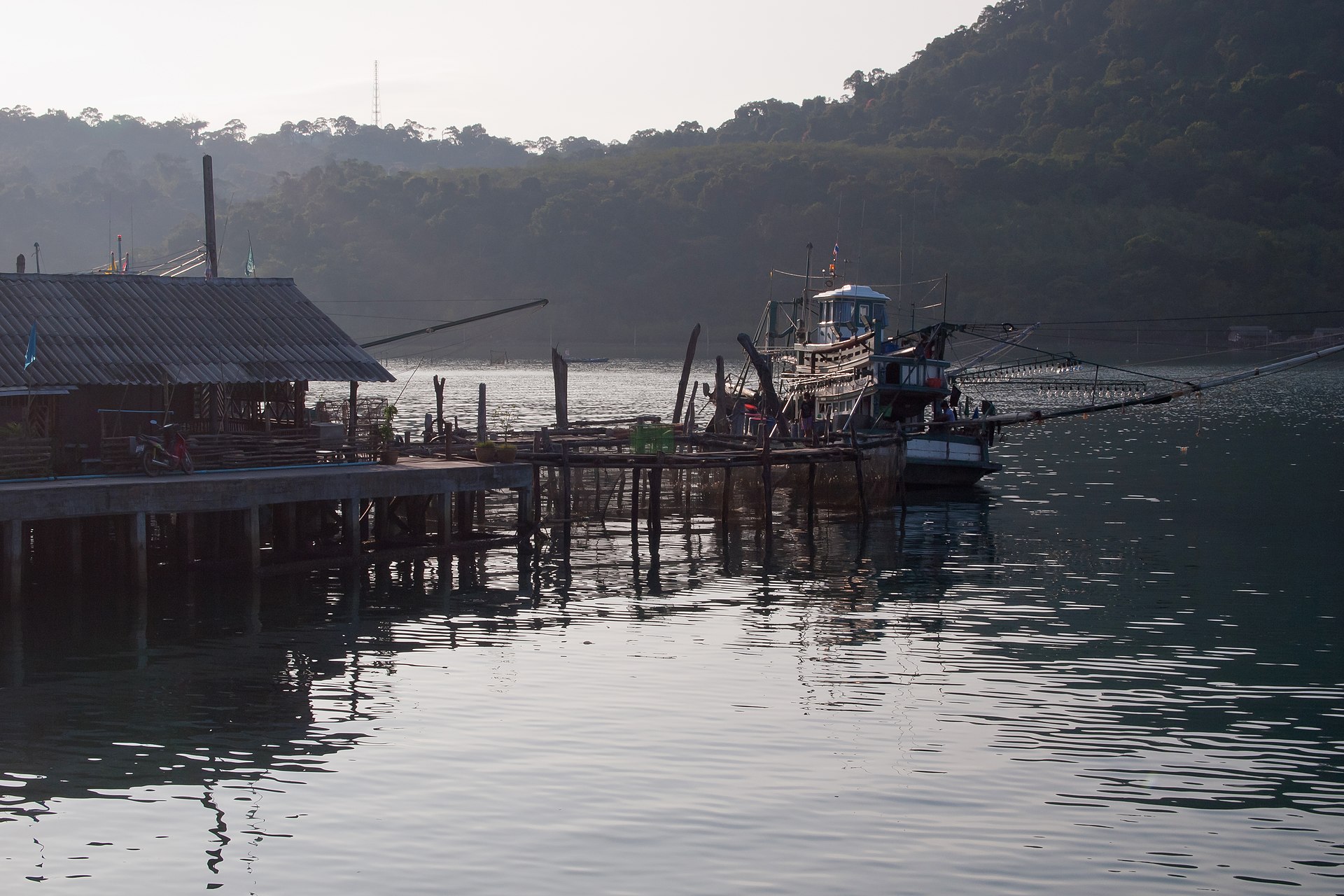
Koh Kood is the easternmost island of Thailand, the far tip of Trat province before the Cambodian border, and the second-largest island on the eastern Gulf coast. What keeps people talking about it is the water — clear enough to see the sandy bottom and schools of fish, and many visitors call it the clearest sea they've ever found in the Gulf of Thailand. The island is still relatively undeveloped: no wide roads, no high-rises, no convenience stores on every corner. The quietness that's hard to find anywhere these days has lasted a little longer here. If you want to lie on a beach and actually hear the waves, this island delivers.
There's enough to fill a full day on the island. Ao Ta Pao Bay and Klong Chao Beach are white-sand stretches with shallow clear water easy to wade into. Ao Phrao and Ao Bang Bao — a fishing village on stilts over the sea — have a different kind of charm. Head inland and you'll find Klong Chao Waterfall, a three-tiered cascade that flows year-round, a short walk in with no entry fee and a deep pool to jump into. One more spot not to miss: an ancient Yang-na tree centuries old, so enormous it takes several people with arms spread wide to encircle the trunk — once you see it, you don't forget it.
Getting there: depart from Laem Sok Pier, about 20 minutes from Trat town. Speedboats and ferries run the crossing in 45 minutes to 1.5 hours depending on the vessel — several companies operate the route including Boonsiri, Seudamgo, and Koh Kood Express. A one-way ticket runs around 350–600 THB. Some operators include a hotel transfer from Trat town for a small surcharge. Book in advance for long weekends.
The best time to visit is November to April when the sea is calm and clear. Wet season boats may be cancelled, and ATMs are scarce on the island — many shops are cash only. That limited connectivity is part of the appeal for some. Rent a motorbike to explore the island; it's the most convenient way to move around.
Laem Ngob Lighthouse (Eastern Edge of the Land)
If you're in Trat and about to take the ferry to Koh Chang, Laem Ngob Lighthouse is worth a stop. It's a white-and-red striped lighthouse standing on the shore at Laem Ngob, with a large sign reading "Eastern Edge of the Land" marking this as the far eastern edge of the Thai mainland. Most people come for a photo to keep as a memento — reviews consistently say it's a landmark you have to stop at, takes under 15 minutes, and suits anyone waiting for a ferry or wanting a good sea shot without spending much time.
The pier is the highlight not to miss: a long walkway stretching out into the sea from which Koh Chang is visible in the distance. Come in the evening and you'll get a sunset that many rate as one of the finest on the eastern seaboard. Around the grounds there's also a monument to Prince Chumphon, the founder of the Royal Thai Navy, and a stretch of community street art to wander and photograph. Restaurants and souvenir shops are nearby. The area is an old fishing community where Thai Buddhist, Thai Muslim, and Thai Chinese families have lived alongside each other for generations — the streets are unhurried and pleasant to walk.
Entry is free, there's parking and clean toilets. Located at the end of the coastal road at Laem Ngob, close to the Koh Chang ferry piers — easy to drive to, open daily. The best time is late afternoon before sunset: the light is good and the temperature is manageable. Note that this is a short photo stop rather than an all-day destination — plan it alongside other Laem Ngob spots or time it around your ferry crossing.
Ban Tha Ranae Mangrove Nature Trail
If you want to see Trat's mangrove forest in a way you won't find anywhere else, the Taban Tree Courtyard at Ban Tha Ranae is the place to come. This small community in Nong Khan Song sub-district, about 20–30 minutes from Trat town, runs boat trips that wind through thousands of rai of mangrove forest — locals call it the "Eastern Amazon." The centrepiece is the Taban tree courtyard: a natural clearing formed by the roots of century-old Taban trees weaving and curling across the ground in wide wave-like patterns you can actually walk on, and the grove has been designated a "Heritage Tree of the Land." Good for nature lovers, families, and anyone who wants a truly unusual photo angle.
The trip takes in three forest types in one ride — Rhizophora (mangrove), Nipa Palm, and Taban — about 30 minutes by boat from the pier. Along the way, keep an eye out for monkeys, mudskippers, fiddler crabs, and mangrove birds. When you reach the Taban courtyard at low tide, you can walk out onto the roots and play "Taban bowling" — a local game using the tree's fruit. Afterwards there's "Roi Roo tea," an herbal tea made from the community's forest plants. You can also do natural-dye fabric workshops using Taban fruit or release mud crabs back into the water. Some visitors choose to explore by SUP paddle instead of a boat. Most reviews say it feels genuinely like local life — nothing staged.
The price is reasonable: 100 THB per person by boat (for 1–2 people the minimum is 300 THB for the whole boat, which seats about 9). Open daily 09:00–17:00. Google Maps rating around 4.5 from hundreds of reviews — the community also has national awards for mangrove conservation, so you're learning as well as exploring.
Important note: the Taban courtyard is only accessible at low tide. Call ahead to check tidal timing with the community (Sai Chon: 081-161-6694) or message their Facebook page before you go. Wear shoes that can get muddy, bring sun protection and insect repellent, and allow 2–3 hours for the full trip.
Black Sand Beach, Laem Ngob
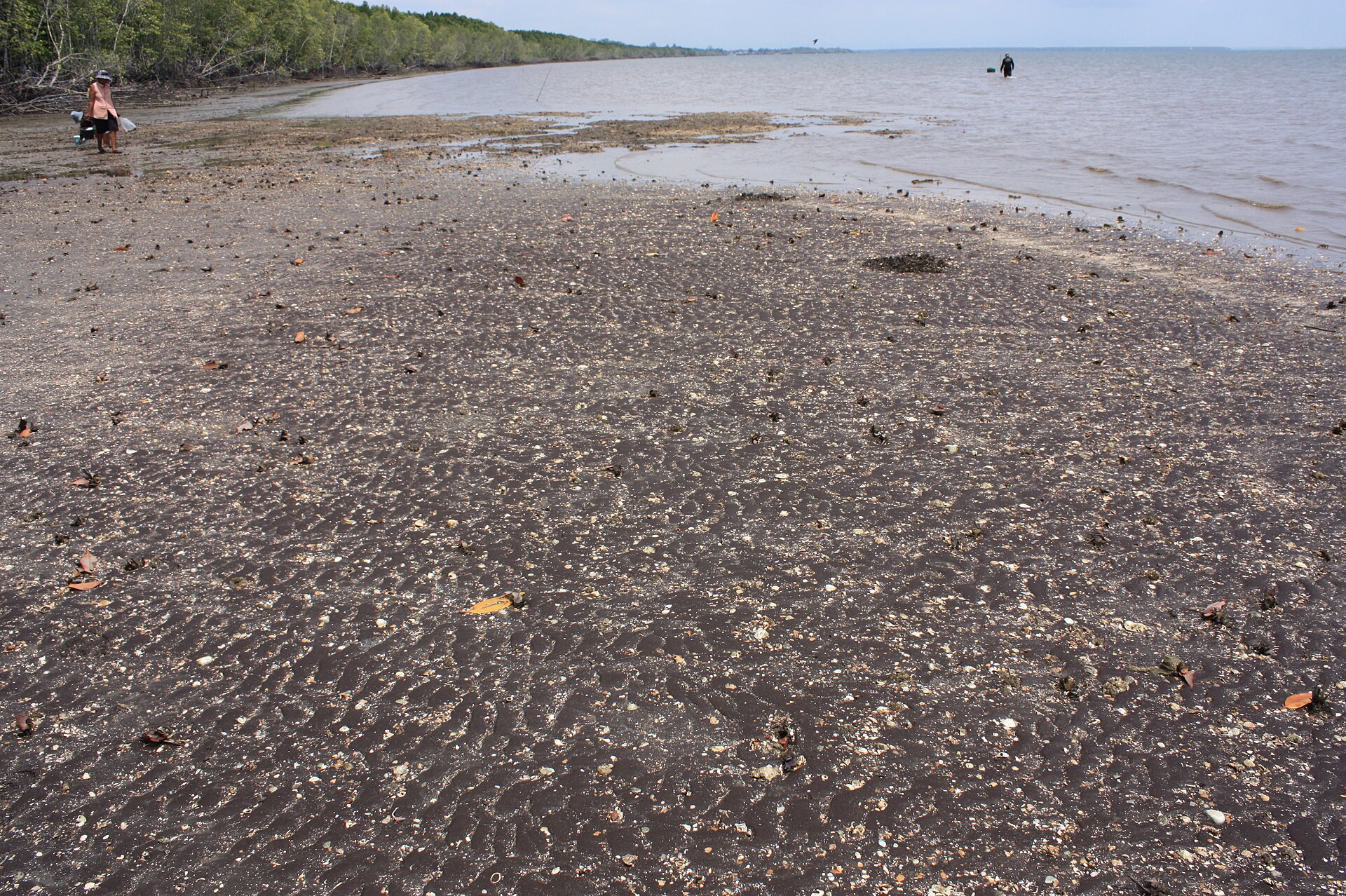
Black Sand Beach at Laem Ngob is one of the most unusual natural attractions in Trat: a naturally black-sand beach that exists in only a handful of places on earth (Taiwan, Malaysia, Hawaii, California, and here in Trat, Thailand). The black colour comes from limonite mineral deposits — not pollution or mud — and the fine-grained sand forms a ridge stretching more than one kilometre through the mangrove forest of Pa Laem Makham National Forest. Good for nature lovers, families with children who want to learn about ecosystems, and anyone who wants a photo angle unlike any normal beach.
The highlight is an elevated boardwalk nature trail running almost one kilometre through a dense stand of mangrove trees, with information boards and wildlife observation points along the way — large mudskippers, fiddler crabs, mud crabs, shellfish, and mangrove birds. At the end of the trail there's a viewing tower you can climb for a view of the Gulf of Thailand and Koh Chang on clear days. Then walk down to the black sand itself for photos. Many visitors smear black sand on their skin following a local belief about its health benefits (no medical verification — treat it as a fun activity).
Cool, shaded, quiet, with a sea breeze. Elevated concrete boardwalk makes walking easy throughout. No entry fee, open roughly 08:30–16:30 daily. Located on the Trat–Laem Ngob highway, about 20 minutes from Trat town — park at the entrance lot and walk in. Pairs well with a trip to Koh Chang or Koh Mak before or after the crossing.
Important: timing matters here. At low tide the full expanse of black sand is exposed and you can walk on it for photos. At high tide the beach is almost completely submerged and only the boardwalk trail remains usable. Check a tide table before heading out. The boardwalk can be slippery — wear good-grip footwear, and allow 1–2 hours.
🛏️ Where to Stay in Trat — One Night Makes a Difference
Trat has accommodation for every style: hotels in the town centre within walking distance of the market and the walking street, quiet resorts in Laem Ngob near the Koh Chang ferry piers, and community homestays for the nature crowd. If you're planning to cover both the coastal side and the town, staying one or two nights lets you head out early without rushing back. Compare rates across multiple booking sites here.
Ban Nam Chiao Community (Wat Jai Bridge)
Ban Nam Chiao is a small village on the canal between Trat town and Laem Ngob, where people have lived together for over 200 years across "2 religions, 3 cultures" — Thai Buddhist, Chinese, and Muslim Cham descent. A few steps apart you'll find Wat Nam Chiao (an old temple that King Rama V visited) and Al-Kubra Mosque, the first mosque in eastern Thailand, over 200 years old. Good for people who want to travel slowly and absorb real community life rather than a quick check-in, and families or anyone interested in traditional crafts.
The landmark everyone comes for is the "Wat Jai Bridge" — a curved iron footbridge arching high over the canal, tall enough for fishing boats to pass under, which means it's steep enough to make people nervous. Local lore says you haven't really arrived at Ban Nam Chiao until you've crossed it. When the bridge shadow reflects in the water as a perfect oval, it earns its nickname "Eye of Ban Nam Chiao" and becomes the most-photographed spot in town. Not to miss: board a boat through a mangrove tunnel watching fishing life go by, pick mussels, try weaving a bamboo hat (a 4-star OTOP craft with several styles available), and eat Ya Na fish crackers and crispy tangmo sweet — the community's own traditional snacks.
Walking the community and crossing the bridge costs nothing. Full activity packages run through the community enterprise (full-day starting around 1,200 THB per person including boat, food, and workshop; overnight homestay around 250 THB per person). Advance booking recommended: call 061-660-0955 or 089-244-6702, or message the Facebook page. Located in Nam Chiao sub-district, Laem Ngob district, about 8 km from Trat town on Highway 3148 — under 20 minutes by car. Walk the community any time; for boat trips, aim for morning to afternoon.
The community has earned the Kinnaree Award (Thailand Tourism Awards 2023) for learning tourism and a Zero-Carbon Community Tourism Award. Visitors consistently say the residents are warm and friendly, the atmosphere is calm, and the multicultural feel is unlike anywhere else in the region. The bridge is steep and can be slippery in the rain — wear grip-soled shoes. If you want a guide or boat, contact the community group in advance.
Trat Walking Street (Lak Mueang Road)
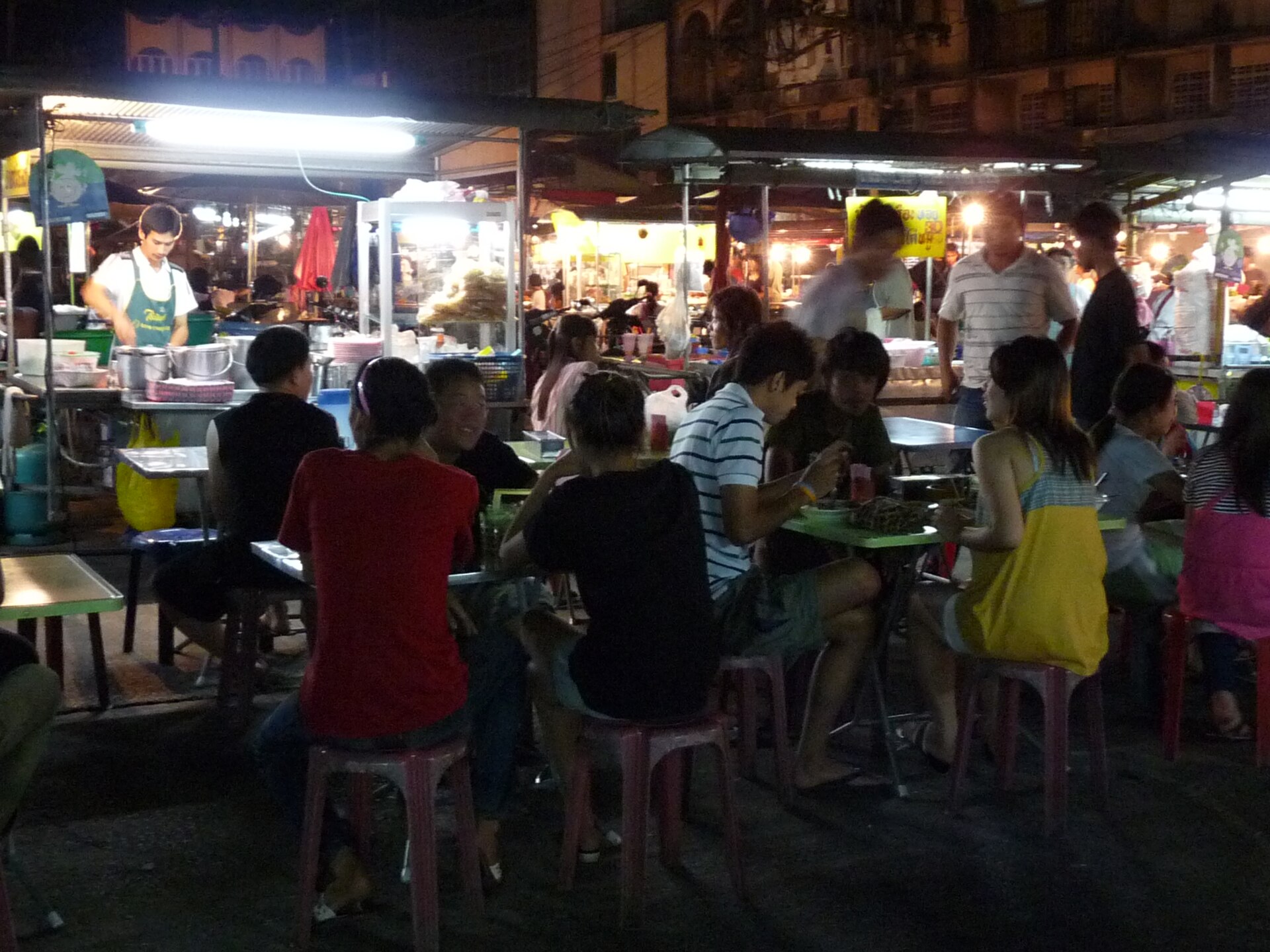
If you happen to be in Trat on a Saturday evening, the "Trat Walking Street — Withi Khon Trat" on Lak Mueang Road in the city centre is not to miss. This is the one night of the week when the old main street closes to traffic and transforms into a promenade for eating, browsing, and strolling — running from about 15:00 until around 21:00, from the Trat Inn junction down to the Saraphat College intersection, about one comfortable kilometre of walking. Great for anyone who wants to see real Trat life without a filter — whether you're a food lover, a leisurely walker, or a family with children out for an evening.
What people keep talking about is the local Trat food that's hard to find elsewhere: forest-style curry in a local recipe, fresh seafood, colourful Thai sweets, and cheap street snacks you carry in a bag while you walk. Beyond food there's a proper market vibe — secondhand clothes, potted plants, craft items, and community OTOP goods that residents sell themselves. One thing that makes the atmosphere — students busking, singing, playing instruments at intervals along the street, against the backdrop of old shophouses that still carry the spirit of the original Trat old town.
Free to enter, no entry fee. Most street food items start in the tens of baht range — 200–300 THB a head covers a long evening of eating and buying. The walking street runs on Saturday evenings only (on other days Lak Mueang Road is a normal road). Heavy rain can thin the crowd or cause cancellation, and parking in the area is limited — park a short walk away and come on foot. If you're staying in central Trat, you can walk here; it's a few minutes from Trat Municipal Market and Trat Hospital.
Trat City Museum
If you want to know Trat as something more than just islands and Koh Chang, Trat City Museum is worth a stop. It's an old teak house on high stilts with a hip roof — actually the original provincial hall from the reign of King Rama VI, badly damaged in a fire in 2004 and restored by the Fine Arts Department to reopen as a museum. The building itself is beautiful in a way that makes architectural enthusiasts appreciate it before they even step inside. Good for history buffs, quiet solo walkers, or families who want a genuinely educational afternoon without rushing.
Inside there are 6 exhibition rooms tracking Trat's story: natural heritage and geography, the province's multiethnic population (with an ancient bronze drum on display), archaeology and history, events from the Rama V era when Trat was returned from France, the naval battle of Koh Chang room — the most talked-about exhibit, designed to feel like a warship interior with a scale model vessel and a light-and-sound narrative — and finally the Trat market room covering the history of the old trading town. Information panels are in both Thai and English; several foreign visitors note in reviews that they could follow the content easily.
Calm and quiet, especially on weekday visits when the rooms are uncrowded. Most reviewers say 1–1.5 hours is enough to see everything. Admission is extremely reasonable — 10 THB for Thai adults, 30 THB for foreigners. The only note from reviews is that some interactive screens may not be working, but that doesn't affect the main content.
Located on Santi Suk Road, Bang Phra sub-district, Trat town, near the provincial hall and the Rama V monument — easy to drive to, easy to park. Open Tue–Fri 09:00–16:00, Sat–Sun and public holidays 09:30–16:30, closed Mondays. A good first stop before heading out to explore — understanding the Battle of Koh Chang makes the memorial site at Laem Ngob make more sense.
Trat City Pillar Shrine
Trat City Pillar Shrine is a city pillar unlike most others in Thailand — rather than a standard Thai-style pavilion, the building is a Chinese-style "Keng" hall, painted vivid red trimmed with gold and covered in dragon carvings and fine plasterwork. Anyone interested in unusual architecture or collecting provincial city pillars will want to stop here. It's one of the most venerated sites in the city, respected by the community for generations. Local tradition holds that construction began during the time of King Taksin, when he rallied his forces at Trat — following Chinese belief for the protection of the city.
What visitors consistently mention is the intensity of colour and craftsmanship. Step inside and you'll find a pair of city pillar shrines and several deities that people come to pray to — Xiao Yun Gong, the deity of fortune Cai Shen Ye, and an earth goddess. People come primarily to pray for health, work, and safe travel, which makes sense in a frontier port city at the edge of the sea and a national border. Those driving long distances or about to board a ferry to the islands often stop to pray first. The atmosphere is warm and intimate — a working neighbourhood shrine with local people coming and going all day.
The shrine is in the heart of the city on Lak Mueang Road, Bang Phra sub-district, near the provincial hall and Wat Yothanimitra — easy to reach by car or on foot from the central market, with parking nearby. Open 05:00–21:00 daily, no entry fee. Good as a first or final stop before heading on to other parts of town.
Note: if you want to see the most atmospheric visit, come during the Pli Mueang ceremony (6th waxing moon of the 6th lunar month) — Thai merit-making and Chinese shrine rites happen together. On ordinary days the shrine is quiet, photogenic throughout the day, and photography is welcome. Dress modestly as it is a sacred site.
Koh Chang Naval Battle Memorial
Koh Chang Naval Battle Memorial is a spot many people overlook — but those who do walk through it often end up glad they stopped. Located on the Laem Ngob seafront, close to Trat town, it suits history enthusiasts, families with children who want a real learning visit, and photographers who want an unusual angle. The centrepiece is the museum building designed as a warship, modelled on HTMS Thonburi, standing prominently at the water's edge in a shape immediately unlike any ordinary building. At the front stands a statue of Prince Chumphon Khet Udomsak — the father of the Royal Thai Navy — looking out over the sea that was once the battlefield on 17 January 1941.
Not to miss: walk up into the warship. Inside, the Battle of Koh Chang — a naval engagement between the Royal Thai Navy and French forces — is told through exhibition boards, old photographs, scale models of warships, and a list of the sailors who gave their lives. Visitors consistently say "genuinely educational, calm atmosphere," and several appreciate the view of Koh Chang Bay from the upper deck. Beyond the museum there's a small quiet beach for sitting in the sea breeze, and kayaks for rent along the shoreline — a good way to wind down before or after the Koh Chang ferry.
No entry fee. Costs are just getting here and kayak rental if you want to paddle. Open roughly 08:00–16:00 daily. Located on the coastal road at Laem Ngob, under half an hour by car from Trat town, near the Koh Chang ferry piers — easy to add to the route. Every year from 17–21 January the site holds a commemoration of the sailors of the Battle of Koh Chang, and it becomes notably livelier.
Note: most exhibition text is in Thai, so foreign visitors may miss some detail. Some sections of the building may be closed at certain times. Come in the morning or afternoon when the sun is lower — easier for photos and walking around. This is a memorial and historic site — dress and conduct accordingly.
🎟️ Tours and Activities in Trat
Several of Trat's best spots — Ban Tha Ranae's mangroves and Ban Nam Chiao — require a boat and some coordination. Booking a guided tour or activity in advance through Klook or GetYourGuide takes care of the boat, guide, and route so you don't have to coordinate it yourself. Good for anyone trying to cover multiple spots in a day or extending the trip to Koh Chang — check packages and activity tickets before you travel.
💡 Good to Know Before You Visit Trat
Attractions in Trat are spread out and Grab is hard to find here. Renting a car or motorbike is most practical. If you'd rather not drive, book a tour package with included transfers in advance.
Fresh markets, the walking street, community boat trips, and most street food stalls run on cash. ATMs are in the town centre but scarce near the mangrove communities.
Outdoor landmarks like Laem Ngob Lighthouse and Black Sand Beach get uncomfortably hot around midday. Morning or late afternoon visits give better photos and a more comfortable walk — and afternoon means a sunset.
Ban Tha Ranae and Ban Nam Chiao both require boats, and departure times depend on tidal schedules. Call the community or book a tour in advance to get the timing right.
Wat Bupha Ram and Trat City Pillar Shrine are active sacred sites. Dress respectfully, remove shoes when entering a chapel or sanctuary, and follow any posted signs and local cues.
Outside the main tourist areas, English is not widely spoken in Trat. Menus and signs are mostly in Thai. Save offline maps and bring a translation app — locals are helpful and good-natured.
Plan a Day in Trat That's Worth the Drive
With one day, split it into two zones. Start the morning on the Laem Ngob side — go from Laem Ngob Lighthouse (Eastern Edge of the Land) to the Koh Chang Naval Battle Memorial, then on to Black Sand Beach in Pa Laem Makham forest nearby. All three are free, clustered in the same zone, and easy to drive between.
In the afternoon, head back into Trat town. Walk through Wat Bupha Ram, pay respects at Trat City Pillar Shrine (open 05:00–21:00), then drop into Trat City Museum. If it falls on a Saturday evening, finish at Trat Walking Street on Lak Mueang Road — open roughly 15:00–21:00 for local food. Ban Tha Ranae mangroves and Ban Nam Chiao community both require a boat, so plan a separate half-day for those and call ahead about tide schedules.
If you're hitting multiple spots across Laem Ngob and Trat town, booking a night or two in a well-placed hotel lets you head out early and skip the long return drive.
Check hotels in Trat →