🔄 Last checked 28 Jun 2026 · details and hours can change — check the venue before you go
📍 All restaurants on the map
Tap a pin for the spot + nearby stays
The charm of Yasothon is that it's an easy small-town trip where the highlights all carry a whiff of legend and faith. Many of the standout spots cluster in the town centre around Phaya Thaen Public Park, the city's green lung where the evening breeze makes for pleasant walks and jogs. Right beside it is the Phaya Khankhak Toad Museum, a giant-toad building as tall as a five-storey block that tells the legend of Phaya Khankhak and the Bun Bang Fai rocket festival — the tradition that made Yasothon famous nationwide. A short walk further inside the municipality brings you to the Ban Sing Tha old town, rows of pastel Sino-European shophouses where you can take retro photos across the whole quarter with no entry fee. For those drawn to faith and culture, there's Wat Mahathat, the town's principal temple, home to Phra That Anon and the dewdrop Emerald Buddha. You can string together landmarks, old town, nature, and pilgrimage all in one trip.
This list includes the pins you shouldn't skip in Yasothon: Phra That Kong Khao Noi in the rice fields, tied to the folk legend of the son who killed his mother that Isan people across the whole region know; the Song Yae Christian church in Thai Charoen district, the largest wooden church in Thailand at nearly a hundred years old, built entirely from hardwood; the red lotus lake of more than 100 rai, the provincial flower that blooms beautifully on cool-season and early-year mornings; and Wat Phra Phutthabat Yasothon in Maha Chana Chai, with its white-and-blue ubosot and a large white jade Buddha. It finishes with Tham Phu Phra cave in Loeng Nok Tha and Dong Mueang Toei, an ancient Khmer–Dvaravati-era community also woven into the Kong Khao Noi legend. Scroll through the details spot by spot and map out your own route.
Phaya Khankhak Toad Museum (Wiman Phaya Thaen)

If you come to Yasothon and don't stop at the enormous toad-shaped building by the Lam Thuan reservoir, you haven't really been. The Phaya Khankhak Museum is a building shaped like a toad (phaya khankhak in Isan) standing 19 metres tall, as high as a five-storey block, crouching proudly in the middle of Phaya Thaen Public Park. It's a landmark that makes every passing driver slow down for a look, and beside it the shimmering golden Wiman Phaya Thaen makes the corner even more striking. It suits families bringing children to learn, photography lovers, and anyone who wants to understand the legend of Phaya Khankhak and Phaya Thaen — the origin story behind the province's famous Bun Bang Fai rocket festival.
The highlight is climbing floor by floor. The ground level tells the history of Yasothon town, higher up comes the legend of Phaya Thaen and Phaya Khankhak, the story of the rockets, and the identity of the city. There are models, exhibits, and facts about hundreds of toad species that thrill the kids. What you can't miss is going all the way up to the top level at the toad's mouth, a 360-degree viewpoint over Yasothon. Many reviews say the view up top is the real star here. Outside there's a replica rocket-festival procession and plenty more photo corners.
Entry is very easy on the wallet: adults 40 baht, children 20 baht. A full visit takes about 1–2 hours. Open Wednesday–Friday around 10:00–16:30, Saturday–Sunday and public holidays 09:30–17:30, closed Tuesdays (except when they fall on a public holiday). It's within Yasothon municipality in Tambon Nai Mueang, easy to reach, with parking available.
One thing to know: the stated opening hours vary slightly from source to source, so it's worth calling to check if you're coming on a weekday, and don't come on a Tuesday because it's closed. The building and the viewpoint are the real draw, though some reviews grumble that the surrounding grounds could be better maintained. Even so, as the provincial symbol and a photo unlike any other, this is one of Yasothon's top check-in spots and shouldn't be missed.
Phra That Kong Khao Noi

Speak of Yasothon and, besides the rockets, almost every Isan person thinks of Phra That Kong Khao Noi, because it's bound up with the folk legend of 'Kong Khao Noi killing his mother' passed down through the generations. The story goes that a farmer's son, ravenous while working the fields, grew furious when his mother arrived late with his meal and the rice basket looked tiny; blind with rage, he struck her and she died. But when he ate, the rice was more than enough, and he was overcome with remorse — so he built a chedi shaped like a rice basket to atone. The actual chedi is an old square brick tower with a pointed top, standing out in the middle of the rice fields. It suits people who like attractions with a story, history lovers, and anyone who wants to stop to pay respects and take a beautiful photo.
The unmissable highlight is the old chedi in the fields itself, at its most photogenic in the late afternoon when the golden light falls across the paddies. Many reviews describe the atmosphere as romantic and quiet. Another popular custom is making a vow and then repaying it with a 'buffalo figurine' — you'll see them lined up around the grounds, a signature sight here. For anyone who enjoys curious details: there are actually two chedis of this type in the Tat Thong area, one at Wat Thung Sadao and one at Ban Tat Thong, just a few kilometres apart — you can visit both.
Money-wise it's very easy: free entry, no admission charge, open at all times. There's a parking lot, restrooms, and village stalls selling local food and souvenirs nearby. The whole trip costs no more than a bit of pocket change for drinks and snacks. It sits in the fields of Tambon Tat Thong, Mueang Yasothon, about 9 km from town — drive along Chaeng Sanit Road (Highway 23) towards Kham Khuean Kaeo and turn into the village. Easy to drive and easy to park.
An honest note: online review scores sit around 3.6–3.7, and some reviews grumble that upkeep isn't quite what it could be. If you come expecting a grand site you may find it plainer than imagined, but if you come to feel a genuine Isan legend, capture the old chedi in the fields, and make a wish, this place offers an atmosphere you won't find elsewhere. Come in the late afternoon to avoid the midday heat, and the light will be just right.
Ban Sing Tha Old Town
If you enjoy strolling through old quarters and photographing historic buildings at your own pace, the Ban Sing Tha old town in the middle of Yasothon municipality is a must. This was once a trading district on the Chi River, dating back to the town's founding. When the French and Chinese-Vietnamese merchants arrived, the shophouses took on a Sino-European style (many compare it to the Sino-Portuguese buildings in Phuket): bright pastel paint, folding timber doors, and stucco detailing still in good shape. You can take retro photos across the entire quarter with no entry fee.
The highlight is walking along both sides of Si Sunthon, Nakhon Thum, Uthai Ramarit, and Witthaya Thamrong roads, each stretch with its own standout corners — from the pink-and-orange Sino-style coffee-shop building and the white fretwork timber building of an old rice-mill shop to the Sing Roundabout, the quarter's signature check-in spot. For the full experience, stop at the Ban Sing Tha Old Town Museum, a two-storey white colonial building with air conditioning, presenting Yasothon's story interactively; it's free too. Many reviews suggest wearing white or cream tones to match the buildings for photos.
The overall feel is slow-life: villagers living simply, no crowds. It's best in the morning or late afternoon when the light is soft and the heat manageable. As you walk, there are famous local bites like pla som (fermented fish) and Yasothon lot chong to try. Allow about one to two hours. The quarter is within the municipality, easy to reach with convenient parking, open for walking every day (the museum itself around 08:30–16:30), free to visit.
People love it because it's an old town that's still genuinely alive, not staged for tourists — an easy stroll with lovely photos and no need to plan much. One thing to know: some of the shops in the quarter are homes where people still live, so be considerate of residents when taking photos, and on weekdays some shops may be closed. If you want more buzz, try coming at the weekend.
Wat Sa Trai Nurak Scripture Library (Wat Ban Na Wiang)
If you like quiet attractions that carry a story stretching back a century, the Wat Sa Trai Nurak scripture library at Ban Na Wiang in Sai Mun district is a spot worth the detour. The library itself is a small wooden building set in the middle of a pond, connected only by a little wooden bridge. Seen from the water's edge, it looks like an old painting, the shadow of the wooden roof falling on the still surface. What makes it special is that it wasn't built over the water just for looks — people of old set it there so the water would serve as a barrier against ants and termites, because inside it once held many palm-leaf Tripitaka manuscripts, exactly the sort of thing insects love most. Placing the library in the middle of the pond was a simple piece of wisdom that genuinely worked.
The craftsmanship here is well worth seeing. The building is entirely wooden, resting on dozens of round wooden posts, with a tiered gabled roof layered up in stages and wing-shaped eaves projecting on all four sides, shingled with small wooden tiles. It's an Isan–Lan Xang style with a Tai Yai and Burmese artistic influence, which gives the roof form a different look from ordinary Isan temples. If you like noticing details of old woodwork, walk around and you'll see the joinery and the layered roof that the craftsmen made carefully and without hurry.
Its age is remarkable too. This library is said to have been built around the 23rd–24th Buddhist century, tied to the story of people migrating from the Vientiane side to settle here. It has been restored several times over the past hundred-plus years, and in 1990 the Fine Arts Department registered it as a national heritage site. Today it's cared for as the community's historical scripture-library museum, so when you walk through, please help preserve it — don't climb on or grab the wooden structure roughly, so this old treasure can last for many more years.
A visit here suits anyone who wants a change from the big temples and a look at something genuinely rare. It doesn't take long — walk around the pond taking photos, listen to stories from community members if someone is around to look after it, and then carry on to other Yasothon spots. It's about 25 km from Yasothon town; driving yourself is recommended, as public transport is hard to reach here. Morning or evening when the sun is gentle is the best time for photos, and you should dress modestly since it's a temple precinct. As for exact entry fees or opening times, it's best to ask locals again before you travel.
Wat Mahathat Yasothon
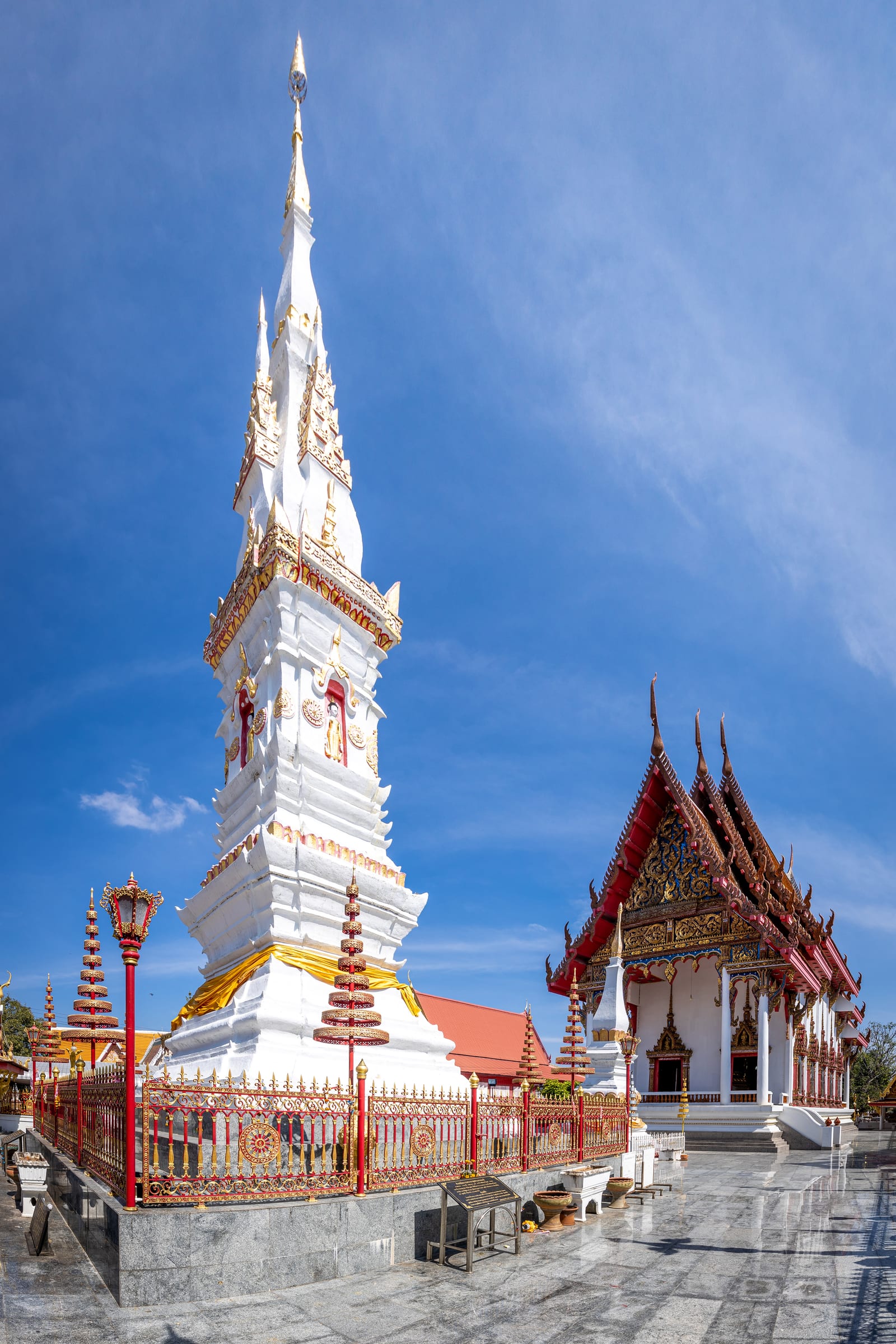
If you come to Yasothon and want to truly understand the town, start at Wat Mahathat, the royal temple in the heart of the old quarter and the town's principal temple since Yasothon was founded. It isn't a grand, monumental temple, but it's one that Yasothon people are deeply attached to. It suits merit-makers, history lovers, and travellers who want to collect the town's important landmarks in one place. A walk around doesn't take long, but you come away with both merit and stories.
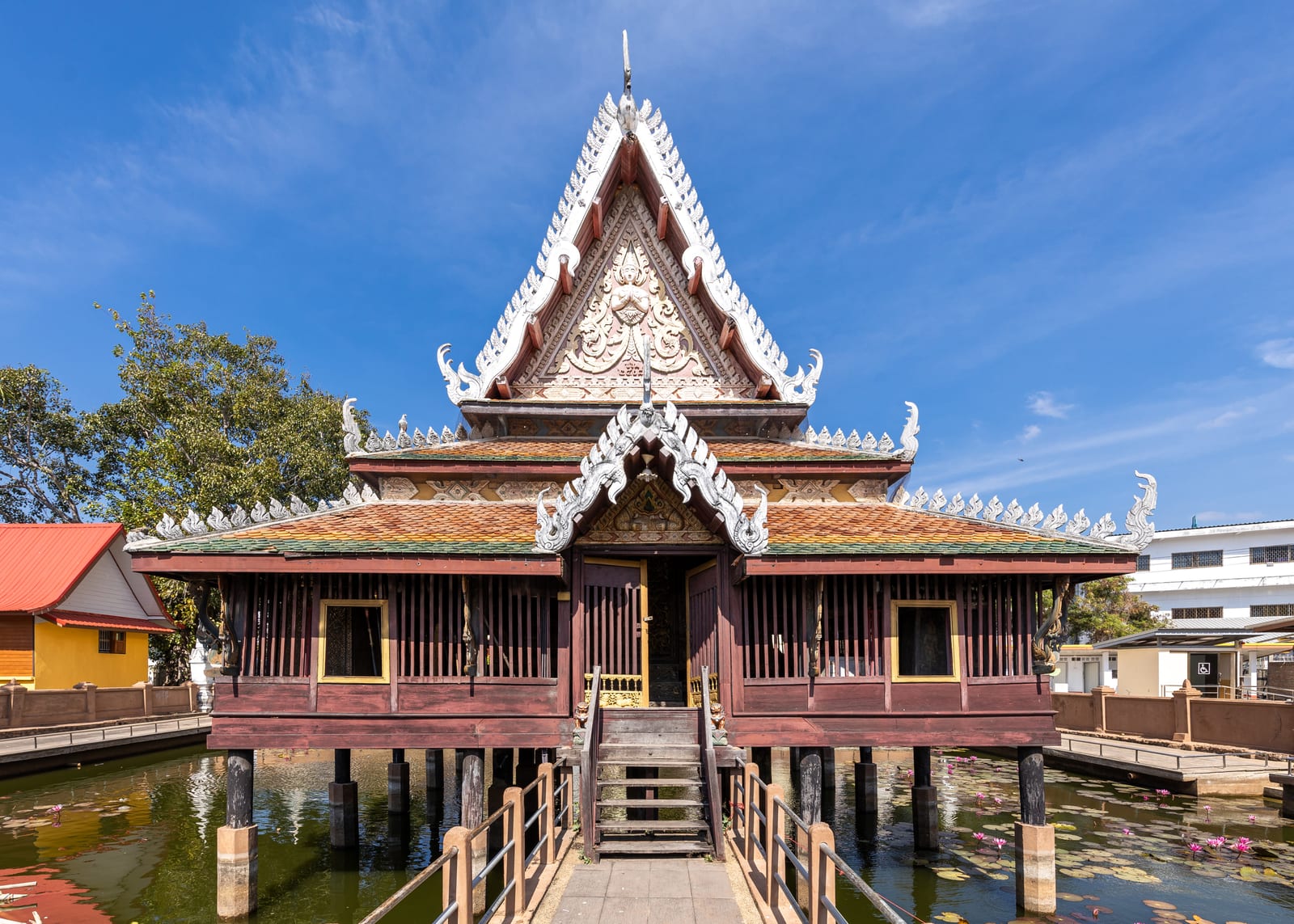
The unmissable highlight is Phra That Anon, or Phra That Yasothon, a square chedi with a spire resembling Phra That Phanom, standing prominently in front of the ubosot. It's an ancient Isan chedi believed to enshrine relics of Phra Anon (Ananda) — said to be the only one of its kind in Thailand. Another treasure many come to pay respects to is the dewdrop Emerald Buddha, or Phra Phuttha Butsayarat, a tiny clear crystal Buddha in Chiang Saen style, said to be the smallest such crystal Buddha in Thailand. Don't miss the wooden scripture library over the water, built to house palm-leaf manuscripts from Vientiane; the shaded, quiet setting is a pleasure to photograph.
Cost-wise you can relax: free entry, donate as your faith moves you. It's right in the town centre, near the market and morning food stalls, with convenient parking. Open for veneration daily around 08:00–17:00. Come in the morning while the sun is gentle for an easy walk and lovely light. If you visit in early March you'll catch the Phra That Phra Anon veneration festival, the big annual tradition where the whole province gathers — very lively.
This temple is popular because it brings together the town's key treasures — a sacred chedi, a rare crystal Buddha, and old architecture in a single place. Reviews from past visitors tend to agree it's a peaceful temple with a genuinely sacred feel, the true spiritual heart of Yasothon. One small note: it's a sacred place, so dress modestly, and at times the ubosot or the hall housing the crystal Buddha may not be open all the time. If you're set on paying respects to the actual crystal Buddha, ask the temple staff first.
🛏️ Hotels in Yasothon — Stay in the centre near Phaya Thaen Park and the old town
To make the most of Yasothon, stay overnight so you can stroll along Phaya Thaen Public Park in the evening, visit the Phaya Khankhak Museum while it's still quiet, and drive out in the morning to catch the red lotus lake in full bloom. The most popular hotels cluster in Yasothon town near Phaya Thaen Park and the Ban Sing Tha old town, within easy walking distance of central cafés and food. There are both central hotels and simple, friendly-priced places. Pick a location near the first spot you want to see in the morning for the best value. Compare prices and reviews before you book.
🔍 Check Yasothon Hotel Prices (Agoda)Song Yae Christian Church

When it comes to unusual sights you have to see with your own eyes in Yasothon, the Song Yae Christian Church — officially St. Michael the Archangel Church — is one of the first. Its selling point is clear: it's the largest wooden Christian church in Thailand, nearly 100 years old. The building is 16 metres wide and 57 metres long, using hardwood posts of various sizes totalling 360 columns, and roofed with more than 80,000 small wooden shingles, with almost no cement anywhere. What's fascinating is how the design blends Thai art with a Western church form. Step inside and it's quiet, shaded, and cool from the breeze passing through the timber openings. Anyone who loves architecture, history, or photography will be captivated.
The must-not-miss thing is standing in the centre of the hall and looking up at the entire structure of wooden posts and beams — a rare sight. Then walk around and look at the stained glass in the window openings; when the sun streams in, the colours fall on the wooden floor beautifully. Many reviews agree the atmosphere inside is more solemn and peaceful than expected — even non-Christians can walk through and take it in comfortably. Another favourite angle is the exterior, where you see the full sweep of the long roofline, and there's the legend of the village's founding, when settlers fled tales of the phi pop ghost, which gives the place a charm with real backstory.
Entry is free, no charge, but there's a donation box for those who wish to support the church. Open for visits daily around 08:00–18:00. Dress modestly and behave respectfully, because it's still a church where Mass is actually held. If you come on a day with a service, you can view the exterior. It's located at Ban Song Yae, Tambon Kham Toei, Thai Charoen district, a fair distance from Yasothon town — driving yourself is easiest.
One thing to know: it's fairly far out with no direct public transport, so plan your route and fuel up. Late morning to afternoon is when the sun lights the stained glass best. It fits well combined with other attractions along the same route. If you like quiet attractions with a story and no crowds, this one delivers, and it photographs well from every angle.
Wat Phra Phutthabat Yasothon
If you're heading over to Maha Chana Chai district, it's worth stopping at Wat Phra Phutthabat Yasothon. It's an old temple set on a sandy rise along the Chi River at Ban Nong Yang, Tambon Hua Mueang, about 6 km from Maha Chana Chai town. What people talk about most is the clean white-and-blue ubosot that looks striking against the sky on a bright day. It suits merit-makers, pilgrims, and anyone who likes quiet temples without the crowds of the famous ones.
The unmissable highlight is Phra Phuttha Lokanat, the principal Buddha in the ubosot, carved entirely from white jade, with a lap width of about 2.31 metres — said to be the largest white jade Buddha in Thailand. The creamy white jade is genuinely calming to look at. Another spot is the replica Buddha footprint enshrined on the sandy rise, and the seated Naga-sheltered Buddha (Luang Pho Nak Prok) said to have been brought from Ayutthaya. Architecture lovers will find the three-tiered Maha Chana Chai chedi, whose interior displays old Isan household objects and stores the Tripitaka, open for you to see.
Cost-wise you can relax: free entry, donate as your faith moves you, open daily during the daytime. The overall setting is shaded and pleasant because it sits by the Chi River, with a cool breeze. Past visitors often say it's quiet and peaceful, better for settling your mind than for casual photos. It's a temple that Yasothon locals and dharma-minded travellers favour for paying respects and making wishes.
A small note: the temple is fairly far out of town, and the final stretch of road is a village lane, so driving your own car or motorbike is easiest. Dress modestly since it's a Buddhist precinct, and to capture the blue ubosot at its best, come in the morning or late afternoon when the sun isn't too harsh. All in all, a worthwhile stop if you're travelling around the Maha Chana Chai side of Yasothon.
Yasothon Red Lotus Lake
If you love the quiet feel of the Isan countryside with natural views worth stopping for, the Ban Samrong red lotus lake belongs on your list. This is a natural lake originally called Nong Loeng, at Ban Samrong, Tambon Khu Mueang, Maha Chana Chai district, Yasothon, where red lotuses grow naturally across more than 90 rai of water, developed by villagers and the local community into a conservation-focused attraction. It's ideal for photographers, nature lovers, and families who want to bring elders for an easy, relaxed walk in the cool morning air.
The unmissable highlight is taking a boat out into the middle of the lake amid the pink-red lotuses in full bloom as far as the eye can see — and this red lotus happens to be Yasothon's provincial flower. Along the way you'll often see flocks of water birds flying up close. Some people choose to cycle or ride a small three-wheeler around the lake instead. Genuine reviews consistently say a morning visit is well worth it: lovely light, lotuses in full bloom, and pleasant air. If you get hungry there's hot khao chi, coffee, and local silk to buy and take home.
Budget is very easy: free parking, and the boat or ride-in fee is just tens of baht (around 20 baht). It's in Maha Chana Chai district, a fair distance from Yasothon town, so driving yourself is recommended. The lotuses are at their best in the cool season, roughly December to February, and you need to come in the morning from around 05:00–11:00, because the lotuses begin to close after noon. Its popularity comes from the image of a pink lotus lake filling the water — grand and easy to reach — a signature cool-season check-in for Yasothon.
Things to know: the red lotus lake is a seasonal phenomenon. Outside the cool season the lotuses may not bloom, and in some years the water level drops because it's pumped out for farming, so check the lotus situation with a local page before you travel, and come early to avoid the strong sun and see the lotuses in full bloom.
Tham Phu Phra
If you enjoy dharma-flavoured trips with a touch of light adventure, Phu Tham Phra is a pin Yasothon people are very proud of. It's a rock cave on the Phu Phra range, and inside it enshrines rows of ancient Buddha images — a reclining Buddha and two Phra Sangkajai figures — said to have been created in the era of Phra Ajarn Di Channo, around 1957. Around it stretches roughly 200 rai of mixed deciduous forest, shady and cool, ideal for anyone who wants a quiet corner to pay respects, meditate, or bring the family for an easy forest walk close to town.
The unmissable highlight is the inner Tham Phra, a natural two-level cave on a rock ledge on the southern side. Deeper in you'll find rows of ancient Buddha images that many reviews describe as genuinely solemn and sacred. Walk up a little further and there's a viewpoint looking out over the forest and long mountain ranges, and nearby there are other caves to explore too — Tham Kliang, Tham Kheng, and Tham Phrom But. If you like collecting them all in one trip, this place is well worth it.
Money-wise you can relax, because entry is free, no charge, open around 06:00–17:00 daily. It's over in Tambon Kut Hae, Loeng Nok Tha district, about 12 km from Loeng Nok Tha town and around 85 km from Yasothon town. The drive in is easy, but once you park you'll have a fair bit of walking up and down.
A small note from those who've been: the path into the cave is fairly steep and rocky, so wear trainers or shoes with good grip, bring water, and take extra care if you go in the rainy season when the trail gets slippery. Morning or late afternoon is the most comfortable time to walk, because the forest air is still cool and the sun isn't harsh.
Ban Song Pueai Heritage Site (Dong Mueang Toei)
If you like history in a quiet way, with no competing for photo angles, Dong Mueang Toei at Ban Song Pueai, Kham Khuean Kaeo district, is a pin worth having on your Yasothon list. This isn't a pretty temple or a splashy photo landmark, but the ruins of a very old ancient town. The oval-shaped mound is ringed by a moat and earthen rampart, and at its centre stand the remains of a brick sanctuary, built without mortar, still about 1.7 metres tall — the genuine article from the pre-Angkorian (Chenla) period, around the 12th–13th Buddhist century, with an early Khmer artistic influence. It suits anyone who wants to experience Isan at a deeper level than usual.
The unmissable highlight is the brick sanctuary ruin at the centre of the mound, along with the story of the Dong Mueang Toei inscription in Pallava script and Sanskrit, which records that this was originally a Brahmanical religious site before turning to Buddhism in later eras. Around the area, fragments of Dvaravati-era earthenware, pieces of kudu with human figures peering from windows, and stone lions have been found. What's interesting is that villagers tie this place to the 'Kong Khao Noi killing his mother' legend, since Phra That Kong Khao Noi is in the same province. Walking around reading the Fine Arts Department information boards feels like opening a history textbook out in the fields.
Cost-wise it's very easy: free entry, since it's within the Dong Mueang Toei monastic grounds, open daily during the daytime, with no ticket seller. Getting there from Yasothon town, take Highway 23 (Chaeng Sanit) south about 20 km, then turn into Ban Song Pueai for another 5 km or so. A sedan can reach it. You should have your own vehicle, as public transport is inconvenient.
Things to know before you go: this is a raw heritage site, not an air-conditioned museum. In places the grass may be overgrown, and the information boards are there but low-key. Anyone expecting a grand check-in spot may be unmoved, but if you come with a genuine curiosity about history, it's very rewarding. The province is currently pushing to develop it as a historical tourism site, and the village also has an agritourism programme with fruit orchards to visit nearby. Come in the morning or evening when the sun is gentle, wear comfortable walking shoes, and bring water.
🎟️ Tickets, Tours, and Activities in Yasothon
Yasothon's attractions are spread across different districts — the Song Yae wooden church in Thai Charoen, the red lotus lake in Maha Chana Chai, and Tham Phu Phra in Loeng Nok Tha. If you'd rather not drive yourself or want a relaxed trip with a guide, look at tour packages around the province and Isan tours on Klook or GetYourGuide. Book tickets and activities in advance so you don't have to queue on the spot, and plan your travel dates to match the red lotus season to see it at its best.
💡 Know Before You Go: Yasothon
The in-town attractions in Yasothon are walkable from each other, but the Song Yae wooden church, the red lotus lake, and Tham Phu Phra are outside town in different directions, and public transport is limited. The most convenient option is to rent a car or motorbike. Grab is almost non-existent in Yasothon, so sort out your transport before heading out of town.
Temples, the donation box at Song Yae church, the Phaya Khankhak Museum entry, and the vehicle/boat fees at the red lotus lake mostly take cash. Carry small bills for entry fees, parking, and roadside food. ATMs are easy to find in town but scarce at attractions outside it.
The red lotuses bloom beautifully in the morning around 05:00–11:00, and only in the December-to-February season. Come out of season and you won't see the flowers. Phaya Thaen Park, meanwhile, can be visited year-round and is best in the cool evening breeze. Plan your dates to match the season for the best value.
Wat Mahathat, Wat Phra Phutthabat Yasothon, Tham Phu Phra, and the Song Yae Christian Church are sacred places where people genuinely come to make merit and pray. Cover shoulders and knees, remove shoes where signs indicate, and keep your voice down inside the viharns and the church.
Outside the major attractions, English signs and menus are rare. Bring a translation app to help, or point at pictures at markets and restaurants to get by. Most Yasothon people are kind and patient with visitors.
Yasothon is famous for the Bun Bang Fai rocket festival held around May each year. The legend of Phaya Khankhak (the toad) that the museum tells comes from this story. If you visit during the rocket festival, you'll see the processions and rocket launches, which are especially lively.
Plan Your Yasothon Trip to Get the Most Out of It
Yasothon is easy to visit because the in-town highlights cluster around Phaya Thaen Public Park — stroll by the water in the cool breeze, then visit the giant-toad Phaya Khankhak Museum right next door in the same area. From there, head into the municipality to walk and photograph the Ban Sing Tha old town with its colourful Sino-European buildings, and stop to pay respects to Phra That Anon and the dewdrop Emerald Buddha at Wat Mahathat, Yasothon's principal temple. Half a day is enough to cover the town. Phra That Kong Khao Noi is in Tambon Tat Thong, just a short way out of town — an easy stop along the way.
If you have more than a day, drive out of town. For faith and architecture, visit the Song Yae Christian Church in Thai Charoen, the largest wooden church in Thailand, then head down towards Maha Chana Chai to pay respects to the white jade Buddha at Wat Phra Phutthabat Yasothon, followed by the red lotus lake at Ban Samrong, which blooms in the morning from the cool season into early year. For quiet nature, go to Tham Phu Phra in Loeng Nok Tha; for history, stop at the ancient Dong Mueang Toei community in Kham Khuean Kaeo and the Wat Sa Trai Nurak scripture library in Sai Mun, an old wooden library in the middle of a pond. Plan your out-of-town stops in the same direction to save the most time.
Yasothon is fun even on a single-day trip, but staying overnight in the town centre lets you stroll along Phaya Thaen Park in the evening, visit the giant-toad museum while it's still quiet, and drive out in the morning to see the red lotus lake or the Song Yae wooden church. Compare prices and reviews for Yasothon hotels before you book.
🔍 Check Yasothon Hotel Prices (Agoda)