🔄 Updated 21 Jun 2026
Trang is a town people know for its roast pork, dim sum, and the islands of Koh Mook and Koh Kradan — but the town itself has an old quarter that's lovely to stroll. The Sino-Portuguese shophouses here aren't as grand as Phuket's, but it's still a neighbourhood where people genuinely live and earn a living, not something staged for tourists. Walk it and you get the real feel of a southern town.
About 24 kilometres down toward the coast is Kantang District, an old port town that Phraya Ratsadanupradit brought to life over a hundred years ago, and home to Kantang railway station — the end point of the southern railway on the Andaman coast. We've set it up as one continuous trip: half a day in Trang's old town, then on to Kantang for the other half.
Walking Trang's old quarter
The heart of the old quarter is Ratchadamnoen Road, which used to be the town's main trading street. The shophouses on both sides blend Chinese, Portuguese and European styles together — wooden folding doors, stucco moulding above the windows, and old shop signs still in use. These days many units have turned into pharmacies, coffee shops and renovated cafes, but they've kept the original bones.
- Ratchadamnoen Road — the main strip of old buildings, the longest stretch to walk, with traditional shops and new cafes mixed together
- Kantang Road (in Trang town) — a dense run of old shophouses connecting through to the market quarter; you can walk straight through
- Trang Clock Tower — the landmark in the middle of town, an easy place to start your walk or meet up
- Shrines and the fresh market — tucked into the quarter, busiest in the morning, best walked before the sun gets harsh
When to walk it
The old quarter is most fun in the morning, roughly 7–10am — it's not hot yet and the dim sum shops are just opening. For the prettiest light to photograph the buildings, late afternoon before sunset is the time.
Want more out of Trang? Book tours & activities
Booking online ahead on Klook or GetYourGuide is usually cheaper than the gate and skips the queue. Pick only the experiences you actually want — prices and availability are shown live on each site.
Dim sum — breakfast Trang style
Any talk of Trang has to start with breakfast, because the dim sum culture here runs deep. Trang folk wake up to sip tea and eat dim sum, har gow and steamed buns alongside roast pork — it's just how mornings work. Shops in the old quarter make everything fresh each morning and often sell out before noon.
Le Trang Dim Sum
The town's famous dim sum name, with several branches around Trang. A big menu, all made fresh each morning with nothing held over, and you can sit and sip tea over dim sum the way locals do.
Chen Jia Dim Sum Cafe
A dim sum cafe reviewers praise for its fresh-made dishes and quick service, with barbecued-pork rice on the side too — good if you want both dim sum and a comfortable place to sit.
Trang roast pork (old-quarter shops)
Crispy-skinned roast pork is the province's signature, eaten alongside dim sum or bought to take home. Several shops are scattered around the market quarter and Ratchadamnoen Road.
Old-school coffee and hot tea shops
Traditional coffee shops inside the old shophouses — order an iced black coffee or hot tea and have it with Chinese doughnuts, the old-fashioned breakfast Trang folk still genuinely eat.
Straight talk
The popular dim sum shops draw long queues and the baskets run out fast. Arrive much past 10am and the menu may be picked over. Go a bit earlier and you'll get the full spread without a long wait.
Cafes in the old buildings
Lately several cafes have opened inside the old buildings on both the Trang and Kantang sides. The draw is the atmosphere of a hundred-year-old building that's been renovated but still keeps its original character — a good place to rest and duck out of the sun mid-walk.
Ling Chen Cafe
A Kantang cafe people talk about for its distinctive decor, near Kantang's old quarter — a good stop after seeing the railway station.
Tropical Cafe
A British-style cafe in darker tones near Kantang station, open morning to evening (closed Tuesdays), an easy place to sit with a coffee.
Sirichai Design Hotel & Cafe
A cafe beneath a hotel in Kantang, open daily through the day, next to the Kantang GSB bank branch — easy to find and good for a stop along the way.
Kantang — port town and the Phraya Ratsada Museum
Kantang was once a rubber-export port and home to the old provincial hall back when Trang's centre was here. The man who brought the town to life was Phraya Ratsadanupradit Mahisornphakdi (Kosimbi na Ranong), the governor of Trang who planted some of the first rubber trees in Thailand.
- Phraya Ratsadanupradit Museum — the governor's former residence, displaying his belongings and the story of Kantang's development, not far from the railway-station area
- Kantang old quarter — old shophouses and wooden homes along the road, with the nostalgic mood of a quiet port town
- The first rubber tree — a symbol Kantang locals are proud of, tied directly to Phraya Ratsada's history
Getting to Kantang
It's about 24 km from Trang town to Kantang, roughly 30–40 minutes by car or songthaew/minivan. If you want the full experience, try taking the train from Trang station down to Kantang — because Kantang is the end of the line.
Kantang railway station — the end of the southern line
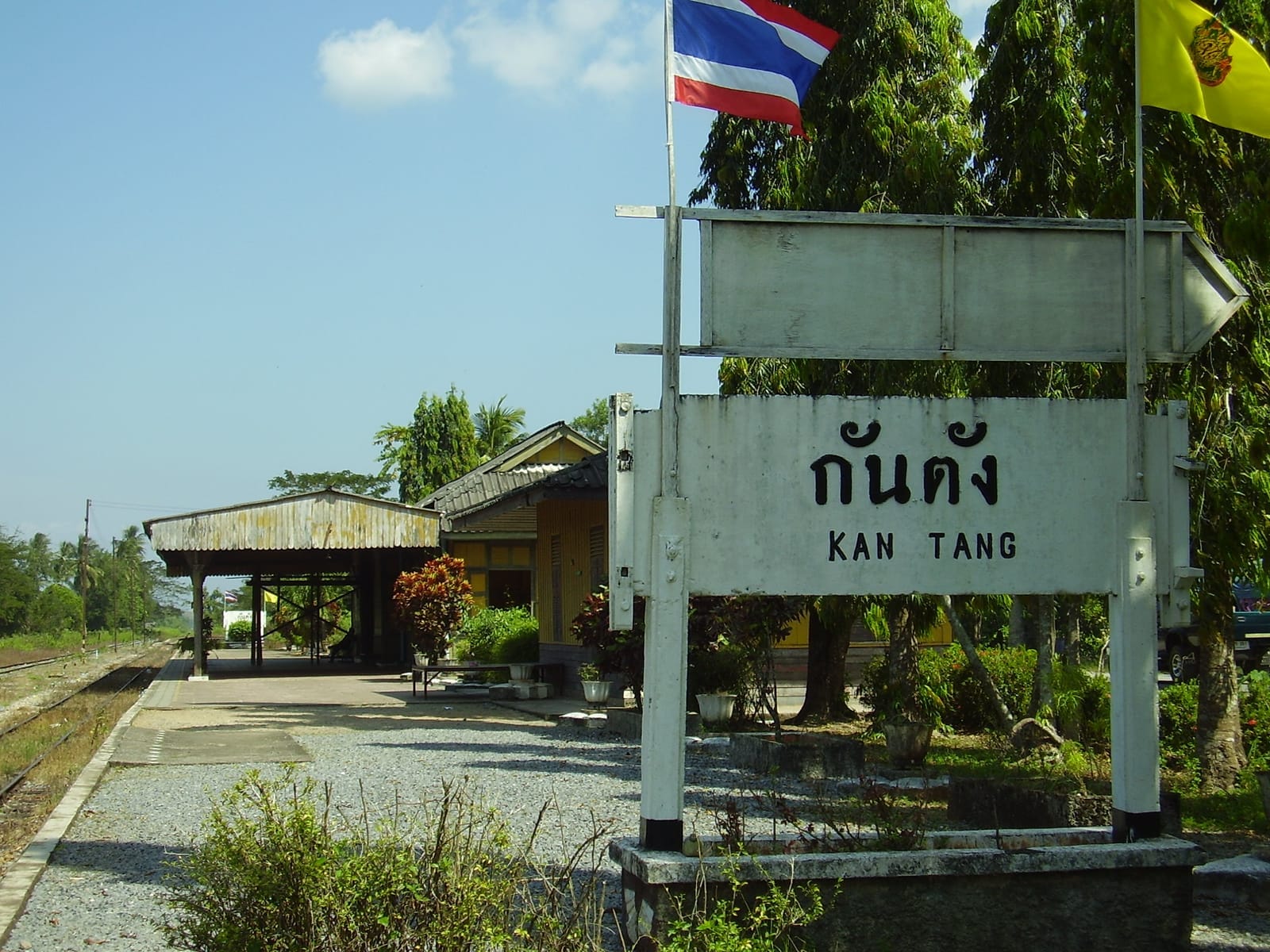
The highlight of this trip is Kantang railway station, a single-storey wooden building with a hipped roof, painted mustard yellow and brown, built back in the reign of King Rama VI. The front has a projecting porch with fretwork trim and old folding doors, and the Fine Arts Department has registered it as a historic site. Most importantly, this is the final station of the southern railway on the Andaman side — the tracks end right here.
The station is still in real use, with trains running the Bangkok–Kantang route. You can walk in and photograph the station sign, the wooden building and the end of the tracks for free — a favourite spot for rail travellers to capture the moment they've reached the very end of the line.
- Entry is free — no admission ticket; you can walk around and take photos anywhere on the grounds
- The best shot is the Kantang sign and the end of the tracks, marking the end of the southern line
- If you mean to ride the train, check the Bangkok–Kantang schedule ahead of time, as there are only a few runs a day
- Around the station there are cafes like Tropical Cafe and shops in Kantang's old quarter to carry on to
Photo tip
The mustard-coloured building looks best in morning light or soft afternoon sun. Avoid midday, when harsh light washes the colour out in photos. Shoot from an angle so the fretwork porch shows, and you'll get more depth in the frame.
A real 2-day plan: old town + Kantang
This route takes Trang's old town at an easy pace on day one, then hits Kantang on day two. If you've only got a single day, you can condense it into half a day plus half a day.
Trang's old quarter
Kantang — port town and railway station
Getting there & trips nearby
- Getting to Trang — take the southern railway to Trang station, or fly into Trang Airport and catch a ride into town
- Around town — the old quarter is easy to walk, everything's close, no car needed
- To Kantang — songthaew/minivan/rental car, or take the train down to the final station
- On to the sea — Kantang and the nearby piers are jumping-off points for Koh Mook, Koh Kradan and Koh Chueak
Want a full Trang plan covering both the old town and the sea
See the Trang travel guide →