🔄 Updated 21 Jun 2026
Udon's two World Heritage Sites sit on opposite sides of the city. Ban Chiang is to the southeast around Nong Han district, while Phu Phra Bat is to the northwest in Ban Phue district. They're a fair distance apart, and trying to fit both into a single day means rushing and wearing yourself out. So we've laid it out as 2 days and 1 night: day one to Ban Chiang and back to the city to sleep, day two an early start to Phu Phra Bat, which is farther and involves a walk uphill. It suits anyone who wants to understand the story, not just snap a photo of a pot and leave.
This plan is written for self-driving, since both sites are outside the city and direct public transport isn't very convenient. If you don't have your own car, renting one and driving yourself is the easiest option, or you can hire a van or taxi for the whole day at roughly 1,500–2,500 THB per day depending on what you agree on. Phu Phra Bat is farther, so it usually costs a little more than Ban Chiang.
Before you set off
The Ban Chiang museum is closed on Mondays, while Phu Phra Bat is open every day with no closing day. If your trip falls on a Monday, swap things around — do Phu Phra Bat on the Monday and save Ban Chiang for another day so you don't waste the trip. Phu Phra Bat involves a fair bit of uphill walking, so bring comfortable walking shoes, a hat, and water.
How Ban Chiang and Phu Phra Bat differ
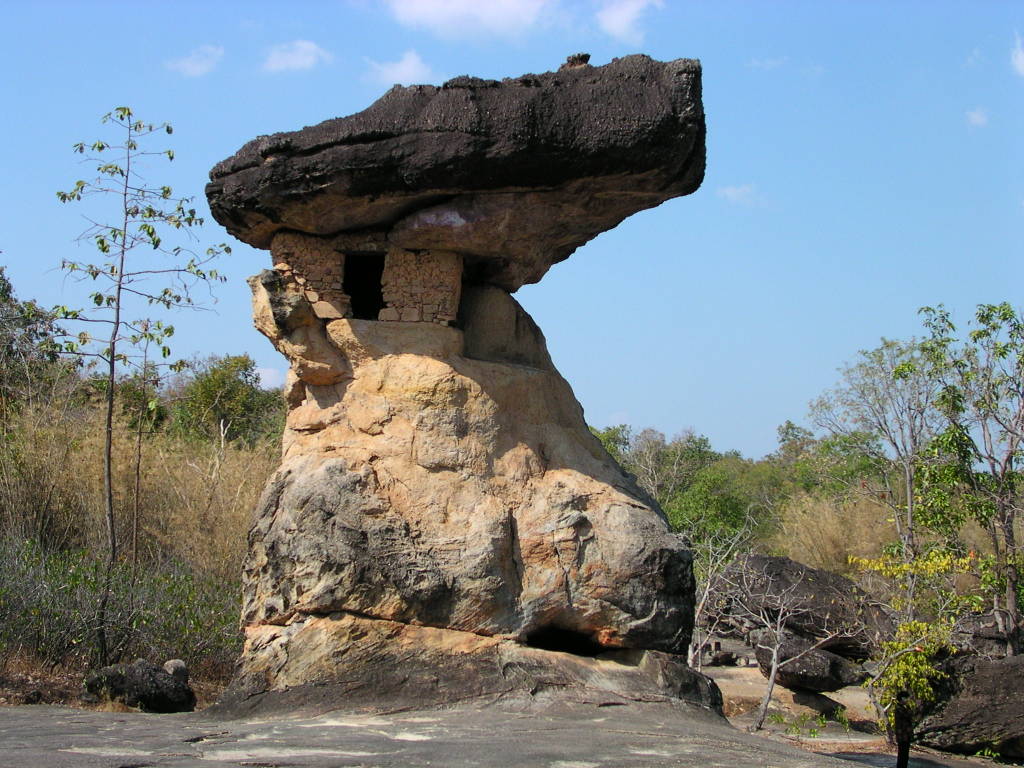
A lot of people assume the two sites are similar because they're both World Heritage Sites, but they really tell different stories. Ban Chiang is a Bronze Age civilization where excavations turned up painted pottery, metal tools, and skeletons thousands of years old — the story of people who settled, farmed, and knew how to smelt metal. Phu Phra Bat, on the other hand, is a forest of oddly shaped sandstone where prehistoric people painted images under the rock shelters, and later, in the Dvaravati period, used the area to plant stone boundary markers (sema) and hold religious ceremonies. What UNESCO recognized here are the traces of the sema-stone culture.
- Ban Chiang — a World Heritage Site since 1992. An indoor museum plus open-air excavation pits, easy walking with no climbing, suitable for all ages.
- Phu Phra Bat — the newest World Heritage Site, listed in 2024. An open-air rock forest you explore on trails through the hills, taking more effort and time.
- Distance — Ban Chiang is about 55–60 km from the city, a bit over an hour's drive. Phu Phra Bat is farther, around 65–70 km, roughly an hour and a half.
- Time needed — Ban Chiang is an easy half-day on foot, while Phu Phra Bat needs around 2–3 hours to walk through properly.
Book the activities in your Udon Thani trip ahead
Booking online ahead on Klook or GetYourGuide is usually cheaper than the gate and skips the queue. Pick only the experiences you actually want — prices and availability are shown live on each site.
Day 1 — Ban Chiang, a 4,000-year-old civilization
Day one heads to Ban Chiang in Nong Han district, about 55–60 km from the city. Take Highway 22, the Udon–Sakon Nakhon road, then turn off into the village. The museum itself is well laid out and pleasantly cool, and half a day on foot is plenty before you drive back to the city to sleep in the evening — saving your energy for the uphill walk at Phu Phra Bat the next day.
Ban Chiang · a morning here, then back to the city
Day one tip
Ban Chiang's painted pots are the first thing people picture, but the real treasure is the story behind them — how people lived here 4,000 years ago. Take your time reading the panels in the exhibition halls and you'll get far more out of it than walking straight past. If you want genuine pottery souvenirs, buying from shops in the village gets you a better price than at the museum entrance.
Day 2 — Phu Phra Bat, rock forest and Hor Nang Usa
Day two starts early for Phu Phra Bat in Ban Phue district, to the northwest of the city. Take Highway 2, the Udon–Nong Khai road, and around km 13 turn left onto Highway 2021 toward Ban Phue district, then continue about another 12 km to the park — roughly 65–70 km from the city in total, about an hour and a half's drive. Here you explore on trails through the rock forest, so allow plenty of time and energy.
Phu Phra Bat · walking the newest World Heritage rock forest
Check before you tackle Phu Phra Bat
Phu Phra Bat involves a fair bit of walking on dirt and rock, and the sun gets strong by late morning, so it's best to arrive right at opening or in the early afternoon for an easier walk. Wear sneakers or hiking shoes and bring water and a hat. Entry fees and hours can change, so if you're going on a major holiday, check with the park first.
Food and where to stay on this plan
Since you drive out to the two World Heritage Sites and back into the city each evening, you get plenty of time to dig into Udon's best food. This city stands out for Vietnamese dishes and kuay jab yuan, mixed with bold Isan flavors. Here's what's worth working into your two days.
Kuay Jab Yuan (Vietnamese rolled-noodle soup)
Chewy rolled noodles in a clear broth with minced pork, egg, and meatballs, topped with fried shallots. It's the signature dish people coming to Udon have to try — well balanced and not too heavy, perfect for breakfast before you set off.
Vietnamese Pho
Flat noodles in a fragrant, spiced bone broth with beef or meatballs, eaten with fresh herbs and a Vietnamese-style dipping sauce — a breakfast that fills you up just right.
Khao Piak Sen
Chewy noodles made from rice flour in a hot broth with minced pork and a poached egg — a light Vietnamese-style breakfast that Udon does well.
Nam Neung
Grilled pork wrapped in rice paper with fresh herbs and rice vermicelli, dipped in a Vietnamese-style sauce. Fun to assemble and great to share when you're back in the city in the evening.
Som Tam, Grilled Chicken & Larb
Classic, boldly flavored Isan food — som tam with fermented fish and crab, smoky charcoal-grilled chicken, and dry-roasted pork larb. Easy to find both in the city and at village spots in Ban Chiang, tasty and cheap.
Khai Krata & Loaded Toast
An easy breakfast before a long drive — eggs sizzling in a pan with pork sausage, eaten with crisp toast. Light on the wallet and found all over the city.
Moo Yo, Naem & Chinese Sausage
The city's go-to souvenirs — firm moo yo, pleasantly sour naem — to take home or snack on along the way. Souvenir shops are all over town.
Snacks by Nong Prajak
On the first evening back in the city, stroll around Nong Prajak lake for the breeze. There are snacks, homemade coconut ice cream, and the giant yellow duck floating on the water — an easy way to close out the day.
As for where to stay, the city is your best base for this plan, since it's the central point you can drive out from in both directions, come back to sleep comfortably, and find food easily. Mid-range hotels in the city run 600–1,200 THB a night. Pick a spot around Nong Prajak or near UD Town so you can walk to food and sights without driving at night.
How to get around and time it smoothly
- Route order — do Ban Chiang, which is closer, on day one, then head farther out to Phu Phra Bat on day two. Sleeping in the city both nights means you never have to drag your bags back and forth.
- Closing days — the Ban Chiang museum is closed on Mondays, while Phu Phra Bat is open daily. If your trip falls on a Monday, flip the order and do Phu Phra Bat that day.
- Transport — there's no convenient direct public transport. We'd recommend renting a car and driving yourself, or hiring a van/taxi for the whole day at around 1,500–2,500 THB per day. Phu Phra Bat is farther, so it usually costs more.
- Opening hours — Ban Chiang 09:00–16:00, Phu Phra Bat 08:30–16:30. Put the farther site and the one with more walking in the morning to early afternoon — don't leave them for the end of the day.
- Entry fees — Ban Chiang is around 30 THB for Thais, Phu Phra Bat 20 THB for Thais; both are cheap. Prices can change, so check again on site.
Got extra time? What else to add
If you finish the two World Heritage Sites early or have a third day, you can add one more stop. Each option lies in a different direction, so pick whichever is closest to your route to make the most of your time.
Udon Thani City Museum
Set in the old Rajinuthit building downtown, it tells the city's history and the story of Krom Luang Prachak. Free entry, pleasantly cool, and a good way to round out the city's history. It's in town and takes about an hour.
Red Lotus Sea (Kumphawapi)
A lake carpeted with blooming red lotuses. Take a boat out before 10 am; it's only at its best from December to February. It's south of the city, adding a touch of nature to a history trip.
Kham Chanot
A famous spiritual Naga shrine that draws crowds and queues. It's in Ban Dung district, far to the north — allow half a day. Good for those into spiritual sites.
Wat Pa Phu Kon (Na Yung)
A white marble reclining Buddha in the forest, beautiful and peaceful. It's in the far north, fairly close to the Ban Phue–Phu Phra Bat route, suited to those with a car and a full day.
See all the sights, food, and places to stay in Udon Thani and plan your whole trip in one place
See the Udon Thani travel guide →