🔄 Updated 21 Jun 2026
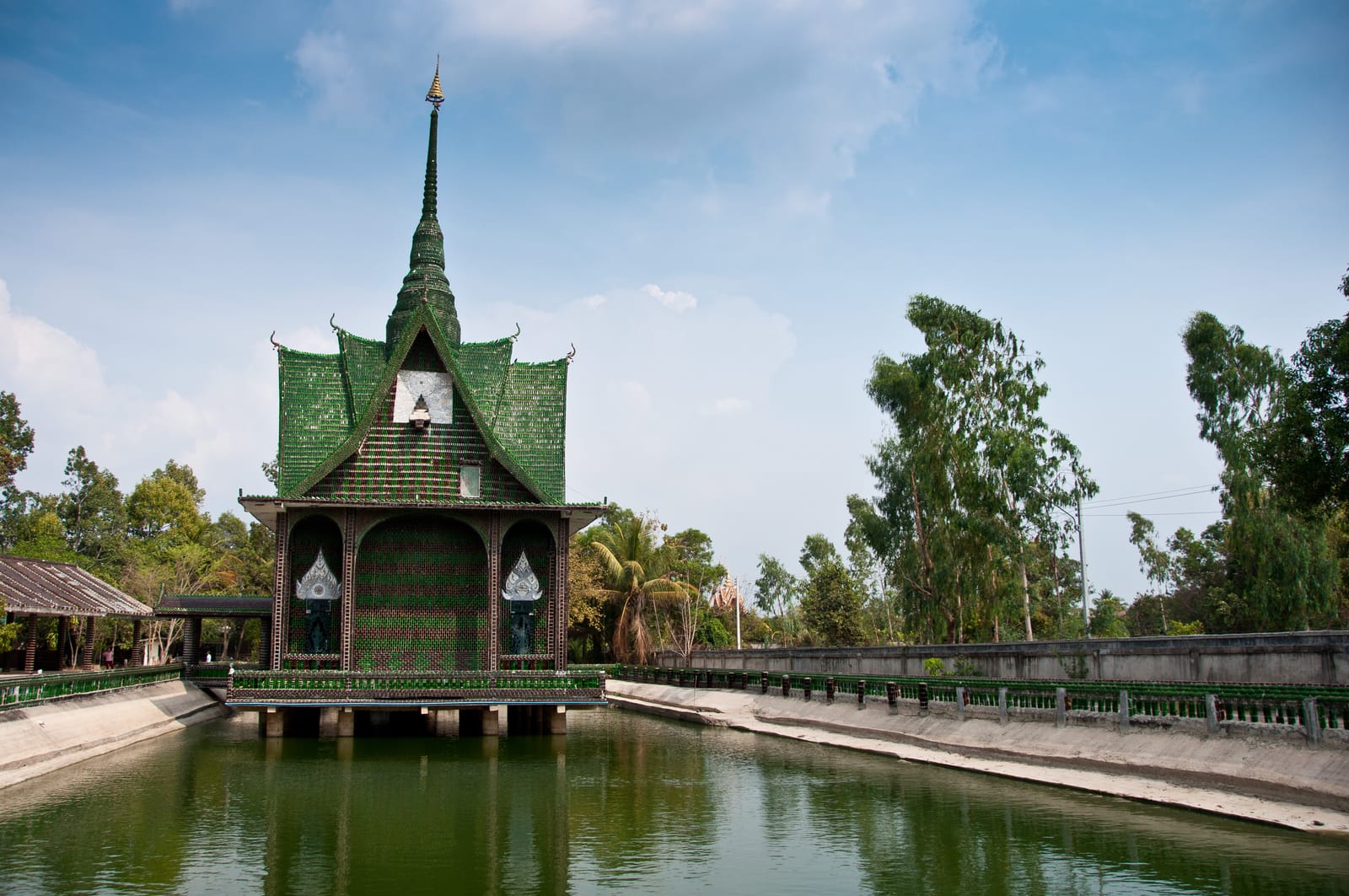
If you're road-tripping through Sisaket and want a stop you'll still remember years later, Wat Lan Khuat is about as memorable as it gets. The official name is Wat Pa Maha Chedi Kaew, in Ban Don, Non Sung subdistrict, Khun Han district. What sets it apart is that everything in the temple is decorated with recycled glass bottles — beer bottles, liquor bottles, soda bottles — roughly 1.5 million of them in total, arranged into patterns across the walls, columns, arches, and roofs.
What makes this place interesting beyond the novelty is the story behind it. Construction began around 1984 on the initiative of Phra Khru Wiwek Thammachan, or Luang Pu Lot, who came to practice meditation in the area and saw discarded bottles littered everywhere as garbage. He started collecting bottles from the surrounding villages to build the first monk's quarters, then slowly expanded until the whole temple took shape. The idea was for the clear bottles to serve as a dhamma riddle — when struck by sunlight, they shine like the light of the teachings.
The highlights worth seeing
Wat Lan Khuat is more than just walls of bottles — each spot is laid out so you can walk a full loop and take it all in. These are the parts people talk about most after a visit.
Temple on the water
Also called the sim klang nam, this four-gabled ordination hall stands right in the middle of a pond and is the most photographed spot in the temple. Inside sits a white jade Buddha image, and the reflection on the water looks best in the morning and late afternoon.
The great glass chedi
A large stupa covered in glass bottles from top to bottom — the source of the temple's official name. From a distance you can see the bottles shimmering in tiers.
Pavilions and entrance arches
From the entrance and the gateway arches to the bell tower and the monks' quarters, everything is laid out in bottle patterns. It's easy to lose track of time studying the details up close.
Best times for photos
Morning sun before 10 a.m. and the late afternoon before 5 p.m. are when the bottles catch the light best. Midday sun is harsh and very hot, and shooting into the glare is tricky. Come early or late and you'll have a far more comfortable time.
Want more out of Sisaket? Book tours & activities
Booking online ahead on Klook or GetYourGuide is usually cheaper than the gate and skips the queue. Pick only the experiences you actually want — prices and availability are shown live on each site.
Hours and admission
- Opening hours — open daily, roughly 8 a.m.–5 p.m. (sometimes from early morning, since it's a working temple where monks actually live)
- Admission — free; it's a temple, so entry is free, though there's a donation box if you'd like to contribute toward its upkeep
- Dress code — dress modestly, as this is temple grounds with resident monks; avoid very short shorts or spaghetti straps
- Time needed — about 45 minutes to an hour covers the whole place; allow around 1.5 hours if you're serious about photos
Getting to Wat Lan Khuat
The temple is in Khun Han district, about 60 km from Sisaket town, roughly an hour and a bit by car. The main route follows Highway 211 onto 2111, passing through Phayu and Phrai Bueng districts on the way to Khun Han. The roads are good and the signage is clear; just drop "Wat Pa Maha Chedi Kaew" into your map and it'll take you straight there.
- Self-drive — by far the easiest option, with a large parking lot. Khun Han's attractions are spread out, so having your own vehicle makes it much simpler to keep exploring afterward.
- No car? — public transport is hard to come by here. Renting a car in Sisaket town or hiring a local driver for a round trip is the way to go.
- From Ubon — coming from Ubon Ratchathani, you can drive via Det Udom and on to Khun Han; the distance is similar to coming from Sisaket town.
Where to go next around Khun Han
Khun Han borders the Phanom Dong Rak mountain range and has waterfalls, durian orchards, and Khmer ruins. If you've driven all the way out here, it's worth lining up a few more stops to make the trip count.
Huai Chan Waterfall
A waterfall in the Khun Han forest, good for a swim toward the end of the rainy season, with shady, relaxed surroundings. It's a short drive from the temple and makes a nice afternoon stop.
Volcanic-soil durian orchards
Sisaket is famous for durian grown in volcanic soil. Khun Han and Kantharalak have orchards where you can stop to taste it, roughly in season from June through August.
Khmer ruins in the province
Sisaket has several Khmer-era ruins, such as Prasat Sa Kamphaeng Yai and Prasat Ban Prasat, ideal if you want to add a culture-focused leg to the trip.
If you're heading to the Pha Mo I Daeng–Preah Vihear side
The attractions on the Kantharalak side, like Pha Mo I Daeng and Khao Phra Wihan National Park, sit right on the Thailand–Cambodia border. At times the border situation leads to closures or restricted access. Before planning a trip to that area, always check the latest situation with the park or the province's official page first.
What it's really like — honestly
- Less crowded than big-city temples — weekdays are quiet and easy, with no jostling for angles. Long weekends get busier but never packed.
- Genuinely hot at midday — it's a forest temple with open areas and strong sun, so bring a hat and water. Mornings and evenings are far more comfortable.
- Still an active place of practice — it's not just a photo stop; monks live here, so keep your voice down and be respectful of the place.
- Worth the drive — it's a fair distance from town, but pairing it with other stops around Khun Han makes the trip far more worthwhile than coming for the one temple and turning back.
Want a full Sisaket trip plan, including where to stay and what to eat?
See the Sisaket travel guide →