🔄 Updated 21 Jun 2026
Mae Hong Son sits in Thailand's far northwest corner, right on the Myanmar border, a small town tucked into a valley with mountains on every side. The draw is the quiet, the cool air almost year-round, the Tai Yai (Shan) culture, and the sea of mist that rolls in often during the cold season. But the thing that makes people hesitate most is the journey, because the road into town is basically one long mountain climb full of curves. Let's go through it piece by piece so you know what to expect on your first trip.
The famous 1864 curves you keep hearing about
"1864 curves" is the number of bends on Highway 108 along the stretch through Khun Yuam–Mae Hong Son, and by now it's become a symbol of the town itself. If you drive up from Chiang Mai there are 2 main routes to choose from, and each one has a different number of curves and a different feel.
- Southern route (Highway 108 via Hot–Mae Sariang–Khun Yuam) — longer, around 350 km and 7–8 hours, but the curves are more spread out and the climb is gradual, with far fewer tight switchbacks than the Pai route. Good for people who get carsick easily and for newer drivers.
- Northern route (Highway 1095 via Pai–Pang Mapha) — shorter, around 250 km and 6–7 hours, but the curves come thick and fast and never let up (the Chiang Mai–Pai stretch alone has roughly 762 bends). It's the route carsick travellers complain about most, but you get to stop in Pai along the way.
- Drive it as a loop (the Mae Hong Son Loop) — one route up, the other route back. A lot of people choose this because you see both landscapes and never have to retrace your steps.
If you're driving yourself
Fill up the tank before heading into the mountains, because stations are far apart on some stretches. Driving in daylight is much safer, mist and animals darting across the road at night are a real thing, and give yourself a lot more time than Google Maps suggests, since the curves mean you'll drive slower than usual.
Book the activities in your Mae Hong Son trip ahead
Booking online ahead on Klook or GetYourGuide is usually cheaper than the gate and skips the queue. Pick only the experiences you actually want — prices and availability are shown live on each site.
Get carsick easily? Here's what helps
This is the number one question for anyone going for the first time. The good news is carsickness is manageable, and if you really suffer with it, there's an option that skips the long drive entirely.
- Take motion-sickness medication ahead of time — dimenhydrinate-based tablets (the kind any pharmacy carries) work best if you take them about 30 minutes before you set off, not once you already feel queasy.
- Sit up front and look far ahead — keeping your eyes on the road far in the distance helps a lot more than looking at your phone or the scenery rushing past beside you. Crack a window for fresh air now and then.
- Eat lightly before you go — an empty stomach or an overly full one both make it worse. Eat a moderate amount and skip greasy, fried food.
- Stop and break it up — if you're driving or hiring a car, pull over every 1–1.5 hours, get out and breathe. It really helps you reset.
- Fly if you get badly carsick — the shortcut a lot of people overlook (see the next section).
Fly or drive — which suits you
Mae Hong Son has an airport right in town (code HGN). Bangkok Airways runs direct Chiang Mai–Mae Hong Son flights, and the flight itself is only about 35 minutes, turning a 6–8 hour drive into under an hour. It's a great solution for anyone who gets badly carsick or is short on time.
- Fly (Chiang Mai–Mae Hong Son) — fast, no carsickness, but fares swing with the season (cold season and long weekends are pricey and book out fast), so reserve ahead. The catch is that once you're in town you still need transport for day trips (rent a car or hire a local driver).
- Drive yourself — total freedom, stop for photos at any viewpoint, and it's good value if you split costs among a few people. But you need to be ready for the curves and the driver has to stay sharp.
- Minivan / bus — the cheapest option, with services from Chiang Mai on both the Pai route and the Mae Sariang route, but it's the easiest way to get carsick since you can't control the pace of the vehicle.
A time-saving trick
A lot of people fly in (arrive fresh and start exploring right away), then rent a car or hire a driver for the way back, looping through Pai. That way you get both the comfort and the full experience of the trip.
When to go — how much do the weather and views change?
Mae Hong Son is cooler than the lowlands almost year-round because it sits high in the valley, and each season has a distinctly different feel. Choose based on what you want to see.
- Nov–Feb (cold season · peak) — pleasantly cool to genuinely cold, with the sea of mist rolling in most mornings. This is the prettiest stretch and also the busiest, so accommodation and flights fill up fast — book ahead.
- November in particular — the Mexican sunflower fields at Doi Mae U Kho (Khun Yuam) burst into yellow across the hills, a highlight you can only catch this one time each year.
- Mar–Apr (hot + haze) — this is the burning season in northern Thailand, so visibility can be poor and there's dust in the air. If you can avoid it, do.
- Jun–Oct (rainy season) — lush and green, the waterfalls look great, fewer crowds and lower prices, but the roads are slippery and some stretches can have landslides. Check the forecast before you head out.
The main sights a first-timer shouldn't miss
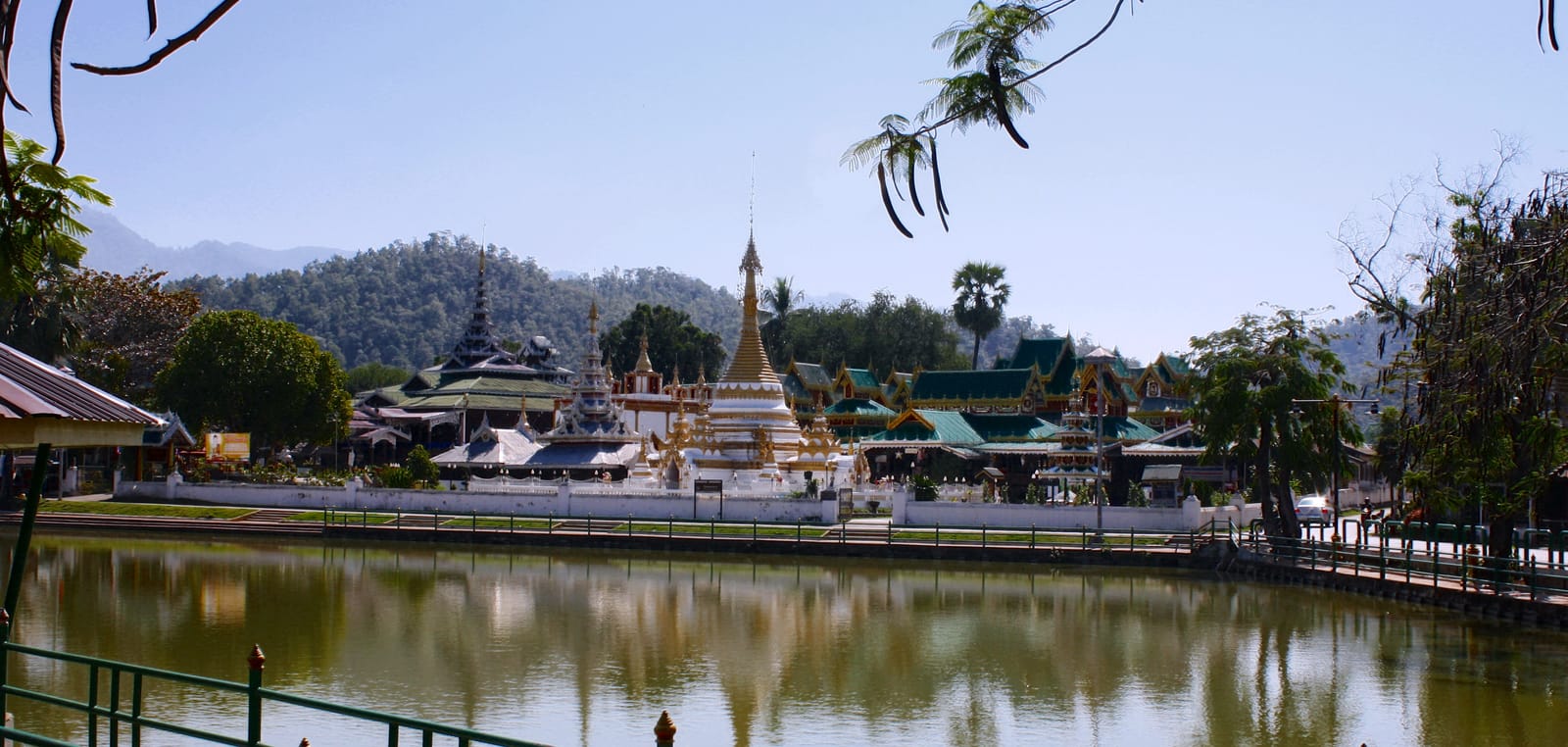
Wat Chong Kham–Chong Klang
A pair of Tai Yai temples beside Nong Chong Kham lake in the town centre. At night the lights switch on and reflect off the water — the most-photographed scene in Mae Hong Son.
ViewpointPhra That Doi Kong Mu
A viewpoint that takes in the whole valley town. Go up in the morning or the evening for a different mood each time.
Half dayBan Rak Thai
A Yunnanese Chinese village by a lake, ringed by terraced tea plantations. Sip tea, eat braised pork with mantou buns, and catch the morning mist settling over it.
Stay overnight nearbyPang Ung
A reservoir set among pine forest that people call the Switzerland of Thailand. At dawn the mist drifts over the water — you have to stay nearby to catch it in time.
If you have an extra day, it's worth stopping in Pai along the way (cafés, the walking street, viewpoints) and at Tham Lod cave in Pang Mapha, a huge cave you enter on a bamboo raft — an experience that sticks with you for a long time.
A 3-day, 2-night plan for your first trip
This plan is built to be genuinely doable without rushing, focusing on the town and the main spots around it. It suits first-timers who want a mix of culture, views and time to relax. Adjust the route depending on whether you fly or drive in.
Arrive + explore the town
Ban Rak Thai + Phu Klon + Pang Ung
Pang Ung mist + heading back
Want to go deeper
If you have 4 days or more, add Tham Lod cave at Pang Mapha and an extra night in Pai for an unhurried wander through the cafés and walking street. The trip ends up far more balanced between natural scenery and downtime.
Small things worth knowing before you go
- Cash — small shops and many villages still prefer cash, so carry some. There are ATMs in town but they get scarce once you head out of it.
- Warm clothes — even in the hot season the pre-dawn air up on the mountains is cold, and in the cold season temperatures can drop a lot. Pack extra to be safe.
- Mobile signal — it's fine in town, but on some mountain stretches and in remote villages the signal gets weak. Download offline maps.
- Book accommodation ahead — in the cold season and on long weekends the scenic places fill up fast, especially around Pang Ung and Ban Rak Thai where there are only a few rooms.
- Drive in daylight — avoid driving up the mountains at night, when visibility is poor and the risk is much higher.
Plan your full Mae Hong Son trip — hotels, food and things to do, all in one place
See the Mae Hong Son travel guide →