🔄 Updated 21 Jun 2026
This plan suits history travelers who want to follow Surin's Khmer temples properly, not just pull over for a photo at one spot and call it done. We've set it across three days: day one lays the groundwork in town and picks up Sikhoraphum, the easiest to reach and the prettiest; day two goes deep south to Ban Phluang and Phum Pon; day three takes in the Ta Muen Thom group on the border ridge, with conditions attached. A private car or a rental is by far the smoothest way, since the temples sit outside town across different districts.
One thing up front: day three covers the border temple group — Ta Muen Thom and Ta Khwai — which sits in an area affected by the Thai–Cambodian border situation. Since the ceasefire, parts of it have started reopening to visitors at certain times, but you have to check with the army unit that oversees the area first, and carry your ID every time. So we've kept day three flexible: if it's closed that day, there are backup temples in the province to take its place without losing the trip.
The 3-day Khmer temple plan at a glance
- Day 1 — Groundwork in town + Prasat Sikhoraphum. Start at the national museum to get a feel for the Khmer art periods, then drive out to Sikhoraphum, the easiest to reach and the prettiest.
- Day 2 — Deep south to Ban Phluang and Phum Pon. The small sandstone sanctuary with its lovely lintel at Ban Phluang, then Phum Pon, the oldest in Thailand.
- Day 3 — The border Ta Muen Thom group (conditions apply). Up the Phanom Dong Rak ridge for the border temples — check with the army unit first, with a backup plan if you can't go up.
Book the activities in your Surin trip ahead
Booking online ahead on Klook or GetYourGuide is usually cheaper than the gate and skips the queue. Pick only the experiences you actually want — prices and availability are shown live on each site.
Where Surin's Khmer temples came from
Most of the stone temples in Surin were built between roughly the 7th and 13th centuries CE, during the height of the Khmer empire. The materials vary — brick, laterite and sandstone — depending on the era and how important each site was. Earlier temples were usually built of brick, while the larger, more significant later ones used sandstone, which could be carved in finer detail. What makes a Khmer temple worth a close look is the lintels and pediments, carved with scenes from Hindu mythology; if you know how to read them, you can tell what story each panel is telling.
Before you head out to the temples, it's worth stopping by the Surin National Museum in town for a round first. It displays Khmer artifacts and lintels and walks you through the sequence of art periods, giving you the big picture. Once you see the real thing out at the temples it's a lot more fun. The museum is open Wednesday to Sunday, closed Monday and Tuesday, roughly 09.00–16.00, free admission.
Day 1 — Groundwork in town + Prasat Sikhoraphum
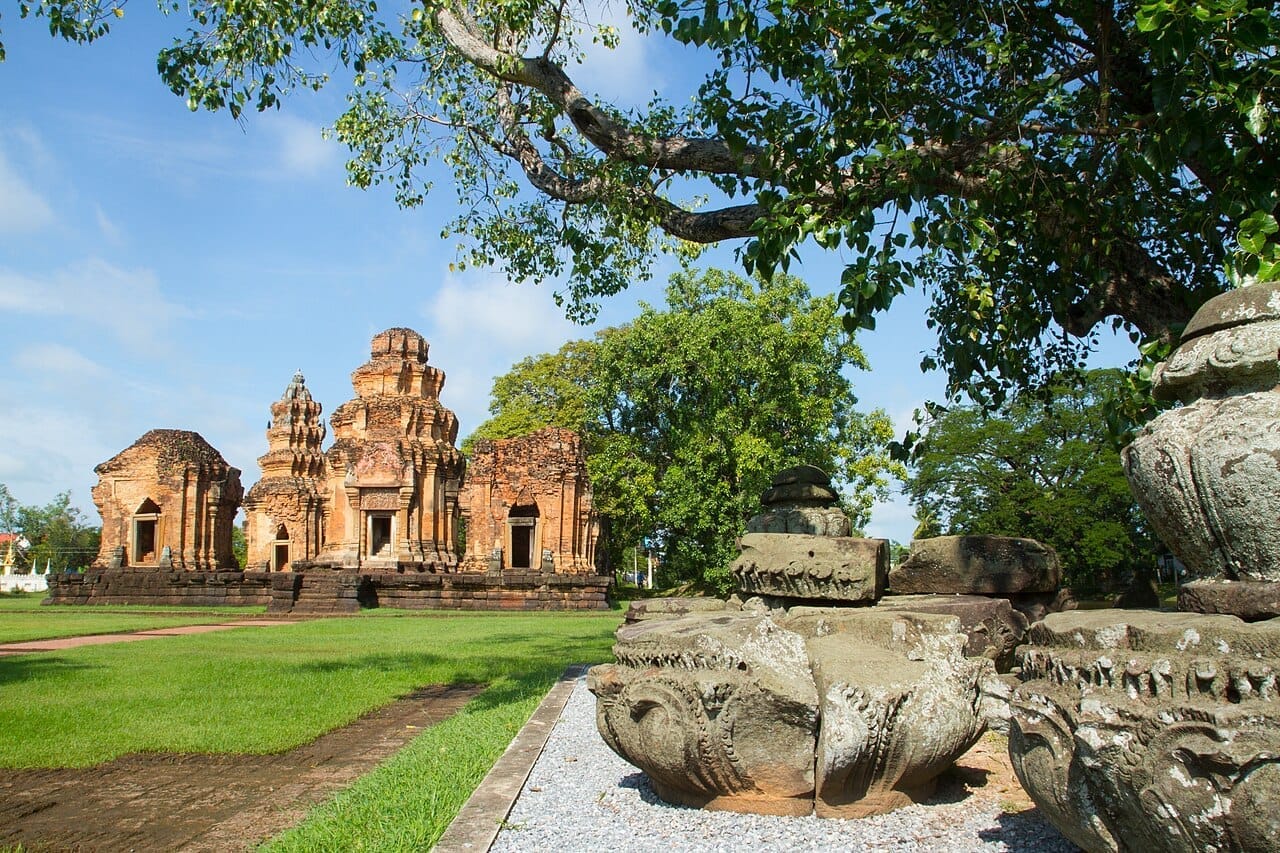
No need to rush day one. Start at the national museum to get the Khmer art periods straight, then head out to Sikhoraphum mid-morning. Prasat Sikhoraphum stands in Ra-ngaeng subdistrict, Sikhoraphum district, along Highway 2077, about 35 kilometers from town along an easy drive. It's a set of five brick towers on a single shared laterite base, with a moat on three sides; the central main tower rises tall and prominent. What draws people in is the lintel and the door-frame pilasters carved with apsaras holding lotus flowers — work so fine it's considered one of the most beautiful apsara carvings in Thailand, with lines that bring Angkor Wat to mind.
City museum + Prasat Sikhoraphum
Getting the most out of Prasat Sikhoraphum
Before chasing the pretty photo, walk around and find the lintel side carved with the apsaras and the door-frame pilasters — that's where the craftsmanship is densest. The temple courtyard is wide and the midday sun is harsh, so aim for early morning or late afternoon, when the slanting light picks up the carving detail far better than noon glare. Some years in November there's a Sikhoraphum thousand-year legend festival with a light-and-sound show — if you happen to catch it, you'll get a whole different atmosphere.
Surin city eats worth slotting into the plan
While you're out collecting temples beyond town, you still want a good meal when you get back in. Surin's lower-Isan food is boldly seasoned and has local specialties like Vietnamese kuay chap and khanom jeen with curry sauce. These are the kinds of places locals actually go, lined up so you can pick by meal. Prices are rough estimates, and it's worth checking each shop's opening days again before you go.
Larb Lung Sit
A boldly seasoned Isan larb spot that Surin locals know well, known for koi suea khua, soi ju and a hotpot of slow-stewed beef. Great for true-Isan eaters who want real flavor — a closing meal after a full day of temples.
Krua Nong Khwan Khao
A punchy lower-Isan restaurant that people seek out after seeing it on TV. A wide range of local dishes and comfortable seating — good for a group after a day of sightseeing.
Vietnamese kuay chap in town
Vietnamese kuay chap is a Surin specialty — chewy noodle rolls in a balanced broth, loaded with mu yo, egg and plenty of toppings. A solid breakfast before heading out on the temple run.
Khanom jeen nam ya pa
Lower-Isan-style khanom jeen with a deep, intense sauce, eaten with lots of fresh veg. A local breakfast that's easy to find at markets and shops in town, and light enough before a long drive.
Local som tam stalls in town
Som tam made by lower-Isan hands, pounded fresh on the spot — som tam thai, pla ra, tam sua. Order it with grilled chicken and sticky rice for a light lunch between temple stops.
Pranit pork noodles
A long-running pork noodle shop that's been going for over twenty years — familiar flavors, a well-balanced broth. Good for a light meal while you're walking around town.
Mu krata in town
The dinner Surin locals meet up for — there are plenty of mu krata buffet places around town, filling and good value on a modest budget. A relaxed way to close the day after a long drive.
Cafés in town
Coffee-and-bakery cafés for a mid-day break, with photogenic spaces. Good for an afternoon stop before the next stretch, or to sit and plan the next day's temples.
Day 2 — Deep south to Ban Phluang and Phum Pon
Day two heads deep south. Leave a bit earlier, since it's farther than Sikhoraphum. First stop is Prasat Ban Phluang, in Ban Phluang subdistrict, Prasat district — a single small, compact sanctuary set on a raised laterite base, built of sandstone in the Khmer Baphuon style, dating to around the 11th century CE. The highlight is the lintel and pediment, beautifully carved and well preserved. It's a short visit, but the carving makes it worth the stop. Open daily, roughly 07.00–18.00.
From Ban Phluang, drive on to Sangkha district and make for Prasat Phum Pon, at Ban Phum Pon in Dom subdistrict. What makes it special is that it's the oldest Khmer temple found in Thailand — the main sanctuary was built around the 7th–8th centuries CE, in the pre-Angkorian era, hundreds of years older than other Khmer temples in the country. The temple is a brick tower whose structure is still clearly visible; it isn't as grand as the later temples, but its historical value is very high. There's a legend of Neang Doh Thom (or Nang Ok) tied to the place, which makes locals especially attached to it.
Ban Phluang–Phum Pon, deep south
The deep-south day needs extra time and fuel
Ban Phluang and Phum Pon are in different districts and the access roads run fairly deep — public transport barely reaches them. You really want a private car, and fill the tank before you set out, since gas stations out here are far apart. Allow more travel time than you'd think. The temple grounds are laterite and uneven stone, so wear comfortable walking shoes.
Day 3 — The border Ta Muen Thom temple group
The last day is the highlight for serious temple chasers. The Ta Muen group sits on the Phanom Dong Rak ridge in Phanom Dong Rak district, right on the Thai–Cambodian border line. It's made up of Prasat Ta Muen Thom, the largest and most important; Prasat Ta Muen Toht; and Prasat Ta Muen. Ta Muen Thom itself is a large sandstone temple with a natural shivalinga in the main chamber, and it used to be a historical site people came specifically to see.
We have to be straight: this area was affected by the recent Thai–Cambodian border situation. Since the ceasefire, parts of it have started reopening to visitors at certain times, but it isn't back to normal tourist access. The temple is still under army supervision, and there may be marks from the events, though overall the structure remains in its original form. To go up, you must ask the army unit that oversees the area first, every single time, whether it's open that day — and carry your ID. As for Prasat Ta Khwai, in a nearby zone, it's still closed and sustained more damage.
Ta Muen Thom group (check first)
If you can't get into Ta Muen Thom on day 3, use the backup plan
Safety comes before a pretty photo. If you call to check and the answer is that it's not open that day, don't push it. Switch to a backup within the province instead — for example, picking up Khmer temples you haven't seen yet, like Prasat Yai Ngao or the small temple groups in Sangkha district, or pivoting to the silk-weaving village of Ban Tha Sawang plus the city museum. You can close out a culture-focused trip just fine without taking any risk.
Surin's Khmer temples in this plan — the highlights
Prasat Sikhoraphum
Five brick towers on a laterite base, with the finest apsara-carved lintel in Thailand. The easiest to reach, about 35 km from town. Open daily, Thais 10 THB, foreigners 50 THB.
Prasat Ban Phluang
A small Baphuon-style sandstone sanctuary in Prasat district, with a beautifully carved, well-preserved lintel and pediment. A short visit. Open daily 07.00–18.00.
Prasat Phum Pon
The oldest Khmer temple in Thailand, a pre-Angkorian brick tower in Sangkha district. Few visitors, quiet and peaceful — good for serious history fans.
Prasat Ta Muen Thom
A large Khmer temple on the Phanom Dong Rak border ridge, with a shivalinga in the main chamber. Right now you can go up only under conditions — ask the army unit first.
How to get out to Surin's temples
Following the whole temple trail in this plan needs a car, since the temples sit outside town across different districts and public transport barely reaches them. Driving yourself is the smoothest. If you arrive in town by the lower-Isan rail line or by coach, it's worth renting a car or hiring one by the day from town to do the temple run. Sikhoraphum still has the odd bus passing through, but Ban Phluang, Phum Pon and Ta Muen Thom pretty much require a private car. Plan the route ahead and keep the tank topped up.
On timing: these open-air temples get very hot around midday, so start early or take in the late afternoon. Wear a hat and sunglasses and carry water. Shoes should be the comfortable walking kind, since the ground is laterite and uneven stone. You can bring kids or older travelers, but mind the uneven levels. And for day three in the border zone — once more — you must check the situation and ask the local army unit beforehand, every time. Don't rely on old blog posts written years ago, because the status has changed a great deal.
Plan the rest of your trip — where to stay, eat and visit in Surin
See the Surin travel guide →