🔄 Updated 21 Jun 2026
If you're into history travel, Surin gives you a lot to work with, because over a thousand years ago this part of Lower Isan was part of the Khmer empire, with stone temples built as Hindu and Buddhist religious sites along the old travel routes. Over time the towns vanished but the temples remained, leaving traces we can still follow today. This article rounds up the Khmer temples in Surin worth stopping at, ordered from easiest to reach to hardest, and finishes with the border group you'll need to check first.
Up front: this article focuses mainly on temples you can actually visit right now. The group right on the Thailand–Cambodia border, like Ta Muen Thom and Ta Khwai, currently sits in an area affected by the border situation and isn't open to normal visits. We'll be clear about which ones you can enter and which to save for next trip.
Where Surin's Khmer temples come from
Most of Surin's stone temples were built between roughly the 7th and 13th centuries CE, matching the high point of the Khmer empire. The materials range from brick and laterite to sandstone, depending on the era and how important each site was. The earliest temples were usually built in brick, while the larger, more important later ones used sandstone, which could be carved in finer detail. What makes Khmer temples worth a close look are the lintels and pediments carved with scenes from Hindu mythology — once your eye is trained, you can read what story each panel is telling.
Before you head out to the temples, it's worth a stop at the Surin National Museum in town first. It displays Khmer artifacts and lintels and lays out the sequence of art periods so you get the big picture. Seeing the real thing at the temples afterward is a lot more fun once you have that context. The museum opens Wednesday to Sunday, closed Monday and Tuesday, roughly 9am–4pm.
Want more out of Surin? Book tours & activities
Booking online ahead on Klook or GetYourGuide is usually cheaper than the gate and skips the queue. Pick only the experiences you actually want — prices and availability are shown live on each site.
Prasat Sikhoraphum — easiest and the prettiest
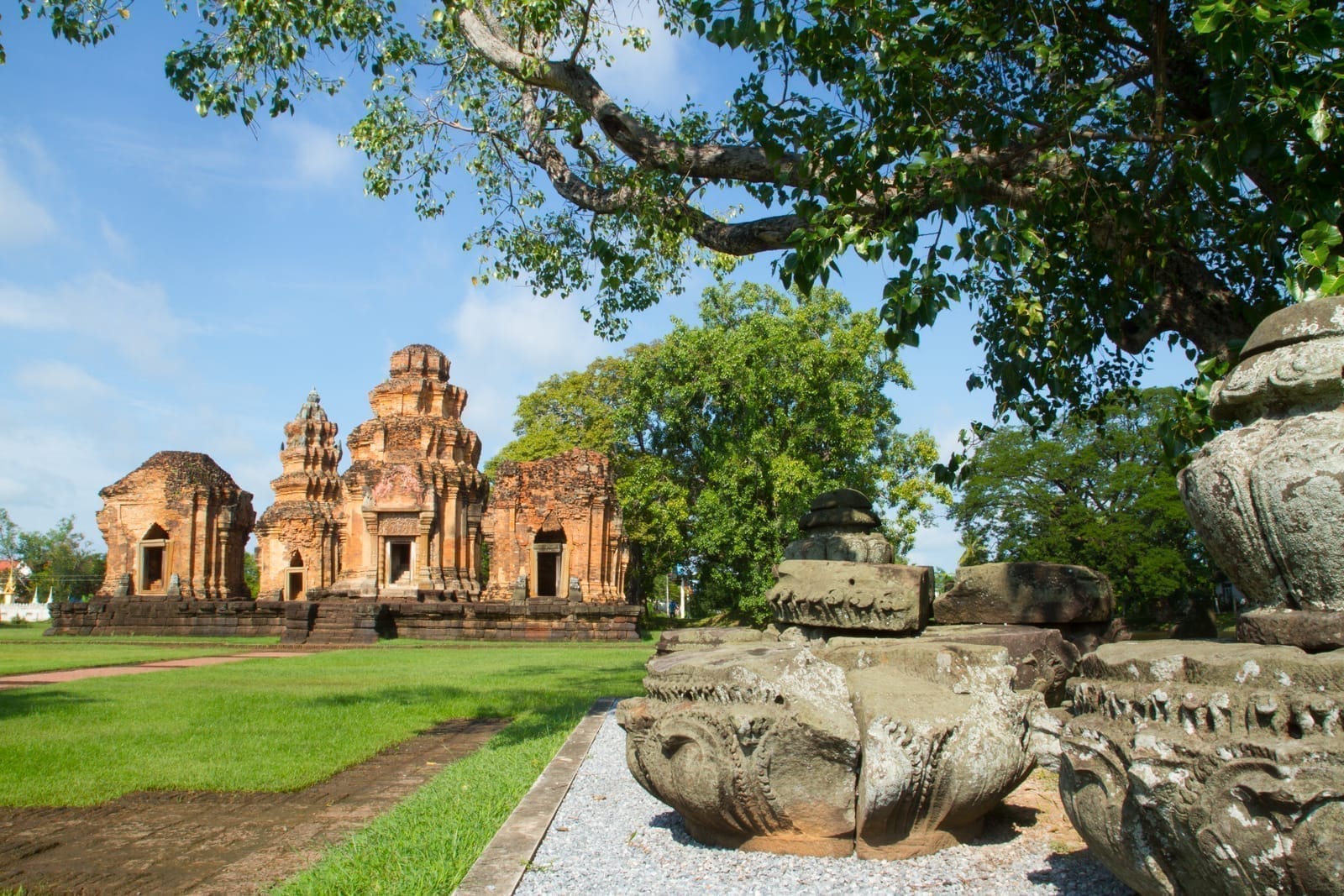
If you only have time for one temple, make it Prasat Sikhoraphum. It sits in Rangaeng subdistrict, Sikhoraphum district, beside Highway 2077, about 35km from Surin town, and the drive there is easy. It's a cluster of five brick towers on a single laterite base, with a moat on three sides; the central tower stands tall while the other four mark the corners. What people come to see are the lintels and the decorative door-frame pillars carved with apsaras holding lotus flowers — the work is so fine it's considered one of the most beautiful apsara carvings in Thailand, with lines that bring Angkor Wat's art to mind.
Prasat Sikhoraphum is open daily, roughly 8am–4:30pm. Admission is 10 THB for Thais and 50 THB for foreigners. The temple grounds are wide and easy to walk, with some shade, but midday sun is harsh — come in the morning or near sunset, when the low-angle light picks up the carving detail far better than noon glare.
Get the most out of Sikhoraphum
Before snapping the pretty shots, walk around to find the lintel side carved with apsaras and the decorative door pillars — that's where the craftsmanship is densest. If you go in the morning before the sun gets harsh, you can stand and study it for a while and see the carved lines clearly. Some years in November there's the Sikhoraphum Thousand-Year Legend festival, with a light-and-sound show; if your timing lines up, it's a whole different atmosphere.
Prasat Ban Pluang — small but a beautiful lintel
Prasat Ban Pluang is in Ban Pluang subdistrict, Prasat district, south of town toward Prasat district. It's a single, compact little temple set on a raised laterite base, built in sandstone in the Khmer Baphuon style, dating to around the 11th century CE. The highlight is the lintel and pediment, finely carved and well preserved. The temple itself isn't large, but the carving detail makes it worth the stop, and it doesn't take long to walk around — a good roadside stop if you're driving down toward Prasat or Sangkha district.
Prasat Phumipon — the oldest in Thailand
Real history buffs shouldn't miss Prasat Phumipon, in Ban Phumipon, Dom subdistrict, Sangkha district. What makes it special is that it's the oldest Khmer temple ever found in Thailand: the main tower was built around the 7th–8th century CE, in the pre-Angkor period, hundreds of years older than other Khmer temples in the country. It's a brick tower whose structure is still clearly visible — not as grand as the later temples, but its historical value is enormous. There's a legend tied to the site about Neang Doh Thom (Nang Ok), which gives it a special bond with local people.
Phumipon lies deeper out toward Sangkha district, quite a bit farther from town than Sikhoraphum, so fewer people come and it has a quiet, calm feel — better for those who want a serious history trail than for a quick photo stop. You'll want your own car and some extra travel time, since public transport barely reaches it.
More Khmer temples in Surin worth collecting
Prasat Sikhoraphum
Five brick towers on a laterite base, with the most beautiful apsara-carved lintel in Thailand. Easiest to reach, about 35km from town, open daily. 10 THB Thai / 50 THB foreigners.
Prasat Ban Pluang
A small Baphuon-style sandstone temple in Prasat district, with a finely carved, well-preserved lintel and pediment. Quick to walk around, a good stop heading south.
Prasat Phumipon
The oldest Khmer temple in Thailand, a pre-Angkor brick tower in Sangkha district. Few visitors, quiet and calm — for serious history-trail travelers.
Prasat Ta Muen Thom
A large Khmer temple on the Phanom Dong Rak border ridge, with a shivalinga in the main chamber. Historically important, but it sits in the border zone and can't be visited right now.
The Ta Muen temple group — status right now
The Ta Muen temple group sits on the Phanom Dong Rak mountain range in Phanom Dong Rak district, right on the Thailand–Cambodia border line. It's made up of Prasat Ta Muen Thom, the largest and most important; Prasat Ta Muen Toch; and Prasat Ta Muen. Ta Muen Thom is a large sandstone temple with a natural shivalinga in its main chamber and was once a history-travel spot people made a point of coming to see. But to be straight with you, this area is currently affected by the unsettled Thailand–Cambodia border situation — there have been clashes in the area and it's still under military control, so it isn't open for normal visits.
Prasat Ta Khwai and the nearby hill areas are in the same zone and also can't be entered. If you really want to follow the border temple group, we'd suggest saving it for a future trip once the situation returns to normal, and always check area announcements and the latest news first. Don't rely on old blog posts written years ago — the status has changed a lot from before.
An honest word on the border temples
Prasat Ta Muen Thom and Ta Khwai sit extremely close to the border line. While the border situation is still unsettled, this area isn't open for normal visits and may close off in stretches. Safety comes before a good photo — always check the current situation with local authorities before you set out. If it isn't open, focus on the in-province temples like Sikhoraphum, Ban Pluang and Phumipon instead — you can have a full temple-trail trip without taking any risk.
A temple-trail route that won't fall flat
The temples in Surin are spread out in different directions, so routing matters. To avoid driving in circles, we've split it by zone into days: day one collects the easy temples on the Sikhoraphum side, day two heads south to Ban Pluang and the deeper Phumipon. Pick it up and adjust to your time and the spots you care about. All of this avoids the border zone.
Groundwork in town + Sikhoraphum
Going deep — Ban Pluang and Phumipon
- Prasat Sikhoraphum — Sikhoraphum district, Hwy 2077, 35km from town, open daily 8am–4:30pm, 10 THB Thai / 50 THB foreigners
- Prasat Ban Pluang — Prasat district, a Baphuon-style sandstone temple with a beautiful lintel, a stop on the way south
- Prasat Phumipon — Sangkha district, the oldest Khmer temple in Thailand, pre-Angkor period, bring your own car
- Ta Muen temple group — Phanom Dong Rak district, on the border line, can't be entered right now, check first
How to follow the Surin temple trail
Following almost all of these temples requires a car, because they're outside town in different districts and hard to reach by public transport. Driving yourself is easiest. If you come by train or bus into town, we'd suggest renting a car or hiring one by the day from town to run the temple circuit. Sikhoraphum still has the odd songthaew or passing bus, but Ban Pluang and Phumipon pretty much require your own vehicle. Plan your route ahead and fill up enough fuel, since gas stations out here are spread far apart.
On timing: these are open-air temples and the midday sun is brutal, so start early or take the late afternoon. Wear a hat and sunglasses and bring water. Wear comfortable walking shoes, since the ground is laterite and uneven stone. You can bring kids or older travelers, but watch out for the uneven, multi-level surfaces.
Plan your Surin stays, food and sights for the full trip
See the Surin travel guide →