🔄 Updated 21 Jun 2026
The temple's full name is Wat Roi Phra Phutthabat Phu Manorom, but most people just call it Wat Phu Manorom. It sits on Phu Manorom hill in Na Si Nuan subdistrict, about 5 kilometres from central Mukdahan. It started out as a temple where people came to pay respects to a Buddha footprint and a chedi on the hill, but once the giant naga and the Big Buddha were added, it became a landmark that nearly every visitor to Mukdahan stops at.
What makes the temple worth the climb isn't just the naga — it's the hilltop setting that faces straight out over the Mekong, so you get both a place to make merit and a viewpoint in one. If you're into asking the naga for blessings, you've come to the right place; if you'd rather photograph the city and the bend of the Mekong, you'll head home with plenty of good shots.
The Si Mukda Naga — the temple's highlight
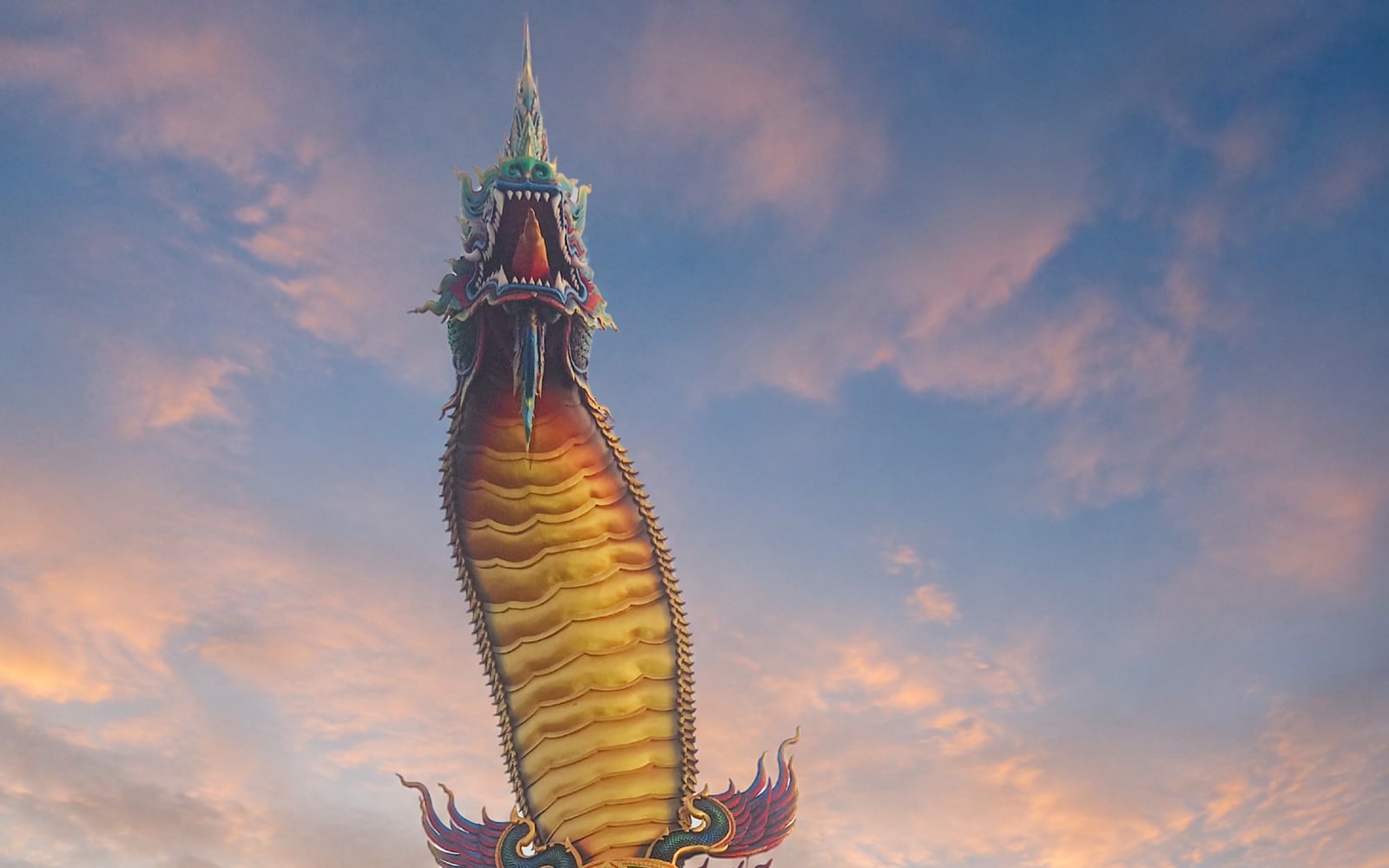
The star here is Phaya Si Mukda Maha Muni Nin Pala Nakkharat, known to most people simply as Pu Si Mukda. It's a giant single-headed naga, 122 metres long, around 20 metres tall, with a body roughly 1.5 metres in diameter, coiling back and forth across the hilltop. The scales are finished in blue-green and shimmer when the sun hits them. The naga raises its head toward the Mekong, so you can get the river in the same frame as the statue.
The custom here is to walk beneath the naga's body. The way it coils leaves several gaps you can pass under, and people who come to ask for blessings usually walk through and make a wish for luck, prosperity, and abundance — following the naga beliefs that run through the cultures of the Mekong basin. Some buy a strip of cloth, write their name on it, and tie it at the spots the temple has set aside.
Getting a good naga photo
The most popular angle is standing so you frame the naga's head with the Mekong behind it. From late morning into the afternoon the sun makes the blue scales really shimmer; in the evening the light is softer and there are fewer people, so it's easier to get a clear shot with you in it.
Want more out of Mukdahan? Book tours & activities
Booking online ahead on Klook or GetYourGuide is usually cheaper than the gate and skips the queue. Pick only the experiences you actually want — prices and availability are shown live on each site.
The Big Buddha and the footprint at the summit
The other spot people climb up to is Phra Chao Yai Kaeo Mukda Si Trairat, a large white Buddha image at the highest point of the temple, built in memory of King Rama IX. You can see it from a distance as you drive up the hill, and it's a favourite place to pay respects and take photos with the city spread out below.
- Replica Buddha footprint — the source of the temple's name, enshrined on the hill. This is where people came to pay respects long before the naga existed.
- Phra That Phu Manorom — an old octagonal chedi on the hill, built in three tiers following the Traiphum (Three Worlds) cosmology, worth a slow walk around and a moment to pay respects.
- Phra Chao Yai Kaeo Mukda Si Trairat — the Big Buddha at the highest point, where you can make a wish and take in the city view in the same spot.
The viewpoint — the city and the bend of the Mekong
Because the temple sits on a hill facing the river, the view is another big reason people come up. Standing on the terrace in front of the naga or near the Big Buddha, you'll see Mukdahan stretching out below, the Mekong curving in a wide arc, and the Savannakhet side of Laos directly across the water. On a clear day you can make it out plainly with the naked eye.
- The Mekong's bend — from up on the hill you can see the river curve in a long, wide arc, the best photo angle the temple has to offer.
- Central Mukdahan — the town laid out below, rooftops and roads and all, gives you a feel for the place before heading off to other spots.
- Savannakhet, Laos — the town on the opposite bank, closer than you'd think; clear on a good day.
- The sunset angle — in the evening the light washes across the surface of the Mekong, and a lot of people come specifically to wait for it.
The best times for the view
Mornings are clear with gentle sun, you can see the Laos side well, and it's a comfortable, cool walk. In the evening, close to closing time, you get soft light and the sunset angle over the Mekong. The temple closes around 5 pm, so give yourself enough time to get up there a while beforehand and not have to rush.
Getting up to the temple — the temple shuttle
The road up the hill is fairly steep, and not every private car makes it all the way to the top. Most people park in the lot at the bottom and take the temple's free songthaew shuttle up and down, so you don't have to hike the hill yourself — handy for older visitors and families with small kids.
- Location — Na Si Nuan subdistrict, Mueang Mukdahan district, about 5 kilometres from town, roughly a 10–15 min drive from the city.
- Hours — open daily, around 8.30 am to 5.00 pm. Aim to arrive before mid-afternoon so you have time to walk around and take photos.
- Entry — no admission fee, and the shuttle up and down is free (there's a donation box if you'd like to give).
- Time needed — about 45 min to an hour to see the whole temple; allow a bit more if you linger over photos or sit and enjoy the view.
What to wear at the temple
This is a temple where people come both to make merit and to take photos, so it's best to dress modestly. Skip very short shorts and spaghetti-strap tops, since there are several spots for paying respects. Some of the ground gets hot at midday, so comfortable walking shoes are the better call.
More to see nearby
Ho Kaeo Mukdahan
A 65-metre observation tower on the same route as the road up to Phu Manorom. Head up for a 360-degree view of the city and the Mekong — easy to pair with the temple in one trip.
In townIndochina Market
A riverside market in the centre of town with souvenirs, food, and Lao–Vietnamese goods. Good for a long, easy evening stroll — a perfect dinner stop after coming down from the temple.
BorderThai–Lao Friendship Bridge 2
The crossing over to Savannakhet — the Laos town you see from the temple. If you want to continue into Laos, this is where you start.
Want a full-day Mukdahan itinerary that pairs Wat Phu Manorom with other spots?
See the Mukdahan travel guide →